On eBird ↗
Brown-banded Antpitta
Live sightings near you, the range map, bar charts of when it is seen, and Macaulay Library photos and recordings.
Brown-banded Antpitta
Grallaria milleri
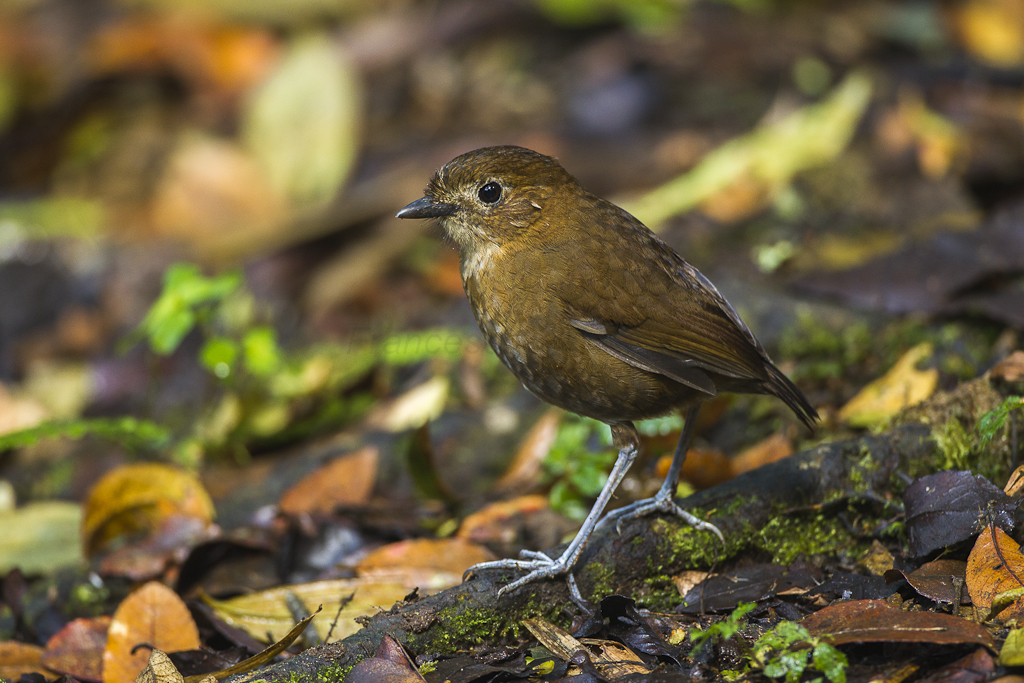
The brown-banded antpitta (Grallaria milleri) is a vulnerable species of bird in the family Grallariidae. It is endemic to Colombia.
From the article Brown-banded antpitta on Wikipedia (CC BY-SA), quoted section by section
Description
The brown-banded antpitta is 13 to 18 cm (5.1 to 7.1 in) long and weighs about 50 to 55 g (1.8 to 1.9 oz). The sexes have the same plumage. Adults have whitish lores with black speckles. Their ear coverts are ochraceous brown. Their crown, nape, back, and uppertail coverts are deep rich raw umber and their rump slightly paler. Their tail can be more rufescent or slightly more greenish than their back. Their wings are generally similar to their tail with dusky brown primaries and raw umber coverts. Their throat is grayish white with tawny olive sides. They have a wide tawny olive breast band, sides and flanks tending to olivaceous, a creamy white central belly, and mixed gray and olivaceous undertail coverts. Subspecies G. m. gilesi is larger than the nominate but otherwise essentially the same. Both subspecies have a dark brown iris, a black bill with a paler tip, and slate gray to blackish legs and feet.
Range & habitat
The nominate subspecies of the brown-banded antpitta is found in the Central Andes of Colombia. It is known from Caldas Department to Quindío Department on the western slope and in Tolima Department on the eastern slope. The specimen of subspecies G. m. gilesi was collected in Antioquia Department but there are no additional records from there. The species inhabits the temperate zone in areas that are regrowing with Chusquea bamboo or alder trees (Alnus acuminata) following natural disturbance like a landslide. In elevation it mostly ranges between 2,700 and 3,200 m (8,900 and 10,500 ft) but there are records as low as 1,800 m (5,900 ft).
Wikipedia: “Distribution and habitat”
What it does
The brown-banded antpitta is one of several antpittas that regularly come to feeding stations set up to view them. There they are fed earthworms and beetle larvae, which are thought to also be a part of their natural diet. Its diet otherwise is not well documented but it is assumed to feed on a variety of insects and other invertebrates. It forages on or near the ground, running and hopping between stops to pick prey from vegetation or the ground. It occasionally joins mixed-species feeding flocks and also occasionally attends army ant swarms.
Wikipedia: “Feeding”
Listen
Looking for field recordings…
Where it lives
Recorded sightings
—
geo-referenced records in GBIF, from museums, herbaria and field observers.
Drag the globe to turn it. Dots are where records exist, not a range map; darker means more records.
In the stacks
Searching the stacks…
Every page naming Grallaria milleri in the Biodiversity Heritage Library →
This page is assembled live from iNaturalist, GBIF, Wikipedia, the Source Library and the Internet Archive. It is not yet part of the hand-edited codex. iNaturalist taxon 116777.