On eBird ↗
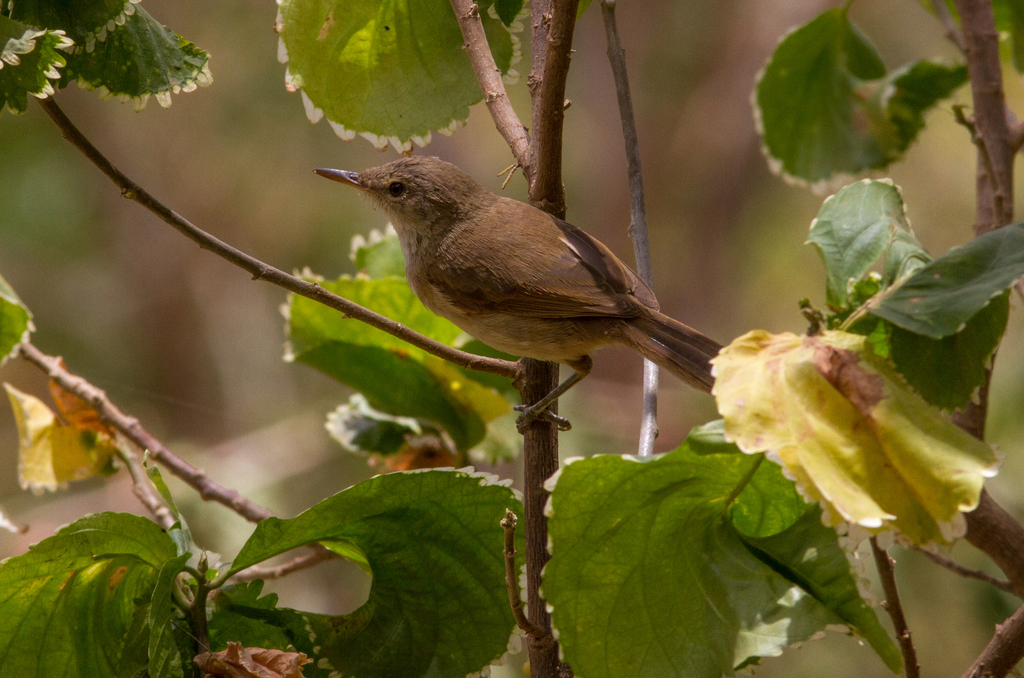
Cape Verde Swamp Warbler
Live sightings near you, the range map, bar charts of when it is seen, and Macaulay Library photos and recordings.
Cape Verde Swamp Warbler
Acrocephalus brevipennis
The Cape Verde warbler (Acrocephalus brevipennis) is an Old World warbler in the genus Acrocephalus. It is also known as the Cape Verde cane warbler or Cape Verde swamp warbler, and in Creole as tchota-de-cana or chincherote (also tchintchirote). It breeds on Santiago, Fogo, and São Nicolau in the Cape Verde Islands. It previously bred on Brava. This species is found in well-vegetated valleys, avoiding drier areas. It nests in reedbeds, two to three eggs being laid in a suspended nest.
From the article Cape Verde warbler on Wikipedia (CC BY-SA), quoted section by section
Description
This is a medium-sized warbler, larger than the Eurasian reed warbler. It resembles that bird in appearance, grey-brown above, greyish-white below, with no obvious markings. The geographical isolation of the bird on the Cape Verde Islands prevents confusion with other similar species. The song is a distinctive liquid bubbling, like that of a bulbul.
Range & habitat
At one time it was thought that the Cape Verde warbler was restricted to the island of Santiago. After a specimen was found in a Lisbon museum, a survey was made on São Nicolau island in 1998 and some individuals were found there. In 2004 a further population was discovered on Fogo island and further survey found it was widespread across the north of the island up to altitudes of about 1,300 m. On Santiago it can be found across the whole island, including in Barragem de Poilão, S. Jorge, Serra Malagueta, Rui Vaz and Tarrafal. Although previously thought to be mainly restricted to woodland and scrub, it is now reported from a wider range of habitats including well-vegetated valleys, reedbeds, cultivated land and around water sources such as dams.
Wikipedia: “Distribution and habitat”
Listen
Looking for field recordings…
Where it lives
Recorded sightings
—
geo-referenced records in GBIF, from museums, herbaria and field observers.
Drag the globe to turn it. Dots are where records exist, not a range map; darker means more records.
In the stacks
Searching the stacks…
Every page naming Acrocephalus brevipennis in the Biodiversity Heritage Library →
This page is assembled live from iNaturalist, GBIF, Wikipedia, the Source Library and the Internet Archive. It is not yet part of the hand-edited codex. iNaturalist taxon 116766.