- Animals
- ›Chordates
- ›Vertebrates
- ›Birds
- ›Perching Birds
- ›Ovenbirds and Woodcreepers
- ›Miners and Leaftossers
- ›Sclerurus
On eBird ↗
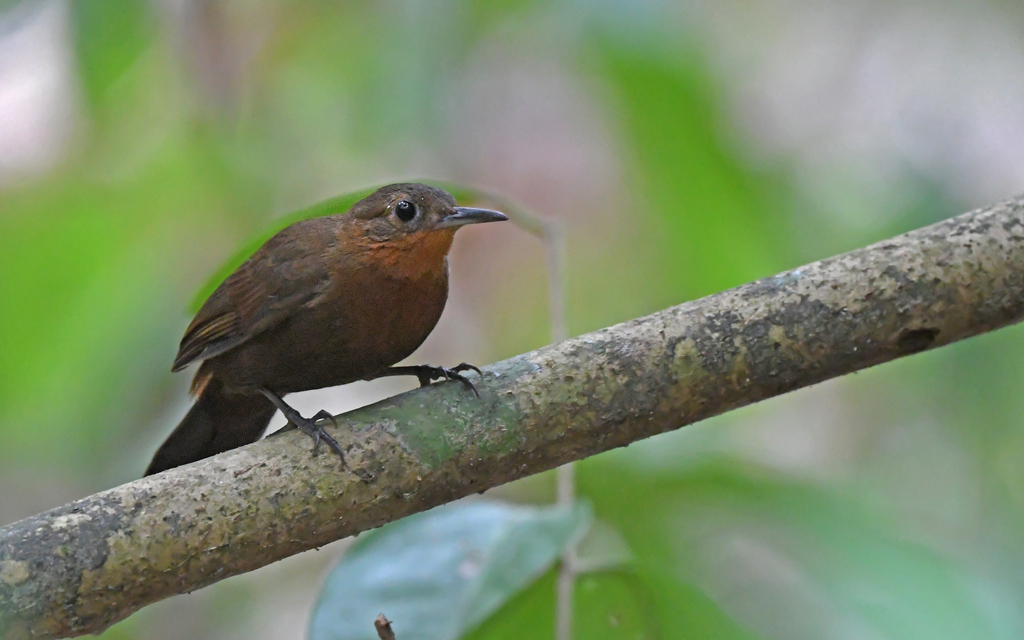
Short-billed Leaftosser
Live sightings near you, the range map, bar charts of when it is seen, and Macaulay Library photos and recordings.
Short-billed Leaftosser
Sclerurus rufigularis
The short-billed leaftosser (Sclerurus rufigularis) is a species of bird in the family Furnariidae. It is found in Bolivia, Brazil, Colombia, Ecuador, French Guiana, Guyana, Peru, Suriname, and Venezuela. Its natural habitat is subtropical or tropical moist lowland forests.
From the article Short-billed leaftosser on Wikipedia (CC BY-SA), quoted section by section
Description
The short-billed leaftosser is a stocky bird with a short tail, and has the shortest bill of the Sclerurus leaftossers. It is 15 to 16 cm (5.9 to 6.3 in) long and weighs 19 to 25 g (0.67 to 0.88 oz). The sexes are alike. The nominate subspecies S. r. rufigularis has a dark brown face, sometimes with paler lores and supercilium. Its crown is dark brown with a reddish cast. Its back is dark reddish brown, its rump chestnut-brown, and its uppertail coverts darker chestnut-brown. Its wings are dark reddish brown and its tail is sooty blackish with some faint reddish brown. Its throat and malar are dull orange-rufous that darkens and becomes richer on its upper breast, which has narrow pale streaks. The rest of its breast is darker still and becomes less chestnut to the rich reddish brown belly and flanks. Its iris is dark gray-brown to brown, its maxilla black to gray, its mandible bicolored, and its legs and feet black, brownish, or gray. Juveniles have a duller and browner rump but are otherwise like adults. Subspecies S. r. fulvigularis is more olive-brown than reddish brown. It has a paler throat than the nominate and a darker upper breast with wider rufous streaks. S. r. brunnescens is similar to fulvigularis but darker and even less reddish. S. r. furfurosus is overall paler than the nominate.
Range & habitat
The subspecies of the short-billed leaftosser are found thus:
S. r. fulvigularis, from southern Venezuela east through the Guianas into northern Brazil S. r. furfurosus, northern Brazil north of the Amazon River S. r. brunnescens, southeastern Colombia, eastern Ecuador, northeastern Peru, and northwestern Brazil all north of the Amazon S. r. rufigularis, northeastern Peru, eastern Bolivia, and southwestern and south-central Brazil, all south of the Amazon The short-billed leaftosser inhabits lowland tropical terra firme evergreen forest. In elevation it ranges from near sea level up to 500 m (1,600 ft) in Brazil, is rare and local up to 300 m (1,000 ft) in Ecuador, and is found as high as 1,800 m (5,900 ft) in Colombia though usually lower.
Wikipedia: “Distribution and habitat”
What it does
The short-billed leaftosser forages mostly on the ground, flipping aside leaves and gleaning from the ground and leaf litter while hopping rather than walking. Its diet of invertebrates includes spiders, insect egg cases, ants, beetle larvae, adult beetles, and winged termites.
Wikipedia: “Feeding”
Listen
Looking for field recordings…
Where it lives
Recorded sightings
—
geo-referenced records in GBIF, from museums, herbaria and field observers.
Drag the globe to turn it. Dots are where records exist, not a range map; darker means more records.
In the stacks
Searching the stacks…
Every page naming Sclerurus rufigularis in the Biodiversity Heritage Library →
This page is assembled live from iNaturalist, GBIF, Wikipedia, the Source Library and the Internet Archive. It is not yet part of the hand-edited codex. iNaturalist taxon 11656.