- Animals
- ›Chordates
- ›Vertebrates
- ›Birds
- ›Perching Birds
- ›Ovenbirds and Woodcreepers
- ›Miners and Leaftossers
- ›Sclerurus
On eBird ↗
Gray-throated Leaftosser
Live sightings near you, the range map, bar charts of when it is seen, and Macaulay Library photos and recordings.
Gray-throated Leaftosser
Sclerurus albigularis
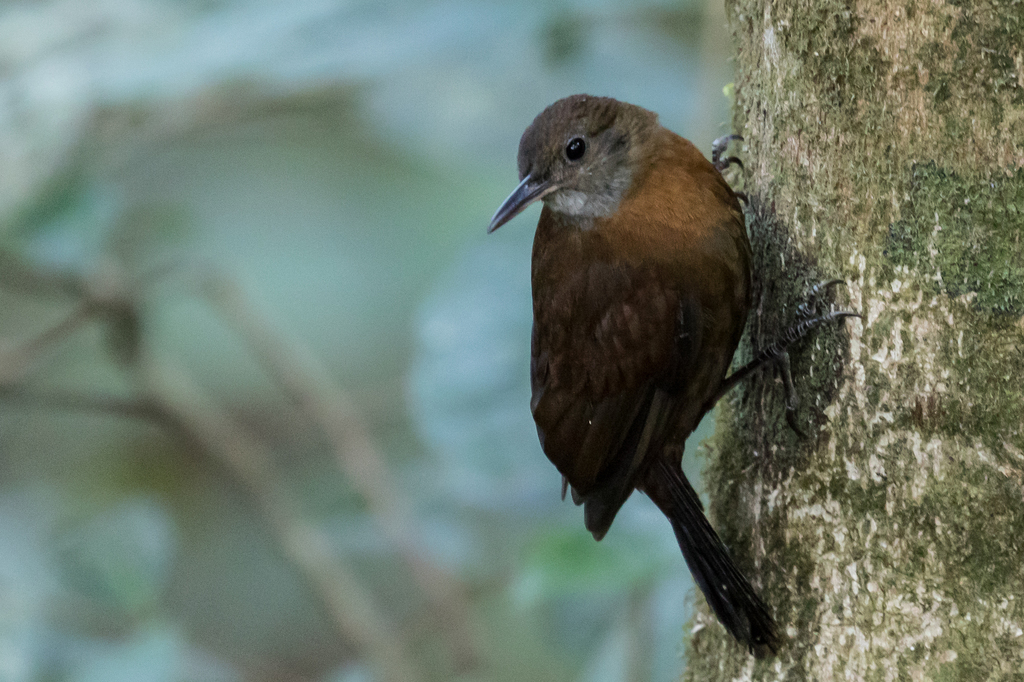
The grey-throated leaftosser (Sclerurus albigularis) is a species of bird in the Furnariidae family. It is found in Bolivia, Brazil, Colombia, Costa Rica, Ecuador, Panama, Peru, Trinidad and Tobago, and Venezuela. Its natural habitats are subtropical or tropical moist lowland forests and subtropical or tropical moist montane forests.
From the article Grey-throated leaftosser on Wikipedia (CC BY-SA), quoted section by section
Description
The grey-throated leaftosser is one of the larger members of genus Sclerurus. It is 16 to 18 cm (6.3 to 7.1 in) long and weighs 34 to 46 g (1.2 to 1.6 oz). The sexes are alike. The nominate subspecies has a grayish brown face with a somewhat scaly appearance. Its crown and back are rich chestnut-brown and its rump and uppertail coverts are a brighter reddish chestnut. Its flight feathers are rich brown and its tail is dark gray-brown. Its throat is grayish white with a darker lower edge, its breast dark rufous with some pale streaks, its belly dark brown, and its flanks and undertail coverts a richer brown. Its iris is dark brown to brown, its maxilla black to dark gray, its mandible pale grayish white to yellowish (sometimes with a dark tip), and its legs and feed black to brown. Juveniles resemble adults but are overall duller and have some dusky scaling on the throat. Subspecies S. a. propinquus has darker upperparts, breast, and belly than the nominate, and its throat is grayer. S. a. canigularis is generally darker than propinquus but its rufous cast is brighter than on both propinquus and the nominate. S. a. zamorae is generally darker than the nominate, with duller chestnut rump and uppertail coverts, a less whitish chin, and a brighter upper breast. S. a. …
Range & habitat
The grey-throated leaftosser has a disjunct distribution. The subspecies are found thus:
Sclerurus albigularis canigularis, Costa Rica and western Panama Sclerurus albigularis propinquus, the Sierra Nevada de Santa Marta of northern Colombia Sclerurus albigularis albigularis, eastern Colombia, northern Venezuela, Trinidad, and Tobago Sclerurus albigularis kunanensis, northern Venezuela's Paria Peninsula Sclerurus albigularis zamorae, from Napo Province in eastern Ecuador south to Peru's Department of Pasco Sclerurus albigularis albicollis, disjunctly in southeastern Peru, the eastern Andean foothills in Bolivia, and several areas in southwestern Brazil Sclerurus albigularis kempffi, the Serranía de Huanchaca in Bolivia's Santa Cruz Department The grey-throated leaftosser inhabits evergreen forest, usually in foothills and lower montane areas, though in places it ranges both higher and lower. In the northeastern part of its range it approaches sea level and in Brazil it is strictly in the lowlands. In Costa Rica it occurs between 600 and 1,500 m (2,000 and 4,900 ft) of elevation, in Colombia between 500 and 2,200 m (1,600 and 7,200 ft), and in Ecuador mostly between 1,000 and 1,700 m (3,300 and 5,600 ft).
Wikipedia: “Distribution and habitat”
What it does
The grey-throated leaftosser forages mostly on the ground, flipping aside leaves, probing the ground and gleaning from it and leaf litter while hopping rather than walking. It usually forages singly or in pairs; it does not join mixed-species foraging flocks. Its diet has not been detailed but has been documented to include beetles, spiders, cockroaches, and tiny frogs.
Wikipedia: “Feeding”
Listen
Looking for field recordings…
Where it lives
Recorded sightings
—
geo-referenced records in GBIF, from museums, herbaria and field observers.
Drag the globe to turn it. Dots are where records exist, not a range map; darker means more records.
In the stacks
Searching the stacks…
Every page naming Sclerurus albigularis in the Biodiversity Heritage Library →
This page is assembled live from iNaturalist, GBIF, Wikipedia, the Source Library and the Internet Archive. It is not yet part of the hand-edited codex. iNaturalist taxon 11642.