- Plants
- ›Vascular Plants
- ›flowering plants
- ›monocots
- ›Agaves, Orchids, Irises, and Allies
- ›Orchids
- ›Orchidoid Orchids
- ›Diurideae
- ›Thelymitrinae
- ›Thelymitra
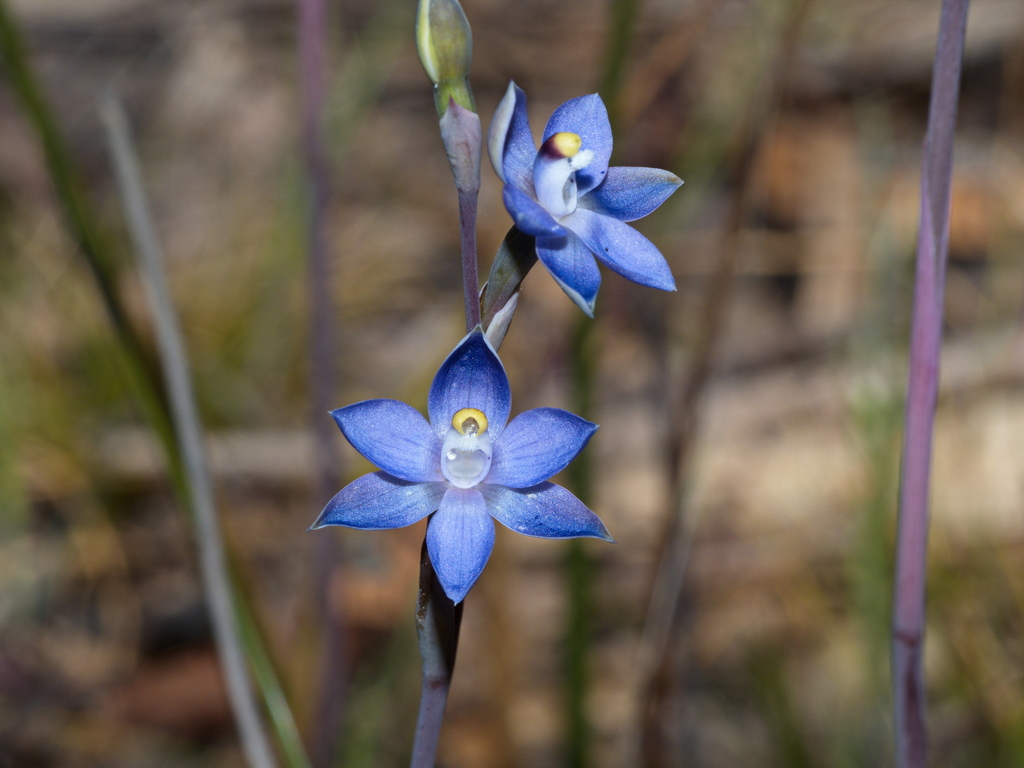
Thelymitra exigua
Thelymitra exigua, commonly called the short sun orchid, is a species of orchid that is endemic to south-eastern Australia. It has a single fleshy, channelled, dark green leaf and up to eight relatively small pale blue flowers with white toothbrush-like tufts on top of the anther.
From the article Thelymitra exigua on Wikipedia (CC BY-SA), quoted section by section
Description
Thelymitra exigua is a tuberous, perennial herb with a single fleshy, channelled, dark green, linear to lance-shaped leaf 50–220 mm (2–9 in) long and 2.5–10 mm (0.1–0.4 in) wide with a purplish base. Up to eight pale blue to pale purplish blue flowers 13–22 mm (0.5–0.9 in) wide are borne on a flowering stem 100–300 mm (4–10 in) tall. The sepals and petals are 5–11 mm (0.2–0.4 in) long and 3–6 mm (0.1–0.2 in) wide. The column is pale pink to pale purplish, 4–6 mm (0.16–0.24 in) long and 2–3 mm (0.08–0.1 in) wide. The lobe on the top of the anther is gently curved and dark brown to black with a yellow tip. The side lobes curve upwards near their middle and have toothbrush-like tufts of white hairs covering their tops. The flowers are self-pollinating, only open on warm to hot sunny days and then only slowly if at all. Flowering occurs from September to November.
Range & habitat
Short sun orchid grows in grassland, heath and shrubland. It is found in western Victoria, south-eastern South Australia and in Tasmania, including on King Island.
== References ==
Wikipedia: “Distribution and habitat”
Where it lives
Recorded sightings
—
geo-referenced records in GBIF, from museums, herbaria and field observers.
Drag the globe to turn it. Dots are where records exist, not a range map; darker means more records.
In the stacks
Searching the stacks…
Every page naming Thelymitra exigua in the Biodiversity Heritage Library →
This page is assembled live from iNaturalist, GBIF, Wikipedia, the Source Library and the Internet Archive. It is not yet part of the hand-edited codex. iNaturalist taxon 1154829.