- Animals
- ›Chordates
- ›Vertebrates
- ›Birds
- ›Perching Birds
- ›Ovenbirds and Woodcreepers
- ›Woodcreepers
- ›Sittasomus
On eBird ↗
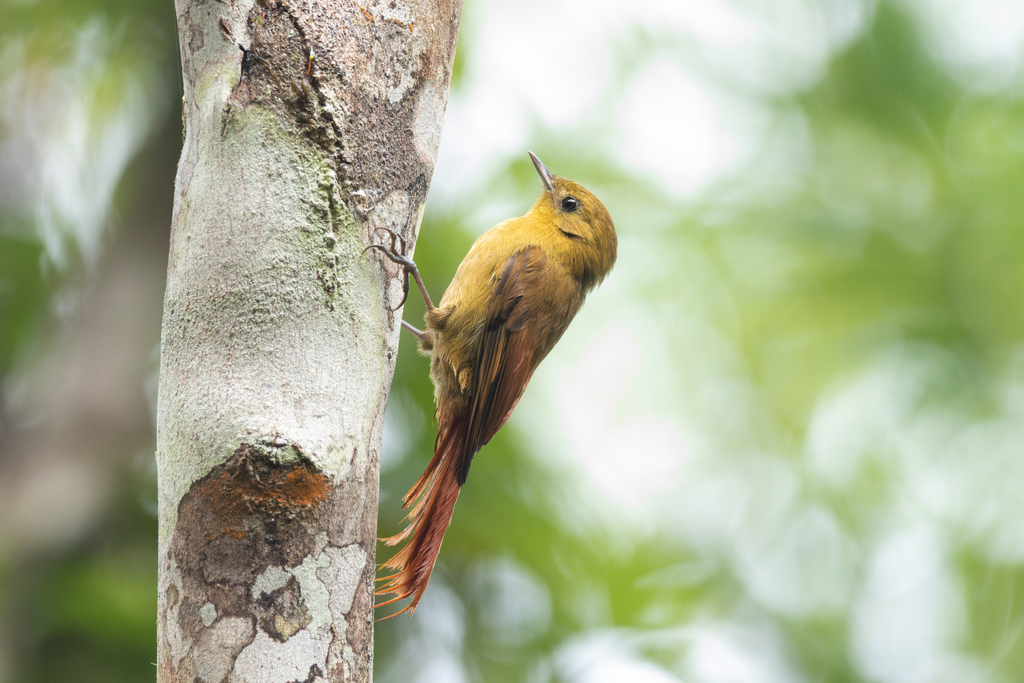
Olivaceous Woodcreeper
Live sightings near you, the range map, bar charts of when it is seen, and Macaulay Library photos and recordings.
Olivaceous Woodcreeper
Sittasomus griseicapillus
The olivaceous woodcreeper (Sittasomus griseicapillus) is a passerine bird in subfamily Dendrocolaptinae of the ovenbird family Furnariidae. It is found from central Mexico south through every Central American country, on the island of Tobago, and in every mainland South American country except Chile, French Guiana, and Suriname.
From the article Olivaceous woodcreeper on Wikipedia (CC BY-SA), quoted section by section
Description
The olivaceous woodcreeper is one of the smallest members of its subfamily. It has a slim body and a short straight bill, and unlike most other woodcreepers has no streaks or spots. The sexes' plumages are alike but females average smaller than males. Adults are 13.1 to 19.3 cm (5.2 to 7.6 in) long. Males weigh 9.0 to 18.0 g (0.32 to 0.63 oz) and females 8.6 to 16.0 g (0.30 to 0.56 oz). Length and weight vary geographically. All subspecies have a dark iris, a dark gray to black maxilla, a black to light gray mandible with a darker tip, and gray, bluish gray, or black legs and feet. The nominate subspecies S. g. griseicapillus is mostly olivaceous, with an olive-brown hindcrown and rufous rump, tail, and flight feathers. Its vent area is grayish and its flanks buff. In flight the wing shows a tawny band. The other members of the "Amazonian" subspecies group are similar but differ from it thus:
S. g. amazonus: darker and grayer, whitish "wingpits", and more rufescent tail and flight feathers S. g. axillaris: a more rufescent back, ochraceous "wingpits", and more rufescent flight feathers S. g. viridis: a more olive-green back and a paler, more yellowish green, vent area S. g. transitivus: grayer and with a cinnamon wing band The six subspecies of the "grayish" group are mostly olive but with a contrasting brown back. Their wings and tail are rufous. …
Range & habitat
The subspecies of the olivaceous woodcreeper are found thus:
S. g. jaliscensis, Mexico north of the Isthmus of Tehuantepec S. g. gracileus, Mexico's Yucatan Peninsula, northern Guatemala, and northern Belize S. g. sylvioides, Mexico south of the Isthmus of Tehuantepec and south through Central America into northwestern Colombia S. g. perijanus, northeastern Colombia and northwestern Venezuela S. g. tachirensis, northern Colombia and western Venezuela S. g. griseus, Tobago and Venezuela's eastern Andes and coastal mountain ranges S. g. aequatorialis, the Pacific slope from western Ecuador south into northwestern Peru S. g. amazonus, western Amazon Basin of southeastern Colombia, southern Venezuela, eastern Ecuador and Peru, and western Brazil east to the Negro and Madeira rivers S. g. axillaris, northeastern Amazon Basin of southwestern Venezuela east to Guyana and south in Brazil to the Amazon River S. g. viridis, Amazon Basin in Bolivia S. g. transitivus, Amazonian Brazil south of the Amazon River, east of the Rio Tapajós south into Mato Grosso S. g. griseicapillus, southeastern Bolivia east across central Brazil and south through Paraguay into north-central Argentina S. g. reiseri, northeastern Brazil S. g. olivaceus, southeastern Bahia state in eastern Brazil S. g. …
Wikipedia: “Distribution and habitat”
What it does
The olivaceous woodcreeper's diet is mostly arthropods but also includes seeds, fruit, and small vertebrates. In much of its range adult and larval beetles dominate its diet but in some areas ants and other Hymenoptera were the most often consumed. It forages by hitching up tree trunks and along branches and vines, mostly from the forest's mid-level to the subcanopy but sometimes in the understory. It has been documented following army ant swarms in Mexico, Central America, and southeastern Brazil but not in Amazonia. It often forages singly but also in pairs, and frequently joins mixed-species feeding flocks. In some places (e.g. in the Serra de Paranapiacaba of Brazil), they may even form a core species of such flocks. The species is known to associate with foraging groups of tamarins (Leontopithecus sp.) to snatch prey startled by the monkeys. They can also be occasionally seen catching flying prey like termites in mid-air.
Wikipedia: “Feeding”
Listen
Looking for field recordings…
Where it lives
Recorded sightings
—
geo-referenced records in GBIF, from museums, herbaria and field observers.
Drag the globe to turn it. Dots are where records exist, not a range map; darker means more records.
In the stacks
Searching the stacks…
Every page naming Sittasomus griseicapillus in the Biodiversity Heritage Library →
This page is assembled live from iNaturalist, GBIF, Wikipedia, the Source Library and the Internet Archive. It is not yet part of the hand-edited codex. iNaturalist taxon 11511.