- Animals
- ›Chordates
- ›Vertebrates
- ›Birds
- ›Perching Birds
- ›Ovenbirds and Woodcreepers
- ›Typical Ovenbirds
- ›Syndactyla
On eBird ↗
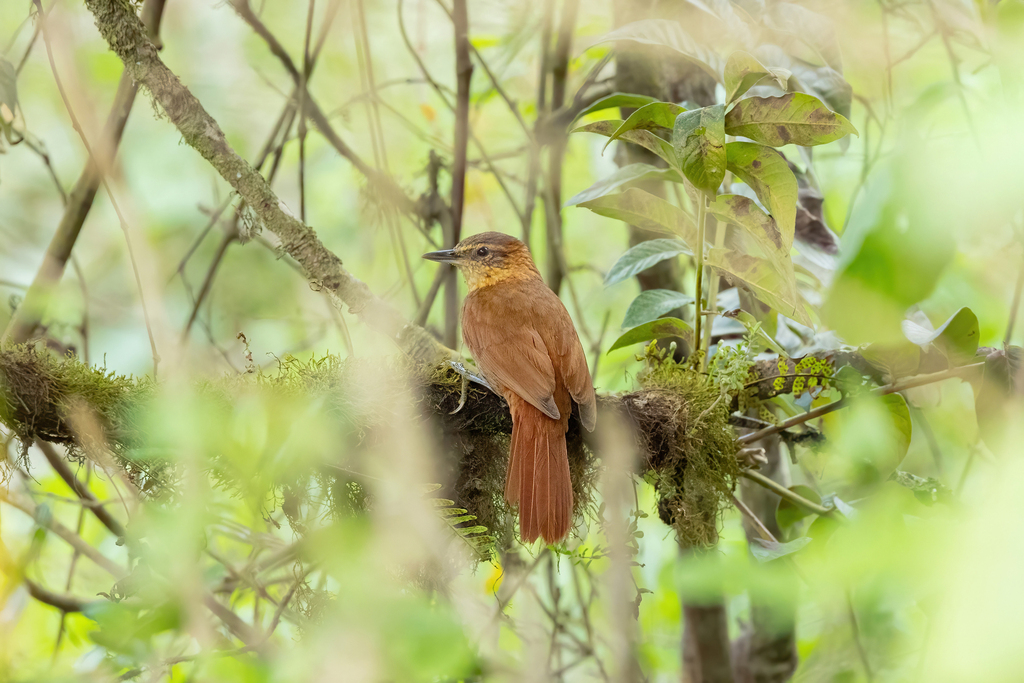
Rufous-necked Foliage-gleaner
Live sightings near you, the range map, bar charts of when it is seen, and Macaulay Library photos and recordings.
Rufous-necked Foliage-gleaner
Syndactyla ruficollis
The rufous-necked foliage-gleaner (Syndactyla ruficollis) is a species of bird in the family Furnariidae. It is found in Ecuador and Peru. Its natural habitats are subtropical or tropical dry forests, subtropical or tropical moist lowland forests, and subtropical or tropical moist montane forests. It is threatened by habitat loss.
From the article Rufous-necked foliage-gleaner on Wikipedia (CC BY-SA), quoted section by section
Description
The rufous-necked foliage-gleaner is 18 to 19 cm (7.1 to 7.5 in) long and weighs 29 to 39 g (1.0 to 1.4 oz). It is a largish furnariid with a less wedge-shaped bill than others of its genus. The sexes have the same plumage. Adults have an orange-rufous supercilium that extends to the nape; a dark brownish band behind the eye; grizzled grayish, dark brownish, and buff lores and ear coverts; and an orange-rufous to ochraceous buff area below the eye. Their crown is dark rufescent brown and they have an ill-defined collar of rufous streaks and spots. Their back is rich rusty brown with long thin buff streaks, their rump a redder brown, and their uppertail coverts bright chestnut. Their tail is dark chestnut and their wings are rich rusty brown with slightly darker primary coverts. Their chin is pale tawny-ochraceous, their throat more intensely ochracous, their breast olivaceous-brown with blurry rufescent buff streaks, their belly medium olivaceous brown, their flanks a slightly darker brown with a rufescent tinge, and their undertail coverts dark rufous. Their iris is brown, their maxilla dark brown to blackish, their mandible pale brownish or pale grayish, and their legs and feet grayish olive or olive-greenish. Juveniles are generally duller overall than adults, with a duskier (less brownish) crown and some dark brown edges on the throat feathers.
Range & habitat
The rufous-necked foliage-gleaner is found in coastal hills and the western slope of the Andes in Ecuador's El Oro and Loja provinces and in northwestern Peru as far south as the Department of Lambayeque. It inhabits montane evergreen forest and tropical deciduous woodlands, where it favors bamboo, streamsides, and shady ravines. In elevation it mostly ranges from 1,000 to 2,600 m (3,300 to 8,500 ft) but occurs occasionally as low as 400 m (1,300 ft) and as high as 2,900 m (9,500 ft).
Wikipedia: “Distribution and habitat”
What it does
The rufous-necked foliage-gleaner feeds mostly on arthropods. It typically forages singly or in pairs and readily joins mixed-species feeding flocks. It mostly forages from the forest's understory to its mid levels. It gleans and probes for its prey among debris, moss, bamboo stems, ferns, and bromeliads while hitching along branches and trunks. It occasionally forages in leaf litter on the ground.
Wikipedia: “Feeding”
Listen
Looking for field recordings…
Where it lives
Recorded sightings
—
geo-referenced records in GBIF, from museums, herbaria and field observers.
Drag the globe to turn it. Dots are where records exist, not a range map; darker means more records.
In the stacks
Searching the stacks…
Every page naming Syndactyla ruficollis in the Biodiversity Heritage Library →
This page is assembled live from iNaturalist, GBIF, Wikipedia, the Source Library and the Internet Archive. It is not yet part of the hand-edited codex. iNaturalist taxon 11478.