- Animals
- ›Chordates
- ›Vertebrates
- ›Birds
- ›Perching Birds
- ›Ovenbirds and Woodcreepers
- ›Typical Ovenbirds
- ›Cinclodes
On eBird ↗
White-bellied Cinclodes
Live sightings near you, the range map, bar charts of when it is seen, and Macaulay Library photos and recordings.
White-bellied Cinclodes
Cinclodes palliatus
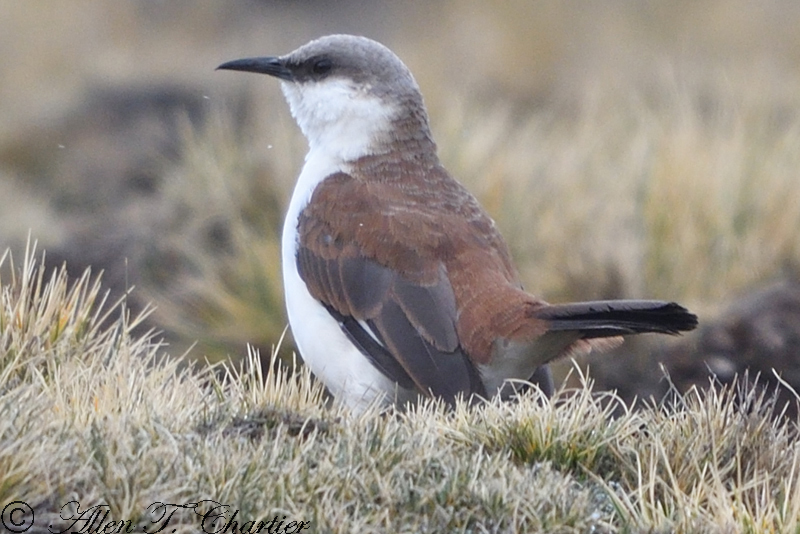
The white-bellied cinclodes (Cinclodes palliatus) is a species of bird in the ovenbird family, Furnariidae. It is endemic to Peru where it inhabits high level, marshy grassland in the Junín Region and possibly also in the Huancavelica Region. This is a very large furnariid with dark upper parts and gleaming white underparts. It is a rare bird with very specific habitat requirements and is threatened by habitat destruction. The International Union for Conservation of Nature has assessed it as being "critically endangered".
From the article White-bellied cinclodes on Wikipedia (CC BY-SA), quoted section by section
Description
The white-bellied cinclodes is larger and has a longer tail than other members of its genus and more resembles a mockingbird than a typical Cinclodes. It grows to a length of about 24 cm (9 in). The crown is brownish-grey, the upper parts and wings rufous-brown with a broad white wing bar, and the underparts pure white. This bird's song is a rapid chattering "pipipipipi pi pi" that sometimes speeds up into a piping, higher-pitched "wee wee wee wee wee".
Range & habitat
This species is known only from a high altitude strip of land in Junín Region in Peru. It has previously also been recorded in the Huancavelica Region but recent surveys of that area have failed to find it. It has very specific habitat requirements; it needs mineral-rich, boggy terrain where such cushion plants as Distichia grow, with crags and rocky slopes nearby. Its altitudinal range is about 4,430 m (14,530 ft) to the snowline at around 5,000 m (16,400 ft). This habitat is often found near the foot of glaciers, but there is much apparently suitable habitat where the birds are not present.
Wikipedia: “Distribution and habitat”
What it does
The white-bellied cinclodes forages in pairs or small groups, pushing its beak into the wet ground to find worms and other invertebrates. Its breeding habits are not well known, but the nest is usually hidden in a rock crevice.
Wikipedia: “Ecology”
Listen
Looking for field recordings…
Where it lives
Recorded sightings
—
geo-referenced records in GBIF, from museums, herbaria and field observers.
Drag the globe to turn it. Dots are where records exist, not a range map; darker means more records.
In the stacks
Searching the stacks…
Every page naming Cinclodes palliatus in the Biodiversity Heritage Library →
This page is assembled live from iNaturalist, GBIF, Wikipedia, the Source Library and the Internet Archive. It is not yet part of the hand-edited codex. iNaturalist taxon 11382.