- Animals
- ›Chordates
- ›Vertebrates
- ›Birds
- ›Perching Birds
- ›Ovenbirds and Woodcreepers
- ›Typical Ovenbirds
- ›Asthenes
On eBird ↗
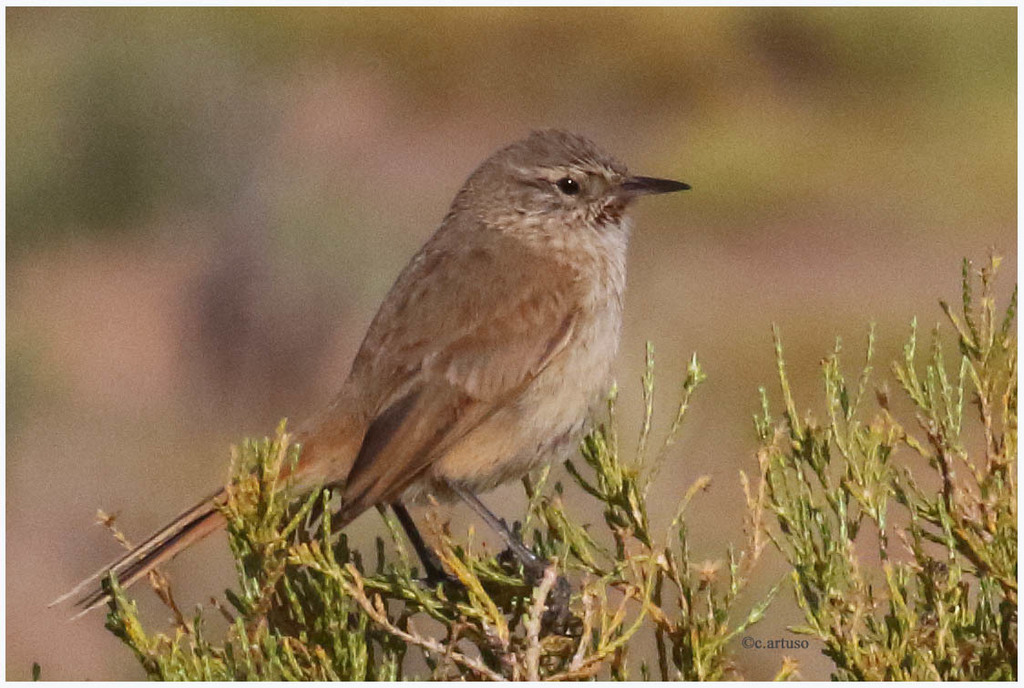
Cordilleran Canastero
Live sightings near you, the range map, bar charts of when it is seen, and Macaulay Library photos and recordings.
Cordilleran Canastero
Asthenes modesta
The cordilleran canastero (Asthenes modesta) is a species of bird in the family Furnariidae. It is found in Argentina, Bolivia, Chile, and Peru. Its natural habitats are temperate grassland and subtropical or tropical high-altitude grassland. Seven subspecies are recognized:
From the article Cordilleran canastero on Wikipedia (CC BY-SA), quoted section by section
Description
The cordilleran canastero is 15 to 16 cm (5.9 to 6.3 in) long and weighs 13 to 22 g (0.46 to 0.78 oz). It is one of the smaller canasteros. The sexes have the same plumage. Adults of the nominate subspecies A. m. modesta have a narrow light buff-brown supercilium, dark brownish lores, brownish ear coverts, and a whitish buff-brown malar region with darker brown streaks. Their crown, nape, back, rump, and uppertail coverts are dull dark brown, though the back is paler and sandier in the southern part of the species' range. Their forehead has indistinct blackish spots and their rump and uppertail coverts have a rufescent tinge. Their wing coverts are dark brownish with chestnut-rufous edges, the greater covers dark brownish with fulvous or tawny edges, and their flight feathers dark fuscous with rufous bases. Their central pair of tail feathers are pointed and dark fuscous with rufous outer webs. The rest of their tail feathers have increasing amounts of rufous to the outermost, which are almost entirely that color. Their chin and upper throat are pale brownish with an orange-rufous patch in the center, their lower throat and upper breast whitish gray-brown with darker streaks, their lower breast and belly pale brown, and their flanks and undertail coverts pale brown with a rufescent tinge. …
Range & habitat
The subspecies of the cordilleran canastero are found thus:
A. m. proxima: Andes of central and southern Peru from the Department of Junín to the Department of Cuzco A. m. modesta: Andes of southwestern Peru and western Bolivia south into northern Chile and northwestern Argentina A. m. hilereti: Tucumán and Catamarca provinces in northwestern Argentina A. m. rostrata: eastern slope of Andes in the central Bolivian departments of La Paz and Cochabamba A. m. serrana: Sierra de Famatina in western Argentina's La Rioja Province A. m. cordobae: central Argentina A. m. australis: Andes and lowlands of central and southern Chile and western and southern Argentina The cordilleran canastero primarily inhabits puna, temperate, and arid to semi-humid grasslands, often those with rocky outcrops and scattered small bushes. It also occurs in arid montane scrublands, Polylepis thickets, and dry open woodlands. In elevation it ranges from near sea level to 4,500 m (14,800 ft).
Wikipedia: “Distribution and habitat”
What it does
The cordilleran canastero feeds on arthropods. It usually forages singly but sometimes in pairs, gleaning prey mostly from the ground and to a lesser extent from low vegetation.
Wikipedia: “Feeding”
Listen
Looking for field recordings…
Where it lives
Recorded sightings
—
geo-referenced records in GBIF, from museums, herbaria and field observers.
Drag the globe to turn it. Dots are where records exist, not a range map; darker means more records.
In the stacks
Searching the stacks…
Every page naming Asthenes modesta in the Biodiversity Heritage Library →
This page is assembled live from iNaturalist, GBIF, Wikipedia, the Source Library and the Internet Archive. It is not yet part of the hand-edited codex. iNaturalist taxon 11331.