- Animals
- ›Chordates
- ›Vertebrates
- ›Birds
- ›Perching Birds
- ›Ovenbirds and Woodcreepers
- ›Typical Ovenbirds
- ›Furnarius
On eBird ↗
Pale-billed Hornero
Live sightings near you, the range map, bar charts of when it is seen, and Macaulay Library photos and recordings.
Pale-billed Hornero
Furnarius torridus
The bay hornero or pale-billed hornero (Furnarius torridus) is a species of bird in the Furnariinae subfamily of the ovenbird family Furnariidae. It is found in Brazil, Colombia, Peru, and possibly Ecuador.
From the article Bay hornero on Wikipedia (CC BY-SA), quoted section by section
Description
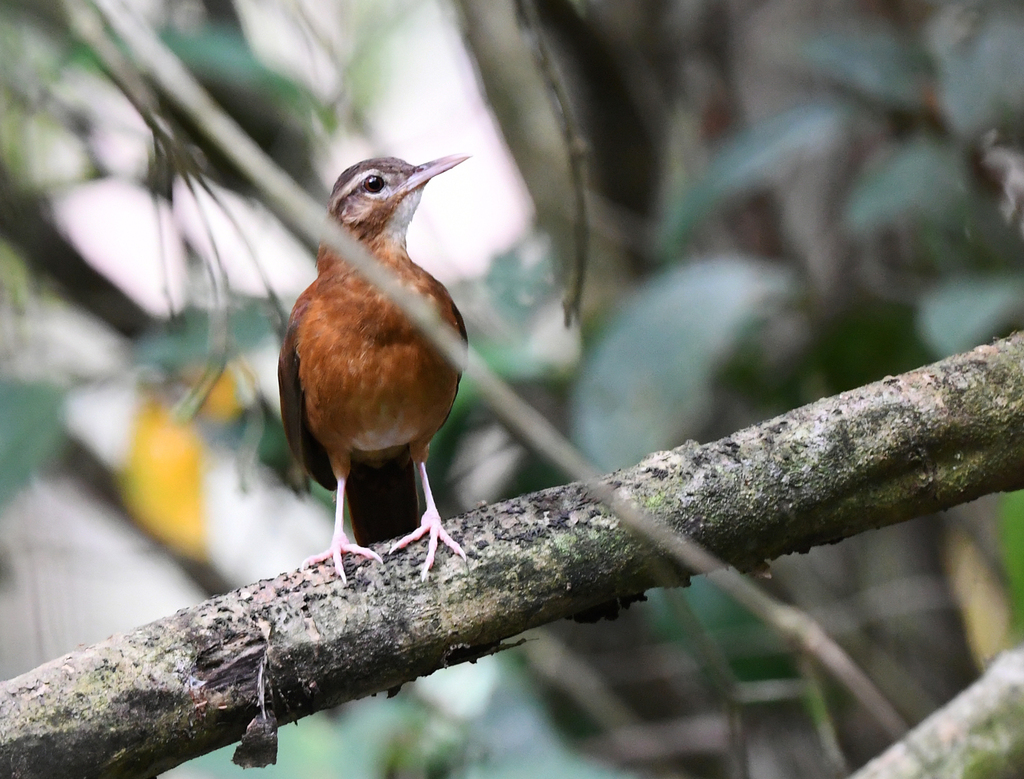
The bay hornero is 16 to 19 cm (6.3 to 7.5 in) long and weighs about 53 g (1.9 oz). It is a stout hornero with a long and nearly straight bill. The sexes' plumages are alike. Adults have a dull buffy white supercilium. Their crown and nape are grayish brown. Their back, rump, uppertail and wing coverts, and tail are chestnut brown ("bay"). Most of their wing is also chestnut brown, with a small area of pale rufous on the inner primaries. Their throat is white with dark tawny brown sides. Their breast is dark tawny brown, their flanks buffy brown, their belly whitish, and their undertail coverts dusky with chestnut brown tips. Their iris is brown or reddish brown, their maxilla light horn brown with a darker base and culmen, their mandible whitish, cream, or pinkish gray, and their legs and feet cream or very light pink.
Range & habitat
The bay hornero is found in the western Amazon Basin along the rios Huallaga, Ucayali, and Napo in Peru, and through extreme southern Colombia and western Brazil along the upper Amazon (rio Solimões). A sight record in Ecuador leads the South American Classification Committee of the American Ornithological Society to call it hypothetical in that country. The bay hornero primarily inhabits middle-aged river islands that undergo annual flooding, typically in stands of Cecropia. It also occurs on older islands and in várzea forest along the rivers. In Colombia most of the few records are grassy islands.
Wikipedia: “Distribution and habitat”
What it does
The bay hornero's diet and foraging behavior are poorly known. It forages on the ground, usually in pairs, and usually under vegetation overhangs. It is assumed to feed on arthropods and other terrestrial vertebrates.
Wikipedia: “Feeding”
Listen
Looking for field recordings…
Where it lives
Recorded sightings
—
geo-referenced records in GBIF, from museums, herbaria and field observers.
Drag the globe to turn it. Dots are where records exist, not a range map; darker means more records.
In the stacks
Searching the stacks…
Every page naming Furnarius torridus in the Biodiversity Heritage Library →
This page is assembled live from iNaturalist, GBIF, Wikipedia, the Source Library and the Internet Archive. It is not yet part of the hand-edited codex. iNaturalist taxon 11274.