- Animals
- ›Chordates
- ›Vertebrates
- ›Birds
- ›Perching Birds
- ›Ovenbirds and Woodcreepers
- ›Typical Ovenbirds
- ›Cranioleuca
On eBird ↗
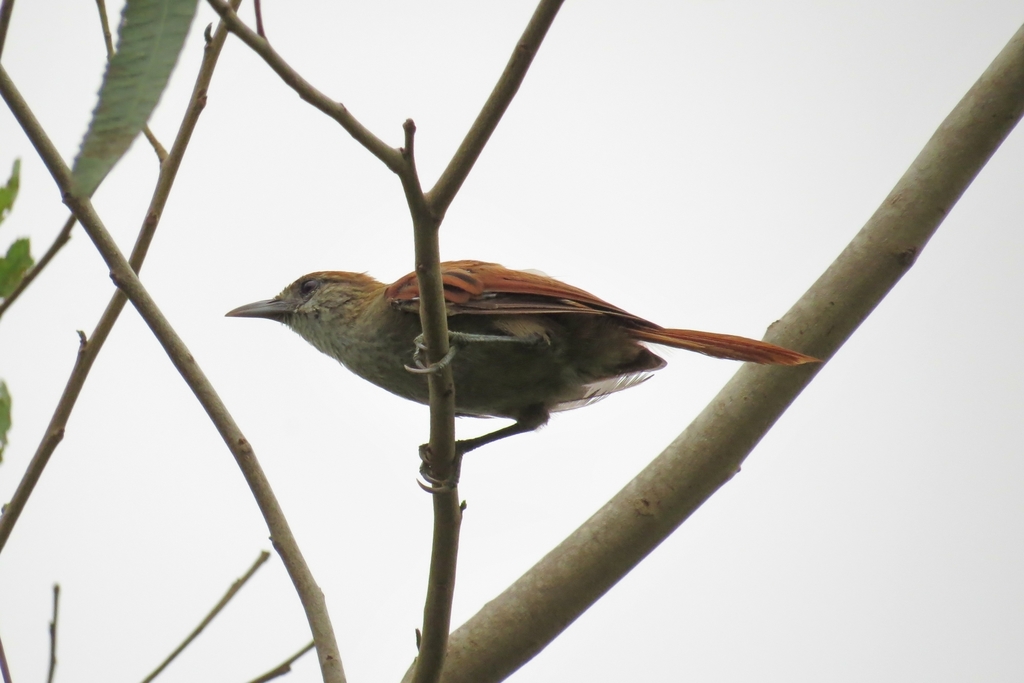
Parker's Spinetail
Live sightings near you, the range map, bar charts of when it is seen, and Macaulay Library photos and recordings.
Parker's Spinetail
Cranioleuca vulpecula
Parker's spinetail (Cranioleuca vulpecula) is a species of bird in the Furnariinae subfamily of the ovenbird family Furnariidae. It is found in Bolivia, Brazil, Ecuador, and Peru.
From the article Parker's spinetail on Wikipedia (CC BY-SA), quoted section by section
Description
Parker's spinetail is 13 to 16 cm (5.1 to 6.3 in) long and weighs 16 to 20 g (0.56 to 0.71 oz). The sexes have the same plumage. Adults have a faint buff supercilium and lores on an otherwise dusky gray face. Their crown, back, rump, and uppertail coverts are rufous; the forecrown has narrow buff streaks. Their tail and wings are also rufous. Their throat is white, and the rest of their underparts are light brown or light brownish gray with indistinct whitish mottling. Their iris is brown or pale brown, their maxilla black, their mandible pale grayish pink, and their legs and feet olive or grayish olive. Juveniles have a duller crown than adults.
Range & habitat
Parker's spinetail is found along the upper Amazon River and its major tributaries, from eastern Ecuador, northeastern Peru, and far northern Bolivia into western Brazil as far east as the Rio Negro. It almost exclusively inhabits early-succession vegetation on young river islands. In elevation, it is seldom found above 300 m (1,000 ft) but can reach 400 m (1,300 ft) in Ecuador.
Wikipedia: “Distribution and habitat”
What it does
Parker's spinetail feeds on arthropods but details are lacking. It typically forages in the under- and mid-storeys of woody vegetation, and usually in pairs. It gleans its prey from bark, dead leaf clusters, and trapped debris while searching along trunks and limbs.
Wikipedia: “Feeding”
Listen
Looking for field recordings…
Where it lives
Recorded sightings
—
geo-referenced records in GBIF, from museums, herbaria and field observers.
Drag the globe to turn it. Dots are where records exist, not a range map; darker means more records.
In the stacks
Searching the stacks…
Every page naming Cranioleuca vulpecula in the Biodiversity Heritage Library →
This page is assembled live from iNaturalist, GBIF, Wikipedia, the Source Library and the Internet Archive. It is not yet part of the hand-edited codex. iNaturalist taxon 11233.