- Animals
- ›Chordates
- ›Vertebrates
- ›Birds
- ›Perching Birds
- ›Ovenbirds and Woodcreepers
- ›Woodcreepers
- ›Campylorhamphus
On eBird ↗
Curve-billed Scythebill
Live sightings near you, the range map, bar charts of when it is seen, and Macaulay Library photos and recordings.
Curve-billed Scythebill
Campylorhamphus procurvoides
The curve-billed scythebill (Campylorhamphus procurvoides) is a species of bird in the Dendrocolaptinae subfamily. It is found in Brazil, Colombia, Ecuador, French Guiana, Guyana, Peru, Suriname, and Venezuela. Its natural habitat is subtropical or tropical moist lowland forests.
From the article Curve-billed scythebill on Wikipedia (CC BY-SA), quoted section by section
Description
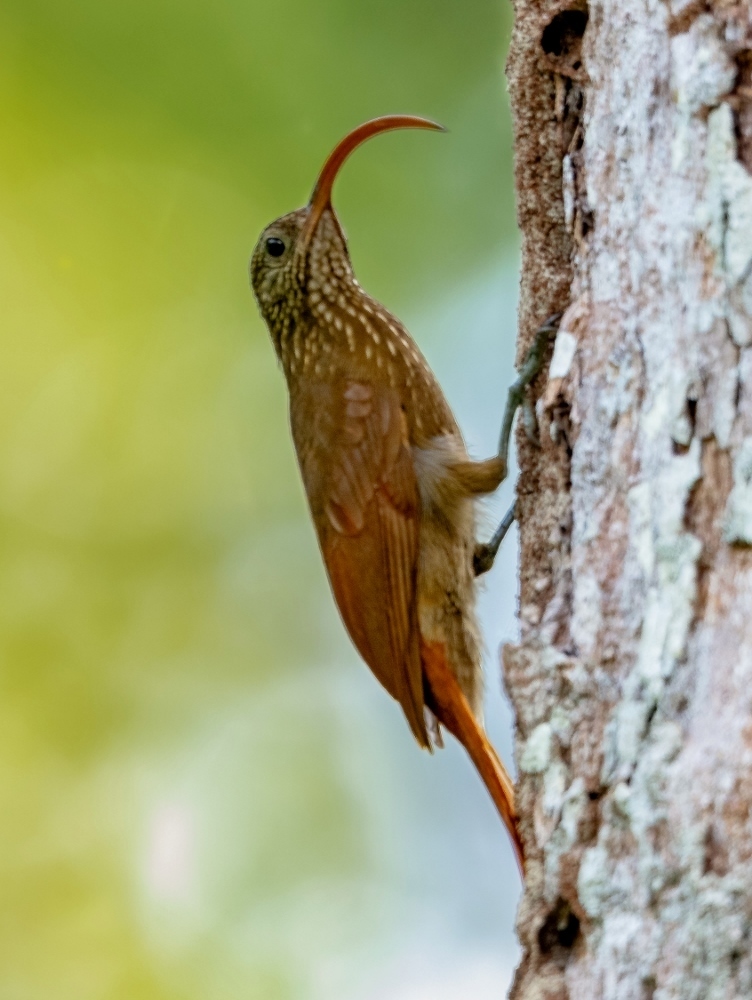
The curve-billed scythebill is 22.5 to 25 cm (8.9 to 9.8 in) long and weighs 30 to 38 g (1.1 to 1.3 oz). It is a slim, medium-sized woodcreeper with a very long, slim, dramatically decurved bill. The sexes have the same plumage. Adults of the nominate subspecies C. p. procurvoides have a dark brown head and neck with thin whitish to buffy streaks on them and the face. Their back and wing coverts are olive-brown to reddish brown. Their flight feathers, rump, and tail ares rufous-chestnut that contrasts with the back. Their throat is buffy-white with a fine scaly appearance. Their underparts are dull brown with buffy-white arrow-shaped marks that become narrow streaks on the belly but don't continue onto the undertail coverts. Their underwing coverts are cinnamon-rufous. Their iris is dark brown to chestnut, their bill dark red to reddish brown (often with a dusky brown base and a paler mandible), and their legs and feet dusky green, brown, or dark gray. Subspecies C. p. gyldenstolpei is very similar to the nominate. C. p. sanus is smaller than the nominate. It is more warmly colored with a whiter throat that is streaked instead of scaly. Its bill is shorter and more strongly decurved.
Range & habitat
The subspecies of the curve-billed scythebill are found thus:
C. p. sanus, the Amazon Basin from southeastern Colombia, northeastern Ecuador, and extreme northeastern Peru east through southern and eastern Venezuela, extreme northwestern Brazil to the Negro River, and Guyana C. p. gyldenstolpei, southwestern Brazil south of the Amazon and west of the Madeira River; probably also in adjacent Peru C. p. procurvoides, the northeastern Amazon Basin in Brazil north of the Amazon between the Negro River and Amapá state, Suriname, and French Guiana The IOC and Clements also place it in eastern Venezuela and Guyana The curve-billed scythebill inhabits humid evergreen forest. It greatly favors terra firme but occasionally occurs in floodplain forest. In southern Amazonia it often occurs in bamboo thickets. Subspecies C. p. gyldenstolpei tends to be in forest on sandy soils. In all forest types the species favors the interior though it does visit the forest edges. In elevation it mostly occurs below 500 m (1,600 ft) but reaches 700 m (2,300 ft) in Suriname. There is also a sight record in Venezuela at 900 m (3,000 ft).
Wikipedia: “Distribution and habitat”
What it does
The curve-billed scythebill's diet is mostly if not entirely arthropods. Single birds and pairs usually forage as part of mixed-species feeding flocks in the forest understory to its mid-level, though it will feed up to the subcanopy. It forages by gleaning and probing while hitching up and along trunks, branches, vines, and bamboo.
Wikipedia: “Feeding”
Listen
Looking for field recordings…
Where it lives
Recorded sightings
—
geo-referenced records in GBIF, from museums, herbaria and field observers.
Drag the globe to turn it. Dots are where records exist, not a range map; darker means more records.
In the stacks
This page is assembled live from iNaturalist, GBIF, Wikipedia, the Source Library and the Internet Archive. It is not yet part of the hand-edited codex. iNaturalist taxon 11196.