- Animals
- ›Chordates
- ›Vertebrates
- ›Birds
- ›Perching Birds
- ›Ovenbirds and Woodcreepers
- ›Typical Ovenbirds
- ›Premnoplex
On eBird ↗
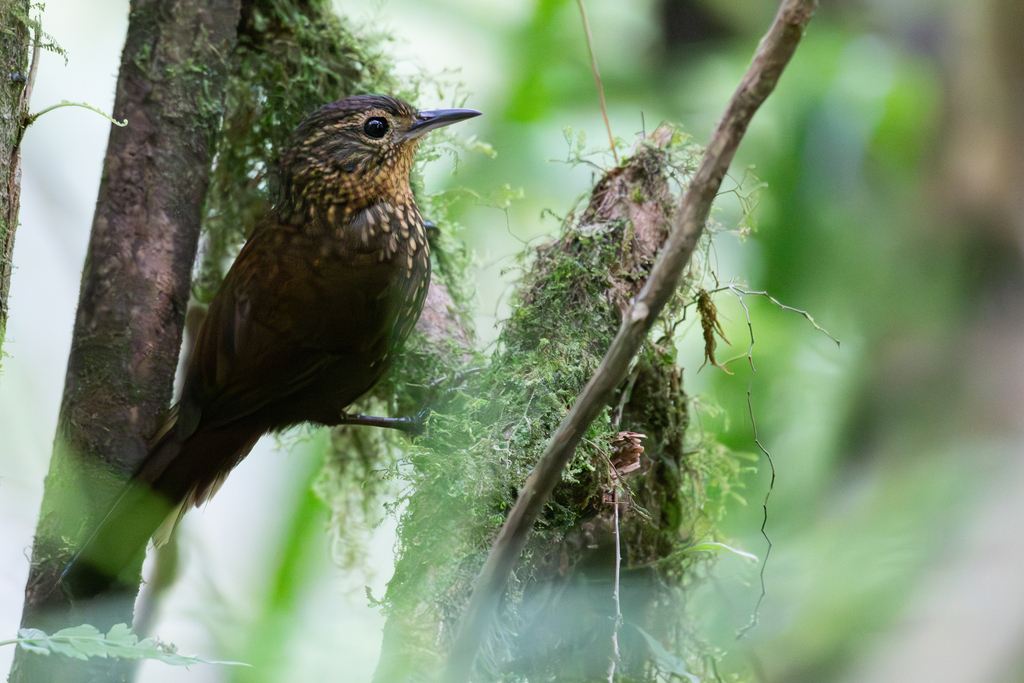
Spotted Barbtail
Live sightings near you, the range map, bar charts of when it is seen, and Macaulay Library photos and recordings.
Spotted Barbtail
Premnoplex brunnescens
The spotted barbtail (Premnoplex brunnescens) is a species of bird in the Furnariidae family. It is found in Bolivia, Colombia, Costa Rica, Ecuador, Panama, Peru, and Venezuela.
From the article Spotted barbtail on Wikipedia (CC BY-SA), quoted section by section
Description
The spotted barbtail ranges from 13 to 15 centimetres (5.1 to 5.9 in) in length, and from 14 to 19 grams in weight. The species does not exhibit sexual dimorphism; males and females are alike. Within its family the spotted barbtail is small and dark, with rich patterning on its underside. The forehead is dark greyish-brown, with spots that are tawny or ochraceous in color. The bird has a narrow supercilium, formed by a series of closely spaced spots above and behind the eye. Similar lines of spots extend down the neck from the supercilium. The crown of the head is also grey brown, with dark-edged feathers, giving the bird a scalloped appearance. The spots on the forehead fade into the crown. The back is dark brown, blackish-edged feathers, similar to but less conspicuous than on the crown. The rump has the same scalloped appearance, and has a slight chestnut hue. The uppertail coverts are chestnut-brown in color, while the wings are largely dark brown. The primary coverts are darker than the rest of the wing, while the other coverts have darker centers. The central feathers of the tail are somewhat stiffened. The tips of all the tail feathers lack barbs, giving the tail a "spiny" appearance. The bird's throat is also tawny in color, with brownish edging to the feathers. Birds within the subspecies albescens have a paler whitish throat. …
Range & habitat
The spotted barbtail is found in evergreen montane forest : in the Talamancan montane forests and throughout the northern Andes. It exhibits a preference for areas with moss and epiphytes. In Central America it occurs between 1,200 to 2,300 metres (3,900 to 7,500 ft) above sea level, whereas in the Andes it is found from 900 to 2,600 m (3,000 to 8,500 ft), extending occasionally up to 3,000 m (9,800 ft), and down to 650 m (2,130 ft) in the Western Andes. It is common across its distribution, and has been found in fragmented as well as intact habitat. It is not considered threatened globally. It is a sedentary species.
Wikipedia: “Habitat and distribution”
What it does
The spotted barbtail has been reported to feed on beetles, various hymenopteran insects, cockroach eggs, and spiders. The foraging behavior of the species seems to vary regionally; it has been reported as feeding alone, as feeding in pairs or family groups, and in mixed-species flocks. The spotted barbtail feeds in the forest understorey, though it may infrequently venture higher up some trees. It may be seen climbing along branches, including very thin ones. It often uses its tail for support, and sometimes may be seen hanging upside-down, or hanging on the underside of a branch. It is a gleaner, searching for food on mossy sections of trees, crevices in tree bark, and among epiphytes.
Wikipedia: “Feeding”
Listen
Looking for field recordings…
Where it lives
Recorded sightings
—
geo-referenced records in GBIF, from museums, herbaria and field observers.
Drag the globe to turn it. Dots are where records exist, not a range map; darker means more records.
In the stacks
Searching the stacks…
Every page naming Premnoplex brunnescens in the Biodiversity Heritage Library →
This page is assembled live from iNaturalist, GBIF, Wikipedia, the Source Library and the Internet Archive. It is not yet part of the hand-edited codex. iNaturalist taxon 11178.