On eBird ↗
Azores Bullfinch
Live sightings near you, the range map, bar charts of when it is seen, and Macaulay Library photos and recordings.
Azores Bullfinch
Pyrrhula murina
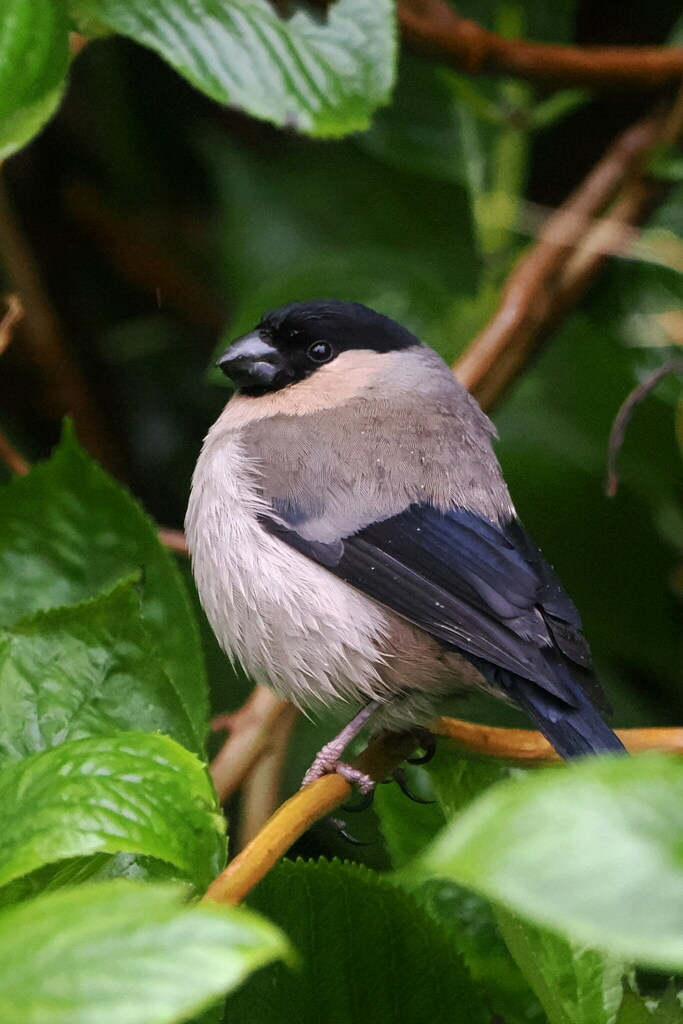
The Azores bullfinch (Pyrrhula murina), also known as the São Miguel bullfinch, or locally in Portuguese as the Priolo, is an endangered passerine bird in the true finch family. It is endemic to São Miguel Island, in the Azores archipelago of Macaronesia in the North Atlantic Ocean.
From the article Azores bullfinch on Wikipedia (CC BY-SA), quoted section by section
Description
The Azores bullfinch has a length of 15–17 cm (5.9–6.7 in) and a weight of about 30 g (1.1 oz), with males being slightly larger than females. Relative to most other finches in its family it is plump, with shorter wings and a longer tail. The plumage pattern is similar to that of the Eurasian bullfinch, though colouration is more sombre, lacking its bright pink underparts. It has a black cap, face, wings and tail; the rest being greyish or pale grey-brown. Males and females are virtually identical in appearance, though males may exhibit a faint pinkish suffusion on the belly and flanks. The contact call is a distinctive short, flute-like, melancholic whistle.
Range & habitat
The Azores bullfinch is now largely restricted to a small area (c. 580 hectares [1,400 acres])) of native laurisilva forest at the eastern end of São Miguel, 300–800 m (980–2,620 ft) asl (above sea level), mainly centred on Pico da Vara in the Serra da Tronqueira range, but also seasonally (September to December) around Salto do Cavalo, further westwards in the range. The latter population probably comprises juveniles following post-fledging dispersal. The species has never been recorded from the western end of the island. Necessary for the recovery of the Azores bullfinch is to restore its available ecological enclaves in the northern archipelago of Macaronesia. The process of species decline, which a significant portion of other endemic Azorean flora is also suffering, is favored by the expansion of invasive alien plants. Projects dedicated to saving the Azores bullfinch include the restoration of original laurel forest habitat in the eastern monteverde of São Miguel.
Wikipedia: “Distribution and habitat”
What it does
The Azores bullfinch's diet is mainly herbivorous, with the birds consuming a range of seeds, fruits, flower buds, fern sporangia and fronds (unusual in birds), and moss tips, as well as some invertebrates such as hemiptera. Native vegetation is preferred although, when the range was more extensive in the 19th century, the species was considered to be a pest in orange orchards around Furnas. The bullfinches move up and downslope through their range according to food availability during the year. The lily of the valley tree (Clethra arborea) contributes greatly to the Azores bullfinch's diet. This evergreen shrub or small tree, once believed to be endemic to Madeira, but now known to have existed in the past on the Canary Islands (where it is considered extinct), raises questions about how it should be treated in the Azores. While it is considered exotic, it is possible that it was native to the Azores, disappeared from there before any botanist had the chance to record it, and was then reintroduced more recently. Despite being an "alien" species, it is a notable element of the bird's diet and therefore plays some role in its survival.
Wikipedia: “Feeding”
Listen
Looking for field recordings…
Where it lives
Recorded sightings
—
geo-referenced records in GBIF, from museums, herbaria and field observers.
Drag the globe to turn it. Dots are where records exist, not a range map; darker means more records.
In the stacks
Searching the stacks…
Every page naming Pyrrhula murina in the Biodiversity Heritage Library →
This page is assembled live from iNaturalist, GBIF, Wikipedia, the Source Library and the Internet Archive. It is not yet part of the hand-edited codex. iNaturalist taxon 111450.