- Animals
- ›Chordates
- ›Vertebrates
- ›Birds
- ›Perching Birds
- ›Ovenbirds and Woodcreepers
- ›Woodcreepers
- ›Xiphorhynchus
On eBird ↗
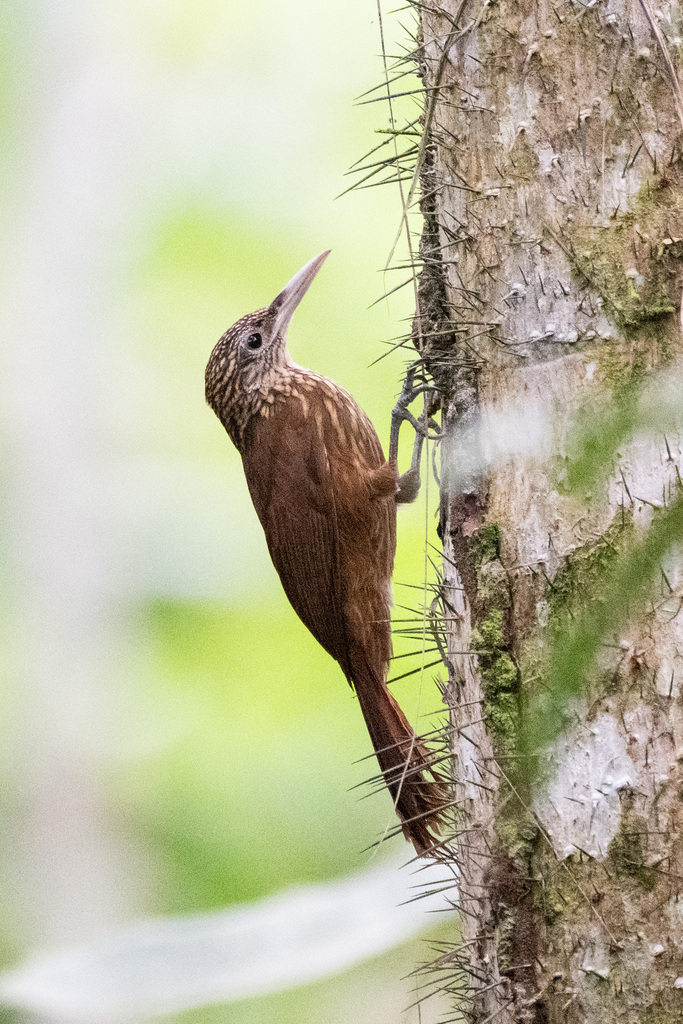
Buff-throated Woodcreeper
Live sightings near you, the range map, bar charts of when it is seen, and Macaulay Library photos and recordings.
Buff-throated Woodcreeper
Xiphorhynchus guttatus
The buff-throated woodcreeper (Xiphorhynchus guttatus) is a resident passerine bird found in tropical South America in the Guiana Shield and disjunctly in the northern Atlantic Forest. It formerly included the cocoa woodcreeper and the Lafresnaye's woodcreeper as subspecies. Some authorities retain Lafresnaye's position as a subspecies of the buff-throated woodcreeper, but the resulting group is polyphyletic (see Systematics and evolution).
From the article Buff-throated woodcreeper on Wikipedia (CC BY-SA), quoted section by section
Description
The buff-throated woodcreeper is 22.5 to 29.5 cm (8.9 to 12 in) long and weighs 45 to 74 g (1.6 to 2.6 oz). It is the largest member of genus Xiphorhynchus, with a heavy body and a long, heavy, decurved bill. The sexes have the same plumage. Adults of the nominate subspecies X. g. guttatus have a dark brown face with narrow whitish buff streaks. Their crown and nape are dark brown with buff teardrop spots that are streakier and blackish-edged on the nape. Their back and wing coverts are reddish olive-brown, with buff streaks with blackish edges on the back. Their lower back and rump are cinnamon-rufous, their flight feathers darker rufous with dusky brownish tips on the primaries, and their tail rufous-chestnut. Their throat is deep buff with a dusky lower edge. Their breast, sides, and belly are reddish brown that becomes redder on the undertail coverts. Their breast and sides have black-edged deep buff streaks that narrow on the belly. Their undertail coverts are mostly unstreaked. Their underwing coverts are cinnamon-rufous to ochraceous buff. Their iris is dark brown, their bill dark brownish black with a paler culmen and an even paler mandible, and their legs and feet blue, greenish gray, or dark gray. …
Range & habitat
The subspecies of the buff-throated woodcreeper are found thus:
X. g. polystictus, Rio Orinoco drainage in eastern Colombia, southern and eastern Venezuela, and extreme northern Brazil; east to the Guyanas. X. g. connectens, north of the Amazon River from about Manaus east to Amapá. X. g. guttatus, coastal eastern Brazil from Rio Grande do Norte south to Espírito Santo and slightly into Rio de Janeiro state X. g. guttatoides, the western Amazon Basin on both sides of the Amazon from southern Venezuela, southeastern Colombia, eastern Ecuador, eastern and southeastern Peru, and northwestern Brazil east to the Rio Negro and Rio Madeira and south into Mato Grosso X. g. dorbignyanus, the southern Amazon Basin from northern and eastern Bolivia east into Brazil as far as central Goiás X. g. eytoni, Brazil south of the Amazon from Rio Tapajós east to western Maranhão. X. g. vicinalis, Brazil south of the Amazon from Rio Madeira east to Rio Tapajós X. g. gracilirostris, Serra do Baturité in northeastern Brazil's Ceará state The buff-throated woodcreeper generally inhabits humid evergreen forest, but varies in details across its very large range. Within the "buff-throated" group, the nominate X. g. guttatus is restricted to the humid tropical Atlantic forest. …
Wikipedia: “Distribution and habitat”
What it does
The buff-throated woodcreeper's diet is mostly arthropods but also occasionally includes small vertebrates. It usually forages singly and occasionally in pairs; three have been observed together at army ant swarms. It regularly joins mixed-species feeding flocks, usually foraging from the forest's mid-level to the subcanopy but sometimes lower and higher. It also regularly follows army ant swarms. It hitches up and along trunks and branches, gleaning and pecking for prey on those substrates, on palm fronds, and in dead leaf clusters, epiphytes, dead wood, and arboreal termite nests. It also sometimes flakes bark, and when following ants makes sallies from a perch to glean from the ground and foliage or make mid-air captures.
Wikipedia: “Feeding”
Listen
Looking for field recordings…
Where it lives
Recorded sightings
—
geo-referenced records in GBIF, from museums, herbaria and field observers.
Drag the globe to turn it. Dots are where records exist, not a range map; darker means more records.
In the stacks
Searching the stacks…
Every page naming Xiphorhynchus guttatus in the Biodiversity Heritage Library →
This page is assembled live from iNaturalist, GBIF, Wikipedia, the Source Library and the Internet Archive. It is not yet part of the hand-edited codex. iNaturalist taxon 11072.