- Animals
- ›Chordates
- ›Vertebrates
- ›Birds
- ›Perching Birds
- ›Ovenbirds and Woodcreepers
- ›Typical Ovenbirds
- ›Synallaxis
On eBird ↗
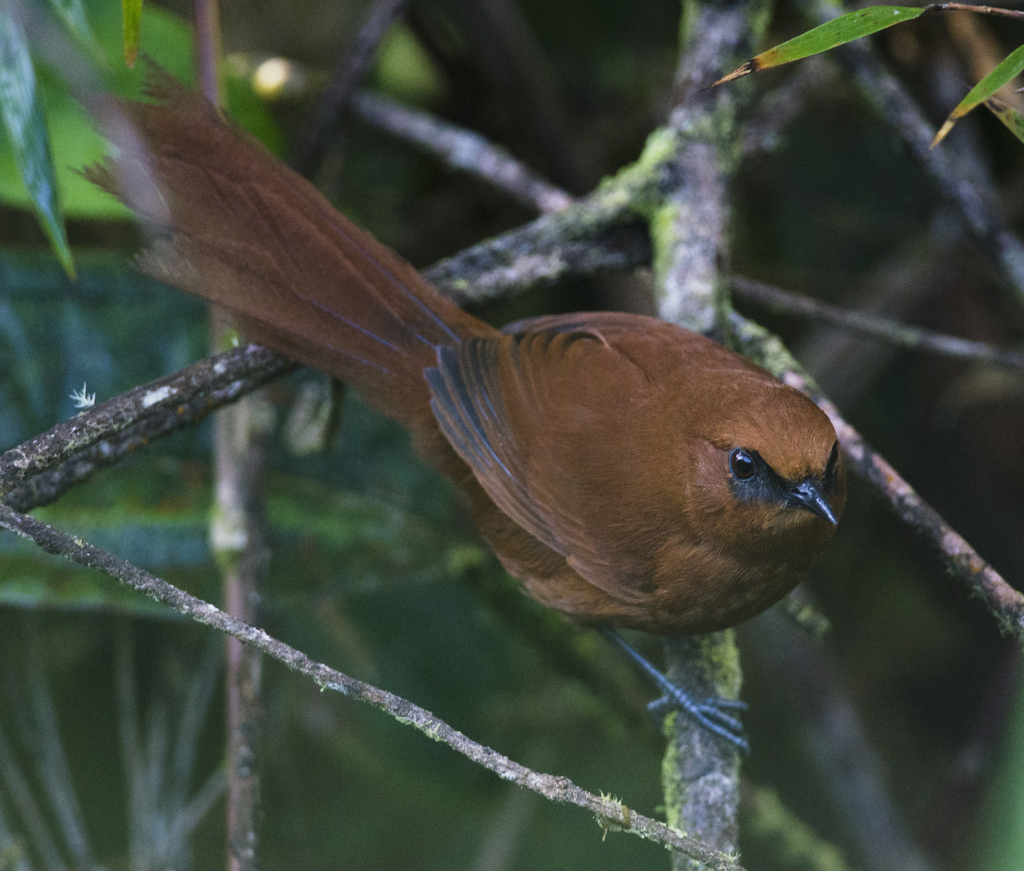
Rufous Spinetail
Live sightings near you, the range map, bar charts of when it is seen, and Macaulay Library photos and recordings.
Rufous Spinetail
Synallaxis unirufa
The rufous spinetail (Synallaxis unirufa) is a species of bird in the family Furnariidae. It is found in Colombia, Ecuador, Peru, and Venezuela. Its natural habitat is subtropical or tropical moist montane forests.
From the article Rufous spinetail on Wikipedia (CC BY-SA), quoted section by section
Description
The rufous spinetail is 16 to 18 cm (6.3 to 7.1 in) long and weighs 17 to 21 g (0.60 to 0.74 oz). It is one of the larger members of genus Synallaxis. The sexes have the same plumage. Adults of the nominate subspecies S. u. unirufa are mostly bright reddish rufous. Their forehead is slightly paler and they have sooty blackish lores. Their throat feathers have black bases that are seldom visible. Their iris is dark brown to dark reddish brown, their bill black with sometimes a pale base to the mandible, and their legs and feet gray to dark gray. Juveniles have brown upperparts, sometimes an olivaceous tinge to the head, and paler underparts than adults.
Subspecies S. u. munoztebari of the rufous spinetail is paler than the nominate, with a faint buff supercilium and forehead and no black on the throat feathers. Subspecies S. u. meridana is paler than the nominate, with somewhat visible black bases to the throat feathers. S. u. ochrogaster has the palest underparts of all four subspecies, especially in the center of its belly.
Range & habitat
The rufous spinetail has a disjunct distribution. The nominate subspecies is by far the most widely distributed. It is found in all three ranges of the Colombian Andes, on the west slope of Ecuador's Andes as far south as Cotopaxi Province, and on the east slope through Ecuador into extreme northern Peru north of the Marañón River. Subspecies S. u. munoztebari is found in the Serranía del Perijá that straddles the border between northeastern Colombia and northwestern Venezuela. S. u. meridana is found in the Andes of western Venezuela between Trujillo and Táchira and the far northwestern part of Colombia's Eastern Andes.S. u. ochrogaster is found in the Peruvian Andes south of the Marañón River between the departments of Amazonas and Cuzco. The rufous spinetail inhabits montane evergreen forest, elfin forest, and the undergrowth and edges of cloudforest in the Andes' subtropical and temperate zones. It tends to prefer the forest undergrowth and favors stands of Chusquea bamboo. In elevation it overall mostly ranges between 1,700 and 3,700 m (5,600 and 12,100 ft) and is found locally as low as 1,200 m (3,900 ft). It has narrower elevational ranges of 2,000 and 3,300 m (6,600 and 10,800 ft) in Colombia and 2,200 and 3,200 m (7,200 and 10,500 ft) in Ecuador.
Wikipedia: “Distribution and habitat”
What it does
The rufous spinetail feeds on arthropods. It usually forages in pairs and occasionally joins mixed-species feeding flocks. It gleans prey from foliage and small branches in dense cover, usually up to about 2 m (7 ft) above the ground but occasionally as high as 4 m (13 ft).
Wikipedia: “Feeding”
Listen
Looking for field recordings…
Where it lives
Recorded sightings
—
geo-referenced records in GBIF, from museums, herbaria and field observers.
Drag the globe to turn it. Dots are where records exist, not a range map; darker means more records.
In the stacks
Searching the stacks…
Every page naming Synallaxis unirufa in the Biodiversity Heritage Library →
This page is assembled live from iNaturalist, GBIF, Wikipedia, the Source Library and the Internet Archive. It is not yet part of the hand-edited codex. iNaturalist taxon 10985.