- Animals
- ›Chordates
- ›Vertebrates
- ›Birds
- ›Perching Birds
- ›Ovenbirds and Woodcreepers
- ›Typical Ovenbirds
- ›Synallaxis
On eBird ↗
Chestnut-throated Spinetail
Live sightings near you, the range map, bar charts of when it is seen, and Macaulay Library photos and recordings.
Chestnut-throated Spinetail
Synallaxis cherriei
The chestnut-throated spinetail (Synallaxis cherriei) is a species of bird in the Furnariinae subfamily of the ovenbird family Furnariidae. It is mainly found in Bolivia, Brazil, Colombia, Ecuador, and Peru.
From the article Chestnut-throated spinetail on Wikipedia (CC BY-SA), quoted section by section
Description
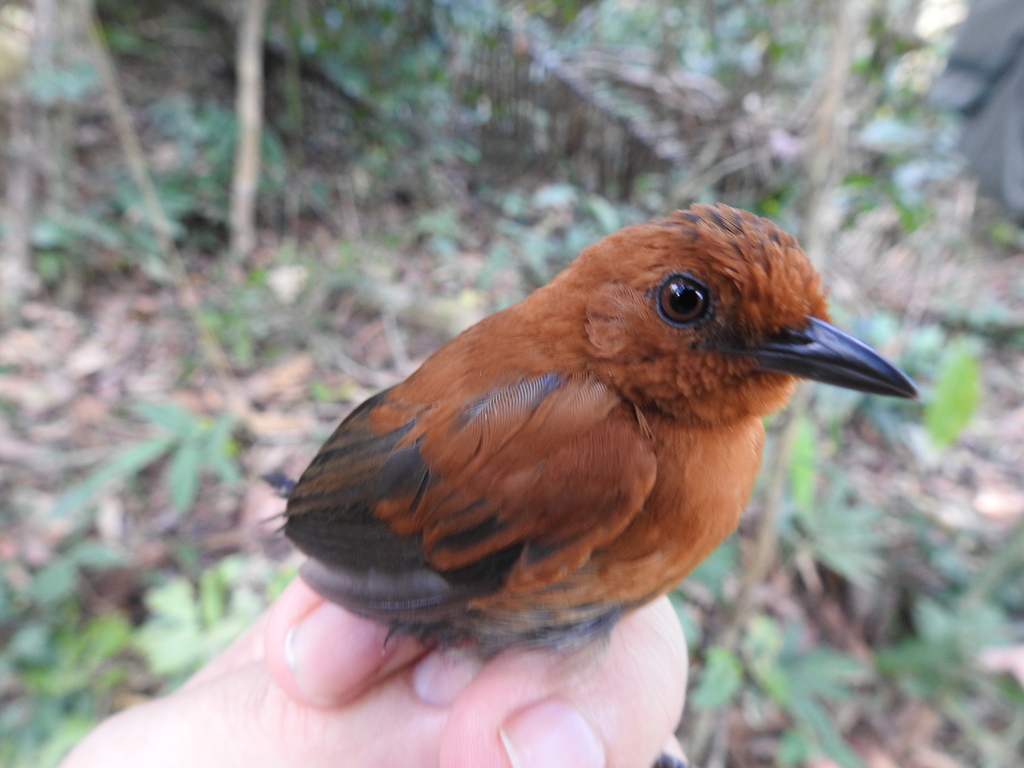
The chestnut-throated spinetail is about 13 to 15 cm (5.1 to 5.9 in) long and weighs about 14 to 17 g (0.49 to 0.60 oz). Adult males of the nominate subspecies have a deep rufous-chestnut forecrown, face, and throat. Their hindcrown, nape, and back are chestnut strongly washed with olive-brown, and their rump and uppertail coverts are dark brown. Their wing coverts are mostly chestnut and their flight feathers dark fuscous. Their tail is slaty-black; it is graduated and the feathers are pointed. Their breast is deep rufous-chestnut, their belly and undertail coverts are gray tinged with olive-brown, and their flanks are slightly darker than their belly. Their iris is ivory gray to dark brown, their maxilla black, their mandible dark gray, and their legs and feet dusky olive to brownish gray. Adult females have slightly paler throat and belly than males. Juveniles have darker and more olivaceous upperparts than adults, with only a hint of rufous. Their throat is whitish with dusky tips on the feathers; their lower breast and belly feathers have faint brown edges. Their mandible is whitish. Subspecies S. c. napoensis has more rufous on its forehead than the nominate, with paler edges on the flight feathers and a darker belly. Subspecies S. c. saturata is paler overall and browner above than the nominate, with a more orange-rufous throat and breast and a paler gray belly.
Range & habitat
The chestnut-throated spinetail has a disjunct distribution. The nominate subspecies is the most widespread of the three; it is found in the central Amazon Basin in the Brazilian states of Rondônia, Mato Grosso, Pará, and Tocantins. Subspecies S. c. napoensis is found in southern Colombia's Putumayo Department and in Ecuador's Sucumbíos and Napo provinces. Subspecies S. c. saturata is found in northern and central Peru and in northern Bolivia. The separate populations of the chestnut-throated spinetail inhabit different landscapes. In Amazonian Brazil it mostly occurs in terra firme forest, and mostly in stands of Chusquea bamboo. The disjunct populations further west occur mostly in thick vegetation in the understorey of the edges of lowland and foothill primary forest and within secondary forest, with no particular association with bamboo.
Wikipedia: “Distribution and habitat”
What it does
The chestnut-throated spinetail feeds on arthropods. It typically forages in pairs, usually keeping in dense vegetation, and usually within about 3 m (10 ft) of the ground. It does sometimes forage on the ground and as high as 8 m (26 ft) above it.
Wikipedia: “Feeding”
Listen
Looking for field recordings…
Where it lives
Recorded sightings
—
geo-referenced records in GBIF, from museums, herbaria and field observers.
Drag the globe to turn it. Dots are where records exist, not a range map; darker means more records.
In the stacks
Searching the stacks…
Every page naming Synallaxis cherriei in the Biodiversity Heritage Library →
This page is assembled live from iNaturalist, GBIF, Wikipedia, the Source Library and the Internet Archive. It is not yet part of the hand-edited codex. iNaturalist taxon 10980.