- Plants
- ›Vascular Plants
- ›flowering plants
- ›Dicots
- ›Nances, Willows, and Allies
- ›Leaf-flower Family
- ›Antidesmatoideae
- ›Antidesmateae
- ›Antidesma
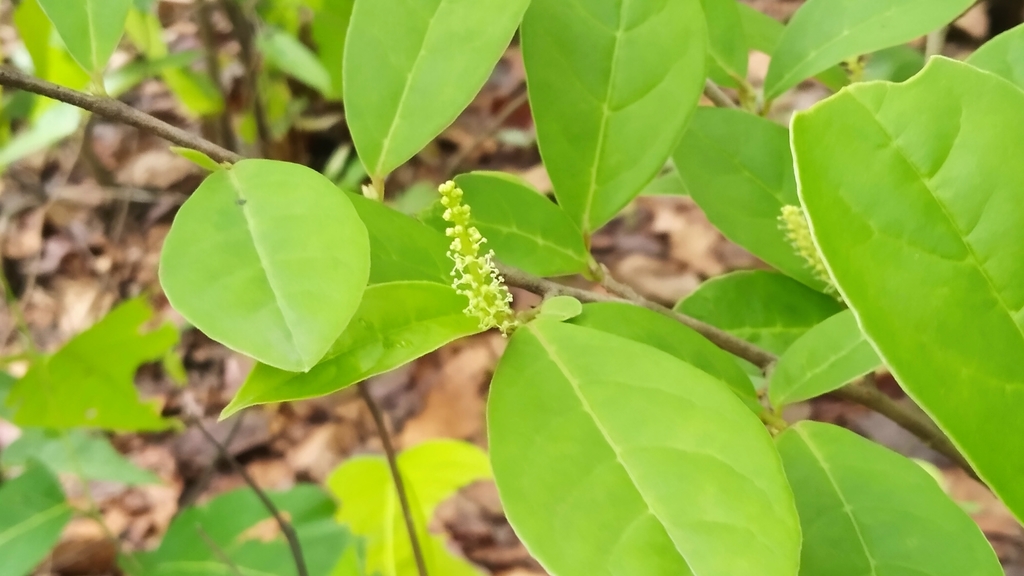
Antidesma acidum
Antidesma acidum is a shrub or small tree that is native to an area from Java to Southwestern China and Pakistan. It is a long-lived, shade-tolerant species that is usually found under closed-canopy. The fruit is eaten in many places, the leaves in some locations. In Luang Prabang (Laos) open-air markets, the leaves are only sold alongside Russula mushrooms, to give a sour flavour to soup made from the fungi.
From the article Antidesma acidum on Wikipedia (CC BY-SA), quoted section by section
Description
The species grows as a shrub or small tree, usually up to 6 m (20 ft) tall, rarely up to 10 m (33 ft). The young twigs have fine hairs. Obovate to elliptic-oblong papery leaves; upper surface smooth (though rarely surface is pilose), lower surface is pubescent (rarely smooth); dull colour, dries to a yellowish-green; acute to obtuse base (rarely attenuate); rounded to acute to acuminate apex (sometimes mucronate); size usually 5–10 cm (2.0–3.9 in), rarely down to 2 cm (0.8 in) and up to 21 cm (8.3 in). Terminal to axillary inflorescences. Ellipsoid smooth drupes, 4–6 by 3–4 mm, nearly terete to laterally compressed. Flowers in China from May to July, fruiting from June to November. Distinguishing characteristics of this species are: the papery dull leaves and their size; domatia are present; the male flowers, at least, have a pubescent disc; usually 2 (rarely 1 or 3) stamens; an absent or small rudimentary ovary; size of the fruit; and female inflorescences and infructescences are usually 2–5 cm (0.8–2.0 in), rarely up to 9 cm (3.5 in). In the southern part of the distribution range, pistillodes are always absent from the male flowers.
Wood anatomy. The wood of A. acidum is diffuse porous with occasional small vessels in solitary or radial multiple arrangements (up to 5 long). …
Range & habitat
The species is native to an area of tropical and subtropical Asia from Java, Indonesia to Southwestern China to Pakistan and the Western Himalaya region. Countries and regions in which it grows are: Indonesia (Jawa); Thailand; Cambodia; Vietnam; China (Guizhou, Sichuan, Yunnan); Laos, Myanmar; India (including Nicobar Islands, Andaman Islands, Assam); Eastern Himalaya; Bangladesh; Nepal; Western Himalaya; Pakistan.
Wikipedia: “Distribution”
What it does
There are a number of forest types in Doi Inthanon National Park, Chiang Mai Province, northern Thailand. This taxa grows in both dry dipterocarp forest (400–1,000 m (1,300–3,300 ft) elevation) and mixed deciduous forest (480–750 m (1,570–2,460 ft) elevation) found there. The dry dipterocarp forest is dominated by Dipterocarpus tuberculatus, Quercus ramsbottomii, Shorea obtusa and Shorea siamensis. In the mixed deciduous forest, the predominant species are Lagerstroemia calyculata, Millettia leucantha, Pterocarpus macrocarpus and Tectona grandis. In fire-influenced deciduous dipterocarp-oak forest in Thung Yai Naresuan Wildlife Sanctuary, western Thailand, the species is occasionally found under closed canopy. There are fires through the region annually or semi-annually. In this region this species is deciduous. In Southeast Asia generally, the shrub grows in secondary forests. The shrub/tree grows in open forests between 100 and 1,500 m (330 and 4,920 ft) altitude in China. In the Himalayan foothills it grows up to an elevation of 600 m (2,000 ft). The plant in India is a host to the whitefly (Aleyrodidae), Dialeuronomada ixorae.
Wikipedia: “Habitat and ecology”
At the table
The people who live in the Phu Khiao Wildlife Sanctuary, Chaiyaphum Province, northeast Thailand, in their folkloric medicine to treat fever, drink a water decoction of the root of this species. Further north, in the Bueng Khong Long Non-hunting Area, Bueng Kan Province, northeastern Thailand, people harvest and eat the ripe wild fruits from March to September. In Cambodia, the fleshy fruit is eaten, and in local medicine an infusion of the root is given to young mothers as a tonic. The Bunong people of Mondulkiri Province, northeastern Cambodia, collect the wild fruits daily for food, and occasionally use the plant in their ethnomedicine to treat cough. When establishing Wurfbainia villosa, "medical cardamom", plantations in Phongsaly Province, northern Laos, in an area where shifting cultivation is dominant, farmers avoid new fallow areas that have sun-loving fast-growing plants, as these affect the cardamom plants. In fallow that is over five years old these short-lived species are replaced by long-lived species such as A. acidum, Alstonia scholaris and Albizia chinensis, which provide shade for the cardamom. At the open air markets of Luang Prabang, north Laos, the leaves of this species are only sold alongside Russula mushrooms. They are regarded as a special herb to provide a sour element in the traditional soup made from the mushroom. …
Wikipedia: “Uses”
In human culture
The species was named in 1788 by the Swiss chemist, botanist and entomologist Anders Jahan Retzius (1742–1821). He influenced a number of scientists in both his family and students. The description of the taxa was published in his work Observationes Botanicae.
Wikipedia: “History”
Where it lives
Recorded sightings
—
geo-referenced records in GBIF, from museums, herbaria and field observers.
Drag the globe to turn it. Dots are where records exist, not a range map; darker means more records.
In the stacks
Searching the stacks…
Every page naming Antidesma acidum in the Biodiversity Heritage Library →
This page is assembled live from iNaturalist, GBIF, Wikipedia, the Source Library and the Internet Archive. It is not yet part of the hand-edited codex. iNaturalist taxon 1096172.