- Animals
- ›Chordates
- ›Vertebrates
- ›Birds
- ›Perching Birds
- ›Ovenbirds and Woodcreepers
- ›Typical Ovenbirds
- ›Synallaxis
On eBird ↗
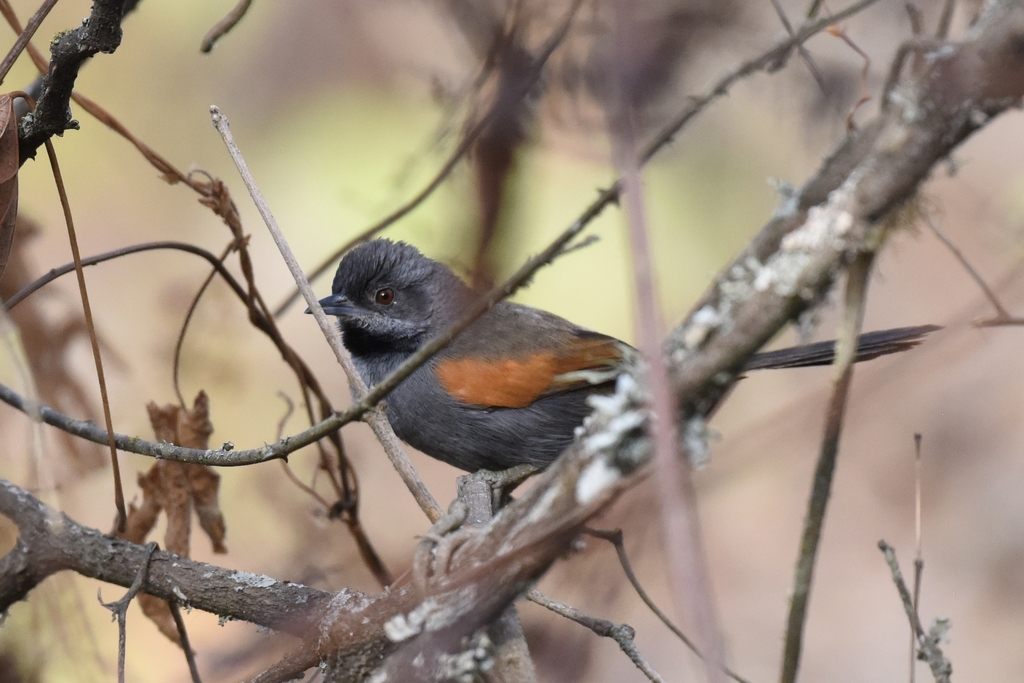
Blackish-headed Spinetail
Live sightings near you, the range map, bar charts of when it is seen, and Macaulay Library photos and recordings.
Blackish-headed Spinetail
Synallaxis tithys
The blackish-headed spinetail (Synallaxis tithys) is a species of bird in the family Furnariidae. It is found in Ecuador and Peru. Its natural habitats are subtropical or tropical dry forests, subtropical or tropical moist lowland forests, and pastureland. It is threatened by habitat loss.
From the article Blackish-headed spinetail on Wikipedia (CC BY-SA), quoted section by section
Description
The blackish-headed spinetail is 14.5 to 17 cm (5.7 to 6.7 in) long and weighs 14 to 18 g (0.49 to 0.63 oz). The sexes have the same plumage. Adults have a mostly black face with some whitish grizzling on the cheeks. Their forecrown is black, their hindcrown and upper back dark gray, and their rump and uppertail coverts dark brownish. Their wing coverts are tawny-rufous and their flight feathers dark fuscous with rufescent brown edges. Their chin is blackish and their throat black. Their underparts are mostly gray with a paler belly and an olive tinge to the flanks and undertail coverts. Their iris is reddish brown to gray-brown, their maxilla black to dark gray, their mandible blue-gray to gray, and their legs and feet gray or pale gray to bluish horn. Juveniles are more olivaceous than adults, with an ill-defined black forehead and gray mottling on their underparts.
Range & habitat
The blackish-headed spinetail is found from Manabí and Loja provinces in southwestern Ecuador south into the departments of Tumbes and Piura in far northwestern Peru. It inhabits the undergrowth of tropical deciduous forest, secondary forest, and adjacent scrublands. In elevation it ranges from near sea level to almost 1,300 m (4,300 ft).
Wikipedia: “Distribution and habitat”
What it does
Movement The blackish-headed spinetail is considered a year-round resident throughout its range but there is some slight evidence of elevational movements.
Feeding The blackish-headed spinetail feeds on arthropods. It usually forages in pairs and only rarely joins mixed-species feeding flocks. It gleans prey from leaf litter, foliage, and small branches in dense cover up to about 2 m (7 ft) above the ground.
Breeding The blackish-headed spinetail is thought to breed during the January to April rainy season. Its nest is a ball of sticks typically placed about 3 to 7 m (10 to 23 ft) up in vine tangles. Nothing else is known about its breeding biology.
Vocalization The blackish-headed spinetail's song is "a short, dry, ascending trill, 't-t-t-t-t-tit' " that it repeats every few seconds. "Excited birds can give a 'weé-di weé-di weé-di' series."
Wikipedia: “Behavior”
Listen
Looking for field recordings…
Where it lives
Recorded sightings
—
geo-referenced records in GBIF, from museums, herbaria and field observers.
Drag the globe to turn it. Dots are where records exist, not a range map; darker means more records.
In the stacks
Searching the stacks…
Every page naming Synallaxis tithys in the Biodiversity Heritage Library →
This page is assembled live from iNaturalist, GBIF, Wikipedia, the Source Library and the Internet Archive. It is not yet part of the hand-edited codex. iNaturalist taxon 10960.