- Animals
- ›Chordates
- ›Vertebrates
- ›Birds
- ›Perching Birds
- ›Ovenbirds and Woodcreepers
- ›Typical Ovenbirds
- ›Synallaxis
On eBird ↗
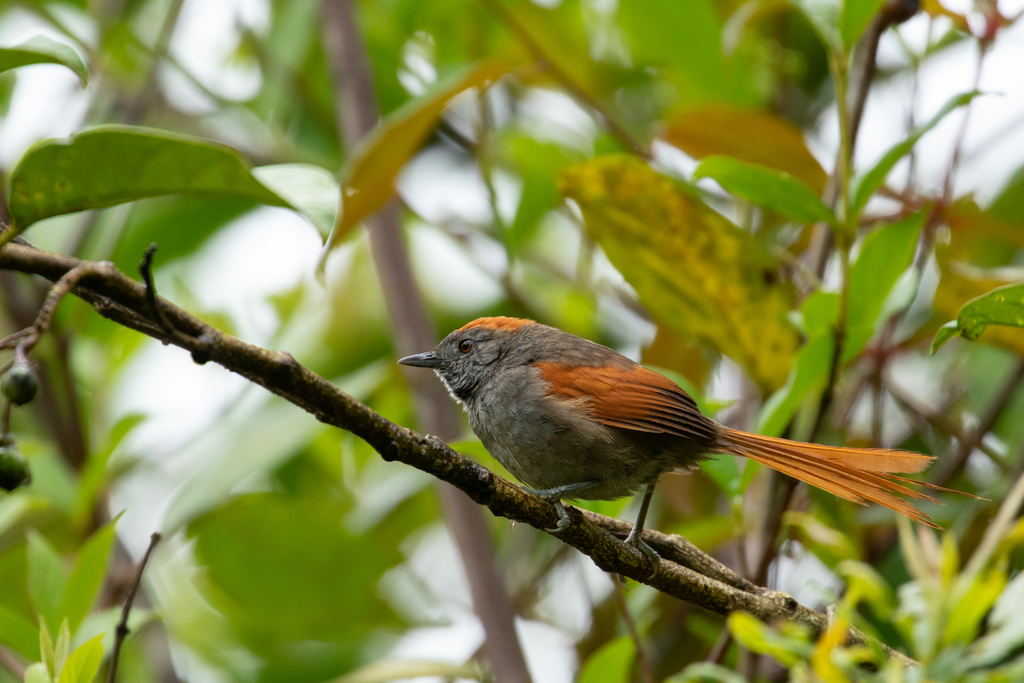
Azara's Spinetail
Live sightings near you, the range map, bar charts of when it is seen, and Macaulay Library photos and recordings.
Azara's Spinetail
Synallaxis azarae
Azara's spinetail (Synallaxis azarae) is a species of bird in the Furnariinae subfamily of the ovenbird family Furnariidae. It is found in Argentina, Bolivia, Colombia, Ecuador, Peru, and Venezuela.
From the article Azara's spinetail on Wikipedia (CC BY-SA), quoted section by section
Description
Azara's spinetail is 15 to 18 cm (5.9 to 7.1 in) long and weighs 12 to 18 g (0.42 to 0.63 oz). The sexes have the same plumage. Adults of the nominate subspecies S. a. azarae have a brownish gray face with a slightly paler supercilium. Their forehead and forecrown are dark grayish brown, their hindcrown and nape dark rufous, and their back, rump and uppertail coverts rich olive-brown. Their wings are mostly rufous-chestnut with dark brownish tips on their flight feathers. Their tail is dull chestnut-brown; the tail is graduated and the feathers have somewhat pointed tips. Their chin and edges of their throat are pale grayish with darker tips on the feathers; the center of their throat is sooty black with pale edges on the feathers. Their breast is dark brownish gray, their belly paler and grayer with faint mottling, and their flanks and undertail coverts browner than the breast and belly. Their iris is reddish brown to chestnut, their maxilla black to dark gray, their mandible gray or blue-gray (sometimes with a blackish base or tip), and their legs and feet olive-gray to grayish green. Juveniles have a brown crown and back, an indistinct throat patch, and a pale brown to ochraeceous wash on their underparts. The other subspecies of Azara's spinetail differ from the nominate and each other thus:
S. a. …
Range & habitat
The subspecies of Azara's spinetail are found thus:
S. a. elegantior: Colombia's Eastern Andes and western Venezuela S. a. media: Colombia's Central and Western Andes and south in Ecuador's Andes to Cotopaxi Province on the western slope and Zamora-Chinchipe Province on the eastern S. a. ochracea: Andes of southwestern Ecuador from Guayas and Chimborazo provinces south into northwestern Peru as far as the Department of Lambayeque S. a. fruticicola northern Peru, in the valley of the Marañón River between the departments of Cajamarca and La Libertad S. a. infumata: Andes of northern and central Peru between the departments of Amazonas and Junín S. a. urubambae: Department of Cuzco in southern Peru S. a. azarae: Andes from the Department of Puno in southeastern Peru into central Bolivia as far as northwestern Santa Cruz Department S. a. samaipatae: Andes of southern Bolivia from Santa Cruz to Tarija Department S. a. superciliosa: Andes of northwestern Argentina between the provinces of Jujuy and Catamarca Azara's spinetail inhabits a variety of semi-open landscapes both humid and drier, including the edges of montane evergreen forest, secondary forest, the edges of cloudforest and elfin forest, bushy pastures and roadsides, riparian thickets, and in Argentina semi-deciduous and deciduous woodlands. It tends to remain in dense vegetation near the ground. …
Wikipedia: “Distribution and habitat”
What it does
Azara's spinetail feeds on arthropods; its diet also includes small seeds. It usually forages in pairs and sometimes joins mixed-species feeding flocks. It gleans prey from foliage, small branches, and occasionally dead leaves. It usually stays below about 2 m (7 ft) of the ground but has been recorded feeding as high as 6 m (20 ft).
Wikipedia: “Feeding”
Listen
Looking for field recordings…
Where it lives
Recorded sightings
—
geo-referenced records in GBIF, from museums, herbaria and field observers.
Drag the globe to turn it. Dots are where records exist, not a range map; darker means more records.
In the stacks
Searching the stacks…
Every page naming Synallaxis azarae in the Biodiversity Heritage Library →
This page is assembled live from iNaturalist, GBIF, Wikipedia, the Source Library and the Internet Archive. It is not yet part of the hand-edited codex. iNaturalist taxon 10948.