- Animals
- ›Chordates
- ›Vertebrates
- ›Birds
- ›Perching Birds
- ›Ovenbirds and Woodcreepers
- ›Woodcreepers
- ›Dendrocincla
On eBird ↗
White-chinned Woodcreeper
Live sightings near you, the range map, bar charts of when it is seen, and Macaulay Library photos and recordings.
White-chinned Woodcreeper
Dendrocincla merula
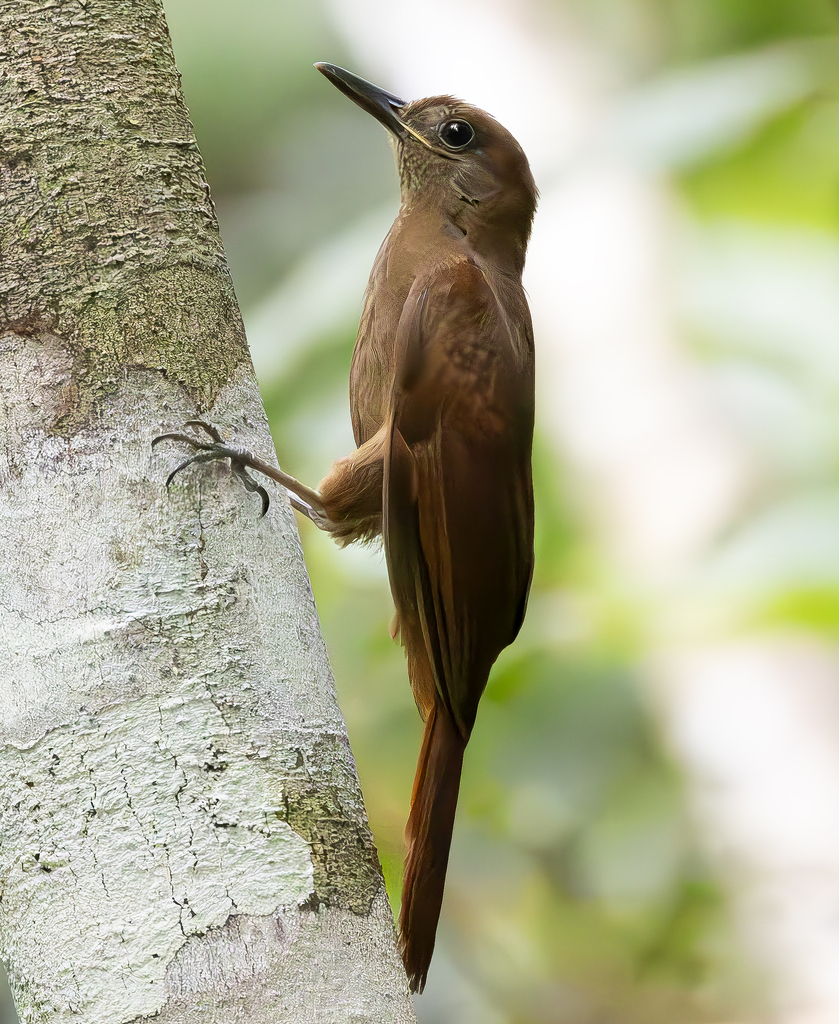
The white-chinned woodcreeper (Dendrocincla merula) is a species of bird in the Dendrocolaptinae subfamily. It is found in Bolivia, Brazil, Colombia, Ecuador, French Guiana, Guyana, Peru, Suriname, and Venezuela. Its natural habitat is subtropical or tropical moist lowland forests.
From the article White-chinned woodcreeper on Wikipedia (CC BY-SA), quoted section by section
Description
The white-chinned woodcreeper is a medium-sized member of its genus with a shortish straight bill. It is 16 to 21 cm (6.3 to 8.3 in) long. Males weigh 28 to 54 g (0.99 to 1.9 oz) and females 29 to 54 g (1.0 to 1.9 oz). Subspecies D. m. merula and D. m. obidensis are significantly larger than the other five. In all subspecies the male and female have the same plumage. The nominate subspecies has mostly dark reddish brown upperparts with slightly redder wing coverts, flight feathers, and tail. A few flight feathers have dark brown tips. It has a narrow white to yellowish vertical stripe on its chin and throat. Its breast is dark olive-brown that becomes dark rufous at the undertail coverts. Its underwing coverts are pale chestnut. Its iris is reddish brown to brown, its bill browish to black with a lighter, though variable, mandible, and its legs and feet are bluish, olive, gray, or brownish. D. m. obidensis is the largest subspecies but is otherwise almost identical to the nominate. The other five subspecies have gray to bluish irises; they also have some plumage color differences and are generally paler overall than the above two. D. m. remota is the palest of all. D. m. olivascens has an olive cast to its upperparts. D. m. castanoptera has somewhat redder upperparts than the nominate. D. m. …
Range & habitat
The white-chinned woodcreeper is a bird of the Amazon Basin. Its subspecies are distributed thus:
D. m. bartletti, from central Colombia and Venezuela south through eastern Ecuador and eastern Peru into northern Bolivia and east into western Brazil to the Rio Negro and Rio Madeira D. m. merula, the Guianas and northern Brazil's Roraima and Pará states D. m. obidensis, Brazil north of the Amazon River from the Rio Negro east to the Atlantic Ocean D. m. remota, eastern Bolivia and probably adjacent far western Brazil D. m. olivascens, Brazil south of the Amazon River between the Rio Madeira and Rio Tapajós D. m. castanoptera, Brazil south of the Amazon River between the Rio Tapajós and Rio Tocantins D. m. badia, Brazil south of the Amazon River between the Rio Tocantins and the Atlantic The white-chinned woodcreeper inhabits humid landscapes, primarily terra firme and floodplain forests. It occurs in much lesser numbers in forest on sandy soils, gallery forest, young secondary forest, and the edges of várzea forest. It is almost always found in the forest understory. In elevation it is mostly found below 300 m (1,000 ft) but on the western fringes of its ranges can reach 600 m (2,000 ft).
Wikipedia: “Distribution and habitat”
What it does
The white-chinned woodcreeper is an obligate follower of army ant swarms. It typically perches on a branch or clings to a trunk near the ground and makes short flights to capture arthropod prey disturbed by the ants. It does not feed on the ants themselves. It does occasionally also take small vertebrates as they flee the ants. In much of Brazil one or two birds may attend a swarm but in Peru up to eight have been observed doing so. It chases away smaller birds from the swarm and is in turn chased away by larger ones.
Wikipedia: “Feeding”
Listen
Looking for field recordings…
Where it lives
Recorded sightings
—
geo-referenced records in GBIF, from museums, herbaria and field observers.
Drag the globe to turn it. Dots are where records exist, not a range map; darker means more records.
In the stacks
Searching the stacks…
Every page naming Dendrocincla merula in the Biodiversity Heritage Library →
This page is assembled live from iNaturalist, GBIF, Wikipedia, the Source Library and the Internet Archive. It is not yet part of the hand-edited codex. iNaturalist taxon 10882.