- Animals
- ›Arthropods
- ›Hexapods
- ›Insects
- ›Winged and Once-winged Insects
- ›Butterflies and Moths
- ›Butterflies
- ›Swallowtails and Parnassians
- ›Parnassians
- ›True Parnassians
- ›Parnassius
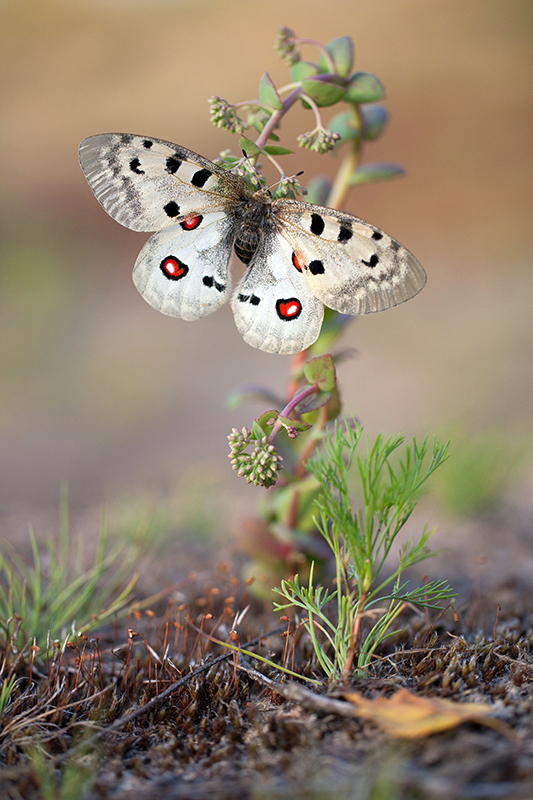
Apollo
Parnassius apollo
The Apollo (Parnassius apollo), also called the mountain Apollo, is a butterfly of the family Papilionidae.
From the article Apollo (butterfly) on Wikipedia (CC BY-SA), quoted section by section
Description
Parnassius apollo has a wingspan of 62–86 millimetres (2.4–3.4 in) in males, of 65–95 millimetres (2.6–3.7 in) in females. The Apollo butterfly shows a great deal of individual variation in the appearance, with an evident colour polymorphism. These very large, beautiful and conspicuous white butterflies are decorated with five large black eyespots on the forewing and two bright red or sometimes orange eyespots on the hindwing. These striking red eyespots can vary in size and form depending on the geographic location of the Apollo butterfly, and the bright red colour often fades in the sun, causing the eyespots of older individuals to appear more orange. The wings are shiny, with slightly transparent edges; some individuals are darker (sphragismelanistic), a general phenomenon common in many butterflies. The caterpillars of this species are velvety black with orange-red spots along the sides. Related species can be found all over the world. The clouded Apollo (Parnassius mnemosyne) lives in valleys. while the small Apollo (Parnassius phoebus) is found in high mountain habitats. The latter has strongly marked black and white antennae, with presence of two red spots near the apex of its forewings.
Distribution of colour variation. The drastic climate change of the Pleistocene era forced a separation of the red Apollo butterfly population. …
Range & habitat
This mountain butterfly species prefers hills and flowery alpine meadows, and pastures of the continental European mountains, in Spain, Scandinavia and Central Europe, in the Balkans up to northern Greece, and in the Alps between Italy and France.
It is also present in some areas of central Asia (Sakha). Typical of high altitudes, its mountain habitat ranges from 400 metres (1,300 ft) up to 2,300 metres (7,500 ft), although it is far more present above 1,000 metres (3,300 ft). The species requires specific climatic conditions, of cold winters and sunny summers. It also requires wide open spaces, with a cover of shrubs less than 5%, and a large surface of lawns (at least 50%). The presence of the host plant for their caterpillars is critical.
Wikipedia: “Distribution and habitat”
What it does
This species has a single brood. Adult Apollo butterflies are seen on the wing from May to September, feeding on nectar produced by flowers. During mating males deposit on the female's abdomen a gelatinous secretion called sphragis, that prevents the female mating a second time. The females lay eggs, which over-winter and hatch in spring the following year. The Apollo caterpillar has a velvety blue black with small orange spots. These caterpillars feed on stonecrop (Sedum species, mainly Sedum telephium, Sedum album, Sedum rupestre and Sedum ropsea), Hylotelephium caucasicum and houseleek (Sempervivum species). When the caterpillar is fully grown it will pupate on the ground, forming a loose cocoon from which the adult butterfly emerges following metamorphosis.
Wikipedia: “Ecology”
Listen
Looking for field recordings…
Where it lives
Recorded sightings
—
geo-referenced records in GBIF, from museums, herbaria and field observers.
Drag the globe to turn it. Dots are where records exist, not a range map; darker means more records.
In the old herbals & bestiaries


In the stacks
Searching the stacks…
Every page naming Parnassius apollo in the Biodiversity Heritage Library →
This page is assembled live from iNaturalist, GBIF, Wikipedia, the Source Library and the Internet Archive. It is not yet part of the hand-edited codex. iNaturalist taxon 108799.