- Animals
- ›Chordates
- ›Vertebrates
- ›Birds
- ›Perching Birds
- ›Ovenbirds and Woodcreepers
- ›Woodcreepers
- ›Xiphocolaptes
On eBird ↗
Great Rufous Woodcreeper
Live sightings near you, the range map, bar charts of when it is seen, and Macaulay Library photos and recordings.
Great Rufous Woodcreeper
Xiphocolaptes major
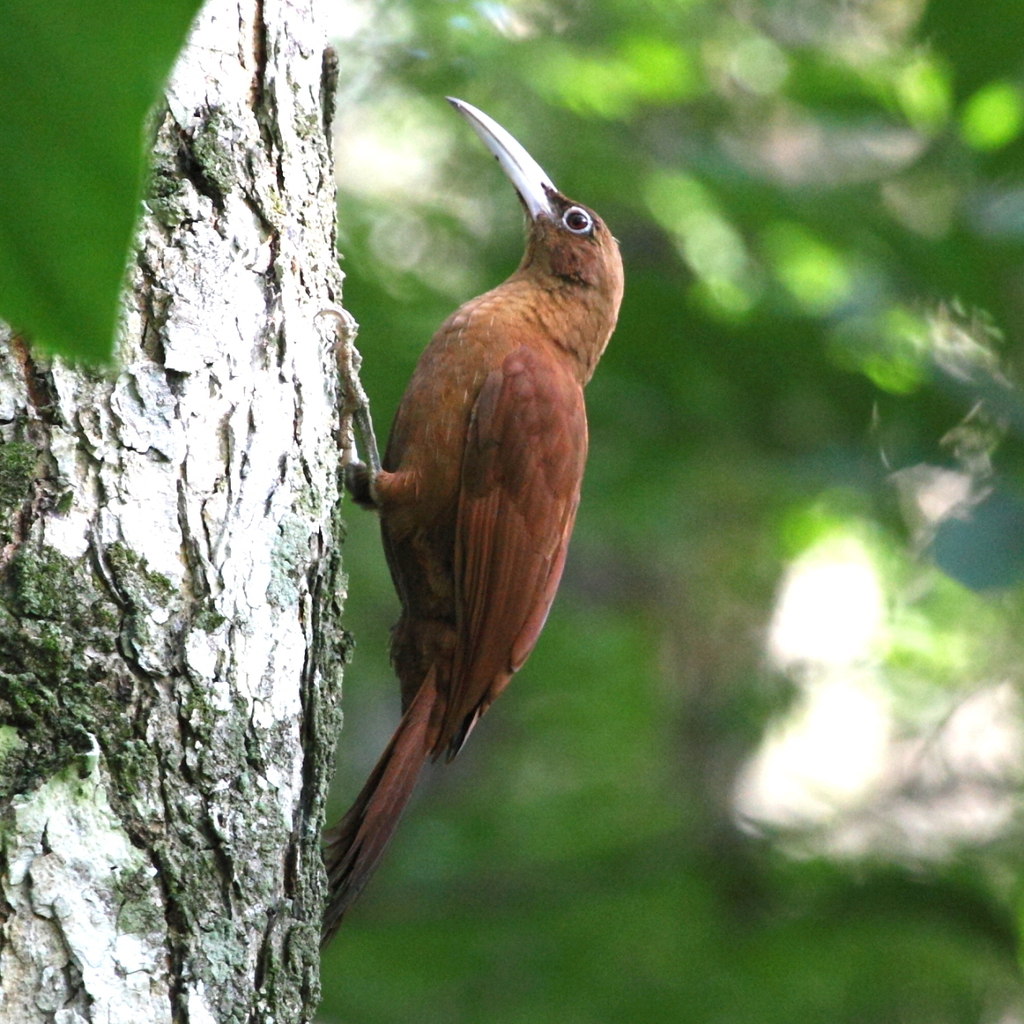
The great rufous woodcreeper (Xiphocolaptes major) is a species of bird in the Dendrocolaptinae subfamily, the woodcreepers. It is found in Argentina, Bolivia, Brazil, and Paraguay. Its natural habitats are subtropical or tropical dry forests and subtropical or tropical moist lowland forests. At 155 g (5.5 oz) and 35 cm (14 in), this is the largest woodcreeper and, if correctly allied with the family, is the largest furnariid.
From the article Great rufous woodcreeper on Wikipedia (CC BY-SA), quoted section by section
Description
The great rufous woodcreeper is the largest, though not the heaviest, member of its subfamily. It is heavy-bodied with a long, heavy, somewhat decurved bill. It is 27 to 34 cm (11 to 13 in) long. Males weigh 120 to 150 g (4.2 to 5.3 oz) and females 120 to 162 g (4.2 to 5.7 oz). The sexes have the same plumage. Adults of the nominate subspecies X. m. major are almost entirely bright rufous-cinnamon. Their crown is slightly darker, their tail more chestnut, and their flight feathers reddish brown with dusky tips on the primaries. Their lores are blackish, their throat pale cinnamon with whitish buff streaks, and their underparts cinnamon with some buffy streaks on the breast and dusky brownish bars on the belly. Their iris is dark brown, rich red-brown, or crimson. Their bill is pale, from horn colored to horn-white, and their legs and feet dark grayish olive, greenish, or bluish gray. Juveniles are generally brighter overall than adults, especially on their underparts; they have stronger streaks on the breast but weaker ones on the crown. Subspecies X. m. remoratus has darker upperparts than the nominate, with less reddish underparts that are more heavily streaked and barred. X. m. castaneus is darker overall than the nominate, with a more brownish head, deeper chestnut upperparts, and less streaking and barring on the underparts. X. m. …
Range & habitat
The subspecies of the great rufous woodcreeper are found thus:
X. m. remoratus, southwestern Mato Grosso state of Brazil X. m. castaneus, north-central and eastern Bolivia, southern Brazil's Mato Grosso do Sul state, and northwestern Argentina's Jujuy and Salta provinces X. m. estebani, northwestern Argentina's Tucumán Province X. m. major, western Paraguay and northern Argentina as far south as Córdoba and Santa Fe provinces The great rufous woodcreeper inhabits a variety of forest landscapes including dry woodland, semi-deciduous woodland, gallery forest, and Gran Chaco woodland. It also occurs in scrubby forest, cerrado, and wooded savanna. It favors the forest interior but occasionally occurs at its edges. In elevation it mostly occurs below 1,500 m (4,900 ft) but reaches as high as 1,800 m (5,900 ft).
Wikipedia: “Distribution and habitat”
What it does
The great rufous woodcreeper's diet is mostly insects, and it feeds on smaller amounts of other arthropods and small vertebrates. It mostly forages alone or in pairs, and occasionally in trios that are thought to be family groups. It is not known to follow army ant swarms or join mixed-species feeding flocks. It forages from the ground to the subcanopy, turning over leaf litter and hitching along trunks and branches, probing and gleaning for prey.
Wikipedia: “Feeding”
Listen
Looking for field recordings…
Where it lives
Recorded sightings
—
geo-referenced records in GBIF, from museums, herbaria and field observers.
Drag the globe to turn it. Dots are where records exist, not a range map; darker means more records.
In the stacks
Searching the stacks…
Every page naming Xiphocolaptes major in the Biodiversity Heritage Library →
This page is assembled live from iNaturalist, GBIF, Wikipedia, the Source Library and the Internet Archive. It is not yet part of the hand-edited codex. iNaturalist taxon 10865.