- Plants
- ›Vascular Plants
- ›flowering plants
- ›Dicots
- ›Legumes, Milkworts, and Allies
- ›Legumes
- ›Acacias, Mimosas, Mesquites, and Allies
- ›Acacia
- ›Juliflorae
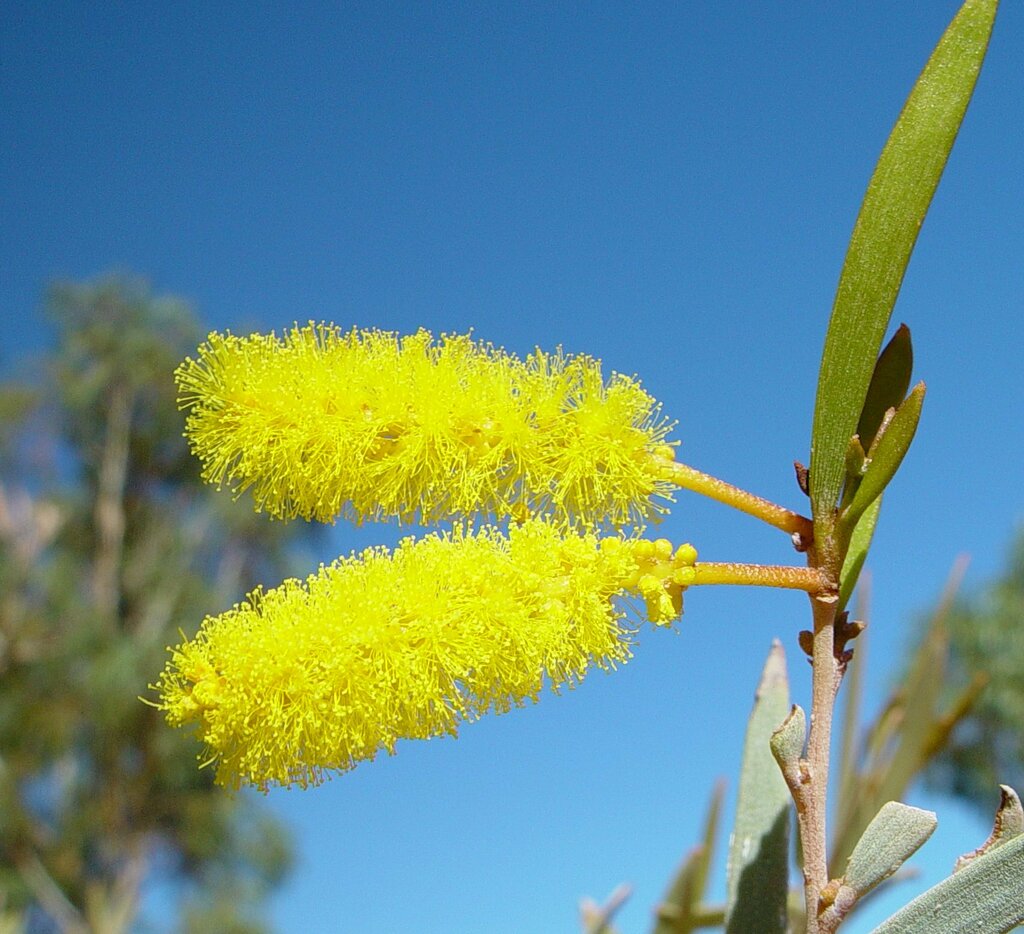
Minni Ritchi
Acacia rhodophloia
Acacia rhodophloia, commonly known as minni ritchi or western red mulga, is a tree or shrub belonging to the genus Acacia and the subgenus Juliflorae that is endemic to a large area of arid central western Australia. The Indigenous group the Kurrama peoples know the plant as mantaru.
From the article Acacia rhodophloia on Wikipedia (CC BY-SA), quoted section by section
Description
The variable tree or shrub typically grows to a height of 1.5 to 4 metres (5 to 13 ft) but can reach as high as 6 m (20 ft). It usually has a few main stems that are sparingly divided around ground level with the upper branches forming a usually horizontally spreading crown on mature plants. The multi-stemmed juvenile plants are more likely to have a rounded habit. The main stems and limbs have attractive red Minni ritchi style bark that curl back onto themselves into small scrolls. It has glabrous branchlets that can have indumentum covered in dried resin at the angled extremities. Like many species of Acacia it has phyllodes rather than true leaves. The evergreen, coriaceous and sub-rigid, narrowly elliptic to narrowly oblong and sometimes linear shaped phyllodes have a length of 2 to 10 cm (0.79 to 3.94 in) and a width of 2 to 13 mm (0.079 to 0.512 in). The ascending to erect, dull green to grey-green phyllodes are straight to shallowly sickle shaped are glabrous or sparsely haired with many fine longitudinal nerves that are very close together with a central nerve than can be more prominent than the others. It blooms sporadically from May to October or at other time following significant rainfall events producing yellow flowers. The simple inflorescences are found on 8 to 20 mm (0.31 to 0.79 in) long stalks. …
Range & habitat
It is native to a large area in the Northern Territory and the Pilbara, Goldfields, Mid West and Kimberley regions of Western Australia where it is commonly situated on granite outcrops, sand plains and rocky hills and rises growing in sandy to gravelly soils. The range of the plant extends into the Northern Territory to around the Ehrenberg Range in the east and to Docker Creek and Bloods Range in the south with one population being recorded in South Australia to the north of Tarcoola It is known to grow in rocky areas in red-brown loamy to loamy clay soils usually as a part of Mulga communities where it can form small nearly pure stands but is also associated with scrub heath, Casuarina scrub communities or commonly found along with spinifex.
Wikipedia: “Distribution”
Where it lives
Recorded sightings
—
geo-referenced records in GBIF, from museums, herbaria and field observers.
Drag the globe to turn it. Dots are where records exist, not a range map; darker means more records.
In the stacks
Searching the stacks…
Every page naming Acacia rhodophloia in the Biodiversity Heritage Library →
This page is assembled live from iNaturalist, GBIF, Wikipedia, the Source Library and the Internet Archive. It is not yet part of the hand-edited codex. iNaturalist taxon 1072503.