On eBird ↗
Chopi Blackbird
Live sightings near you, the range map, bar charts of when it is seen, and Macaulay Library photos and recordings.
Chopí Blackbird
Gnorimopsar chopi
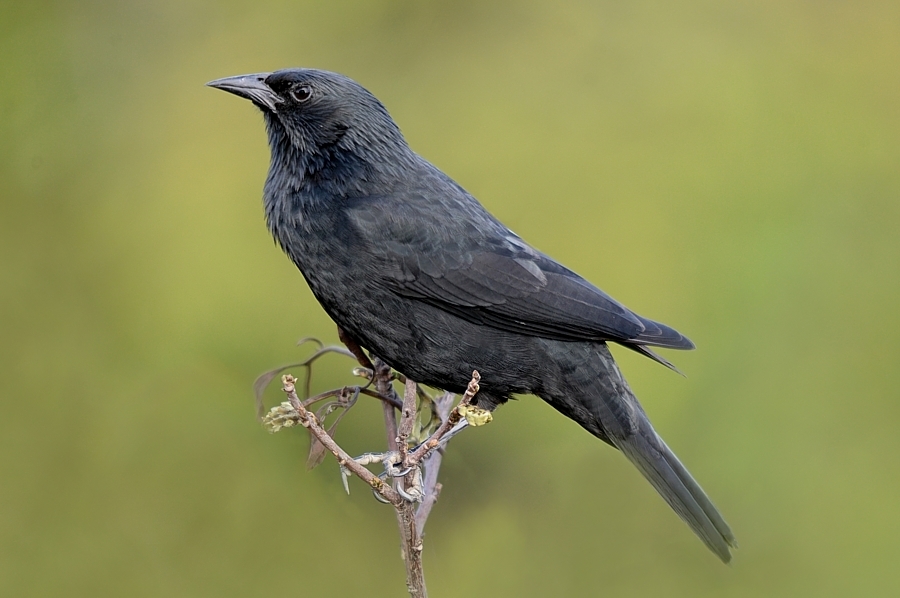
The chopi blackbird (Gnorimopsar chopi) is a species of bird in the family Icteridae. It is monotypic within the genus Gnorimopsar. It is found in Argentina, Bolivia, Brazil, Paraguay, Peru, and Uruguay. Its natural habitats are dry savanna, subtropical or tropical seasonally wet or flooded lowland grassland, pastureland, and heavily degraded former forest.
From the article Chopi blackbird on Wikipedia (CC BY-SA), quoted section by section
Description
The chopi blackbird is 25 cm (9.8 in) in length and has black plumage across the body. It is similar to the Forbes's blackbird but has a slightly curved bill with a groove along the lower mandible. The call is a loud explosive "tjouw", either given as a single call or as a series that vary randomly in pitch.
Range & habitat
The Chopi blackbird is found from the extreme sout east of Peru in Madre de Dios east through the lowlands of northern and eastern Bolivia, Paraguay, Brazil south of the Amazon, Uruguay and northern and eastern Argentina.
Wikipedia: “Distribution”
What it does
The chopi blackbird is a gregarious species and is typically noted in flocks, which may reach large sizes. They roost in large aggregations in dense foliage and cane brakes. These flocks are highly vocal, the birds singing as if holding conversations, even in flight. When nesting they will aggressively defend the nest site from predators, unhestitatngly chasing hawks and caracaras. It is a semi-colonial species, nesting in cavities, nests stites include old woodpecker holes, hollow trees, cavities in fence posts disuesed rufous hornero nests, within the nests of jabiru storks, the dense foliage of Auracaria angustifolia, holes in banks and termite nests, and under the eaves and older parts of houses. When not nesting in a cavity the Chjopi black bird builds an open cup nest among the dnese foliage of palms and other trees. The clutch size is 4 or 5 eggs, the chopi blackbird is a host for the shiny cowbird and screaming cowbird.
== References ==
Wikipedia: “Behavior”
In human culture
The chopi blackbird's common name and its specific name, chopi, are onomatopoeic, being derived from its common vocalisation which is sometimes writtens as "chop-ee".
Wikipedia: “Etymology”
Listen
Looking for field recordings…
Where it lives
Recorded sightings
—
geo-referenced records in GBIF, from museums, herbaria and field observers.
Drag the globe to turn it. Dots are where records exist, not a range map; darker means more records.
In the stacks
Searching the stacks…
Every page naming Gnorimopsar chopi in the Biodiversity Heritage Library →
This page is assembled live from iNaturalist, GBIF, Wikipedia, the Source Library and the Internet Archive. It is not yet part of the hand-edited codex. iNaturalist taxon 10723.