On eBird ↗
Red-and-black Grosbeak
Live sightings near you, the range map, bar charts of when it is seen, and Macaulay Library photos and recordings.
Red-and-black Grosbeak
Periporphyrus erythromelas
The red-and-black grosbeak (Periporphyrus erythromelas) is a species of grosbeaks in the family Cardinalidae. It is the only species in the genus Periporphyrus. It is found in Brazil, French Guiana, Guyana, Suriname, and Venezuela. Its natural habitat is subtropical or tropical moist lowland forest.
From the article Red-and-black grosbeak on Wikipedia (CC BY-SA), quoted section by section
Description
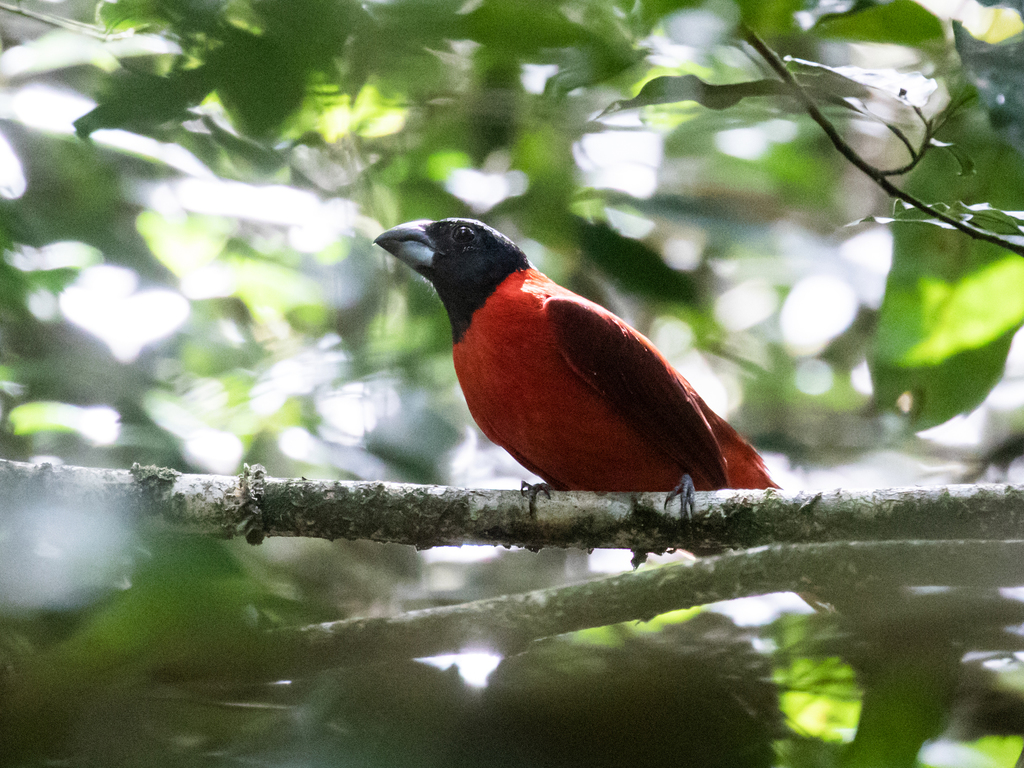
The red-and-black-grosbeak is 20.5 cm (8.1 in) long; one male weighed 48 g (1.7 oz). Both sexes have a heavy bill and their entire head including the throat is black. The male's nape, breast, and belly are bright red and its back is a deep red. Its wings are blackish brown with reddish brown edges on the flight feathers. Its tail is reddish. The female's upperparts are dark greenish yellow and their underparts yellowish green with some darker mottling. Their flight feathers are blackish brown with wide yellowish green edges on the outer webs. Their tail is dark greenish brown. The immature male has a similar color scheme to the adult but it is duller with orange-red underparts. Both sexes have a dark brown iris, a black maxilla, a silver-gray or pale blue-gray mandible whose tip and tomium are black, and dark grayish black or pinkish gray legs and feet.
Range & habitat
The red-and-black grosbeak is primarily found from the eastern edges of far eastern Venezuela's Bolívar and Delta Amacuro states east through the Guianas and into northeastern Brazil. In Brazil it ranges from Amapá to northwestern Maranhão and inland along the Amazon at least to western Pará, and there are scattered records west and south of that range. It inhabits mature humid terra firme and várzea forest. In elevation it reaches 1,000 m (3,300 ft) in Venezuela and Brazil.
Wikipedia: “Distribution and habitat”
What it does
The red-and-black grosbeak forages in the lower levels of the forest for arthropods and seeds. It does not join mixed-species foraging flocks but feeds in pairs or family groups.
Wikipedia: “Feeding”
Listen
Looking for field recordings…
Where it lives
Recorded sightings
—
geo-referenced records in GBIF, from museums, herbaria and field observers.
Drag the globe to turn it. Dots are where records exist, not a range map; darker means more records.
In the stacks
Searching the stacks…
Every page naming Periporphyrus erythromelas in the Biodiversity Heritage Library →
This page is assembled live from iNaturalist, GBIF, Wikipedia, the Source Library and the Internet Archive. It is not yet part of the hand-edited codex. iNaturalist taxon 10680.