On eBird ↗
Scarlet-and-white Tanager
Live sightings near you, the range map, bar charts of when it is seen, and Macaulay Library photos and recordings.
Scarlet-and-white Tanager
Chrysothlypis salmoni
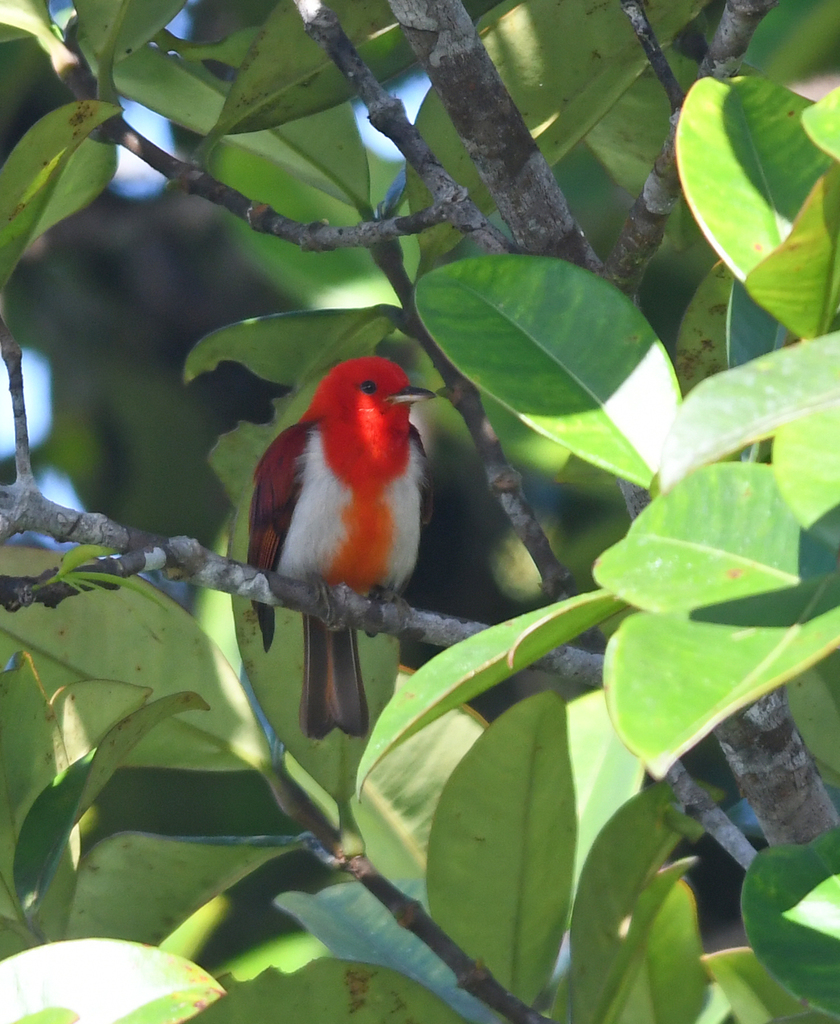
The scarlet-and-white tanager (Chrysothlypis salmoni) is a species of bird in the family Thraupidae. It is found in Colombia and northern Ecuador. Its natural habitats are subtropical or tropical moist lowland forests and heavily degraded former forest. The male is highly distinctive and has bright scarlet upperparts, darker red wings and undertail coverts, and white underparts with a scarlet median stripe running down the throat and belly. Females are patterned like the males, but are olive-brown instead of scarlet.
The scarlet-and-white tanager is found in secondary growth and disturbed vegetation, mostly between elevations of 25–1,200 m (100–3,900 ft), but sometimes up to elevations of 1,700 m (5,600 ft). It feeds mainly on fruit and arthropods. Foraging occurs singly, in pairs, or in groups of up to six, and it can be found in mixed-species flocks with other tanagers, especially those in the genus Tangara.
From the article Scarlet-and-white tanager on Wikipedia (CC BY-SA), quoted section by section
Description
The scarlet-and-white tanager is a relatively thin tanager around 12 cm (4.7 in) long and weighing 9.8–14.5 g (0.35–0.51 oz). The adult male is highly distinctive and has a bright scarlet head, throat, and upperparts. Its wings are mostly a darker red, with brownish-black flight feathers, along with black wingtips. It has a scarlet median stripe running down its breast and belly, with the remaining underparts being white. The undertail coverts are also scarlet. Females have olive-brown upperparts and white underparts, with dusky wings and a dark brown tail. The throat and chest are tinged yellowish-buff, with there sometimes being a yellowish-buff median stripe, similar to the male. Immature males are indistinguishable from the female, while subadult males have patches of red, being otherwise similar in appearance to the female. The iris is brown. The upper mandible of the bill is dusky, while the lower mandible is pale yellow. The legs are grayish-horn.
Vocalizations. Its song is an inconspicuous, high-pitched ti ti ti-te-te-ta-heét. The flight call is a weak chip or sciip.
Range & habitat
The scarlet-and-white tanager is found on the Pacific slope of the western and central Andes in Colombia and Ecuador, mostly at elevations of 25–1,200 m (82–3,937 ft). However, it can be found at elevations of up to 1,700 m (5,600 ft) in the Chocó of the Cordillera Central in Colombia. It inhabits stunted secondary growth on foothills, especially around dense, mossy woodland around ridge tops, steep canyon slopes, or landslide scars. It is also found in openings and disturbed habitat in tall, wet forests with dense mossy growth. It tends to be uncommon and present locally at low elevations, but is more widespread at elevations above 300 m (1,000 ft).
Wikipedia: “Distribution”
What it does
The scarlet-and-white tanager feeds on fruit and arthropods. A study from the western Valle de Cauca showed that 58% of the diet is composed of fruit, with the remainder being small arthropods. Most fruit eaten is from arillate species, such as Tovomitopsis and Clusia, along with Miconia berries. It forages singly, in pairs, or small groups of up to six individuals, either alone or in mixed-species flocks with other tanagers, especially those in the genus Tangara. It feeds on fruit by gleaning, hanging from leaves, or hovering. Smaller fruit are swallowed whole, while larger ones are eaten in pieces. Arthropods are usually foraged at elevations of 4.5–15 m (15–49 ft), and seldom below 3 m (10 ft). Most insects are caught by gleaning, hovering, aerial sallies, or sallies to leaves and flowers.
Wikipedia: “Diet”
Listen
Looking for field recordings…
Where it lives
Recorded sightings
—
geo-referenced records in GBIF, from museums, herbaria and field observers.
Drag the globe to turn it. Dots are where records exist, not a range map; darker means more records.
In the stacks
Searching the stacks…
Every page naming Chrysothlypis salmoni in the Biodiversity Heritage Library →
This page is assembled live from iNaturalist, GBIF, Wikipedia, the Source Library and the Internet Archive. It is not yet part of the hand-edited codex. iNaturalist taxon 10629.