On eBird ↗
Lark Bunting
Live sightings near you, the range map, bar charts of when it is seen, and Macaulay Library photos and recordings.
Lark Bunting
Calamospiza melanocorys
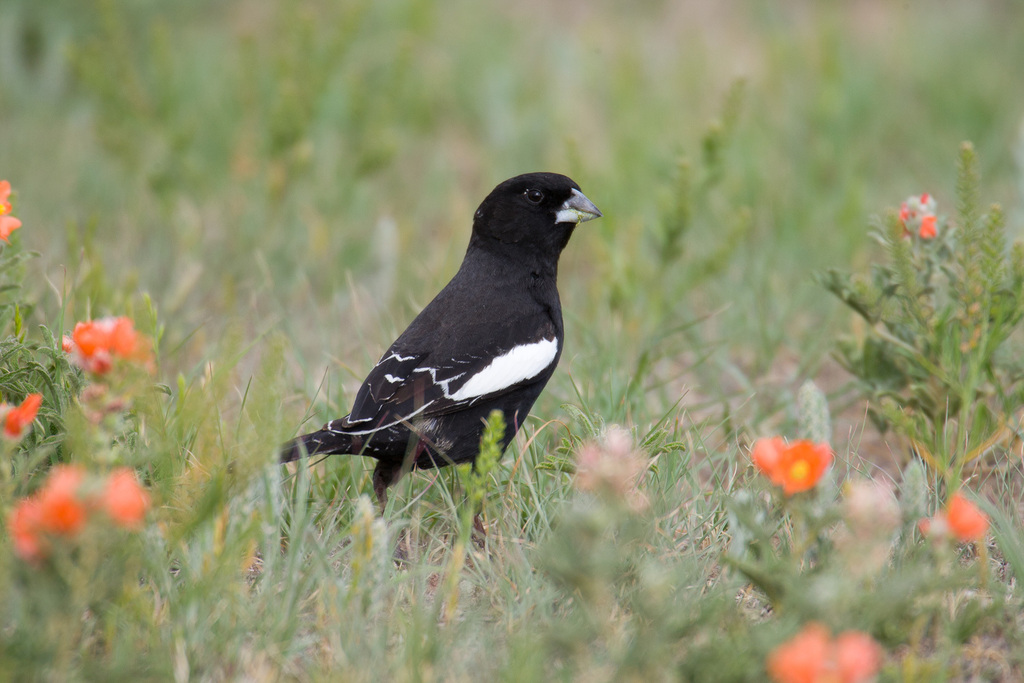
The lark bunting (Calamospiza melanocorys) is a medium-sized American bunting native to central and western North America. It was designated the state bird of Colorado in 1931.
From the article Lark bunting on Wikipedia (CC BY-SA), quoted section by section
Description
Lark buntings are small songbirds, with a short, thick, bluish bill. There is a large patch of white on the wings and they have a relatively short tail with white tips at the end of the feathers. Breeding males have an all black body with a large white patch on the upper part of the wing. Nonbreeding males and females look similar and are grayish brown with white stripes. Measurements:
Length: 5.5–7.1 in (140–180 mm) Weight: 1.3–1.5 oz (37–43 g) Wingspan: 9.8–11.0 in (250–280 mm)
Range & habitat
The lark bunting is the most prevalent of the passerine species found in the grasslands of North America. Their breeding habitat is prairie regions in central Canada and the mid-western United States. These birds migrate in flocks to winter southern Texas, Arizona and the high plateau of northern Mexico in the fall.
Wikipedia: “Distribution and habitat”
What it does
Lark buntings primarily forage on the ground, mainly eating insects in summer and seeds in winter; they sometimes take short flights in pursuit of insects. Outside of the nesting season, they often feed in flocks.
Wikipedia: “Feeding”
Listen
Looking for field recordings…
Where it lives
Recorded sightings
—
geo-referenced records in GBIF, from museums, herbaria and field observers.
Drag the globe to turn it. Dots are where records exist, not a range map; darker means more records.
In the stacks
Searching the stacks…
Every page naming Calamospiza melanocorys in the Biodiversity Heritage Library →
This page is assembled live from iNaturalist, GBIF, Wikipedia, the Source Library and the Internet Archive. It is not yet part of the hand-edited codex. iNaturalist taxon 10585.