On eBird ↗
Great Inca-Finch
Live sightings near you, the range map, bar charts of when it is seen, and Macaulay Library photos and recordings.
Great Inca-Finch
Incaspiza pulchra
The great Inca finch (Incaspiza pulchra) is a species of passerine bird in the tanager family Thraupidae. It was traditionally placed in the family Emberizidae. It is endemic to Peru.
From the article Great Inca finch on Wikipedia (CC BY-SA), quoted section by section
Description
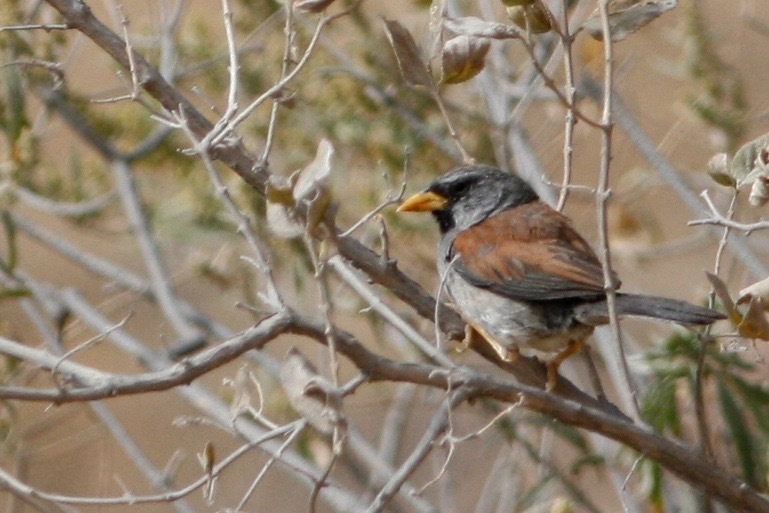
The great Inca finch is 16.5 cm (6.5 in) long and weighs 25.5 to 32 g (0.90 to 1.1 oz). It has a long tail and a slim pointed bill. The species is sexually dimorphic though the sexes are very similar. Adult males have a mostly gray head with a brown cast on the crown and nape, blackish lores, a blackish triangular mask and throat, and a thin whitish gray supercilium above the mask. Their upperparts are mostly brownish with rufous scapulars. Their wings are mostly rufous with gray lesser coverts and browner basal halves of the tertials. Their tail is black with white edges on the outer feathers. Their breast is gray, their flanks buffy gray, and their belly and vent off-white. Adult females have the same plumage pattern as males but are overall somewhat duller and have a browner crown and nape. Both sexes have a dark brown iris, an orange-yellow bill, and orange-yellow legs and feet.
Range & habitat
The great Inca finch is found on the western slope of the Peruvian Andes from southern La Libertad Department south to southern Lima Department. It inhabits slopes and gullies with Melocactus "Turks's head" cacti and terrestrial bromeliads. In elevation it ranges between 1,000 and 2,700 m (3,300 and 8,900 ft) though mostly above 1,500 m (4,900 ft).
Wikipedia: “Distribution and habitat”
What it does
The great Inca finch forages on the ground and feeds primarily Melocactus cactus fruit. During the breeding season it is usually single or in pairs and in the non-breeding season may be in groups of up to about seven individuals.
Wikipedia: “Feeding”
Listen
Looking for field recordings…
Where it lives
Recorded sightings
—
geo-referenced records in GBIF, from museums, herbaria and field observers.
Drag the globe to turn it. Dots are where records exist, not a range map; darker means more records.
In the stacks
Searching the stacks…
Every page naming Incaspiza pulchra in the Biodiversity Heritage Library →
This page is assembled live from iNaturalist, GBIF, Wikipedia, the Source Library and the Internet Archive. It is not yet part of the hand-edited codex. iNaturalist taxon 10548.