On eBird ↗
Semper's Warbler
Live sightings near you, the range map, bar charts of when it is seen, and Macaulay Library photos and recordings.
Semper's Warbler
Leucopeza semperi
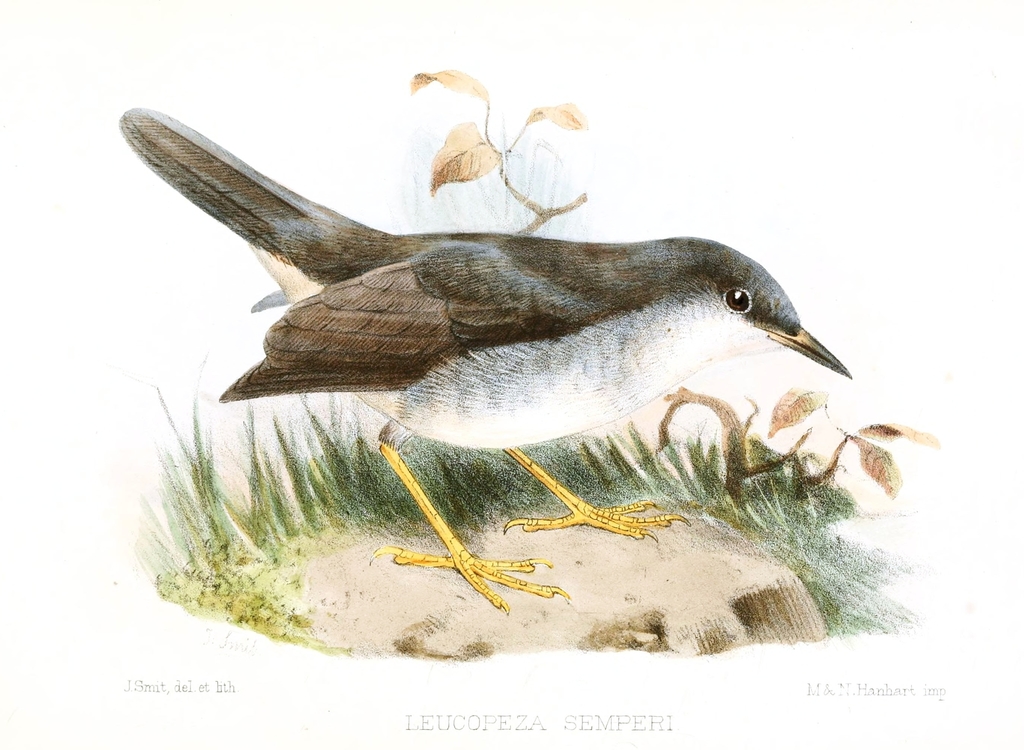
Semper's warbler (Leucopeza semperi), local name pied-blanc, is a possibly extinct passerine bird of the New World warbler family, Parulidae. It is endemic to Saint Lucia, in the Lesser Antilles. It is the only species in the genus Leucopeza.
From the article Semper's warbler on Wikipedia (CC BY-SA), quoted section by section
Description
Semper's warbler is about 14.5 centimetres (5.7 inches) in length. It has a dark gray head with a pale superciliary, dark gray upperparts, a grayish-white belly, and brown wings and tail, with a grayish olive-brown wash on its flanks. Its dark gray bill is long and pointed. First-year birds are brownish-gray above, with pale buffish brown underparts and a whiter throat. The long legs are pale white to yellow in coloration. Juveniles remain undescribed. The song remains undescribed. The only documented calls consist of tuck-tick-tick-tuck noises, as well as chattering sounds made when an individual is alarmed.
Range & habitat
Semper's warbler is endemic to Saint Lucia, living in the undisturbed undergrowth of lower montane rainforests and elfin woodlands. Most records of the species come from the Barre de l'Isle ridge, between Piton Flore and Piton Canaries.
Wikipedia: “Distribution and habitat”
What it does
There is next to no information about the ecology of the Semper's warbler. Most if not all of its foraging activity took place in forest understory, generally close to the ground. It may nest on or near the ground.
Wikipedia: “Ecology and behavior”
Listen
Looking for field recordings…
Where it lives
Recorded sightings
—
geo-referenced records in GBIF, from museums, herbaria and field observers.
Drag the globe to turn it. Dots are where records exist, not a range map; darker means more records.
In the stacks
Searching the stacks…
Every page naming Leucopeza semperi in the Biodiversity Heritage Library →
This page is assembled live from iNaturalist, GBIF, Wikipedia, the Source Library and the Internet Archive. It is not yet part of the hand-edited codex. iNaturalist taxon 10537.