On eBird ↗
Yellow-headed Blackbird
Live sightings near you, the range map, bar charts of when it is seen, and Macaulay Library photos and recordings.
Yellow-headed Blackbird
Xanthocephalus xanthocephalus
The yellow-headed blackbird (Xanthocephalus xanthocephalus) is a medium-sized blackbird with a yellow head.
It is the only member of the genus Xanthocephalus. Their scientific name derives from the Greek word for yellow, xanthous, and the word for head, cephalus.
From the article Yellow-headed blackbird on Wikipedia (CC BY-SA), quoted section by section
Description
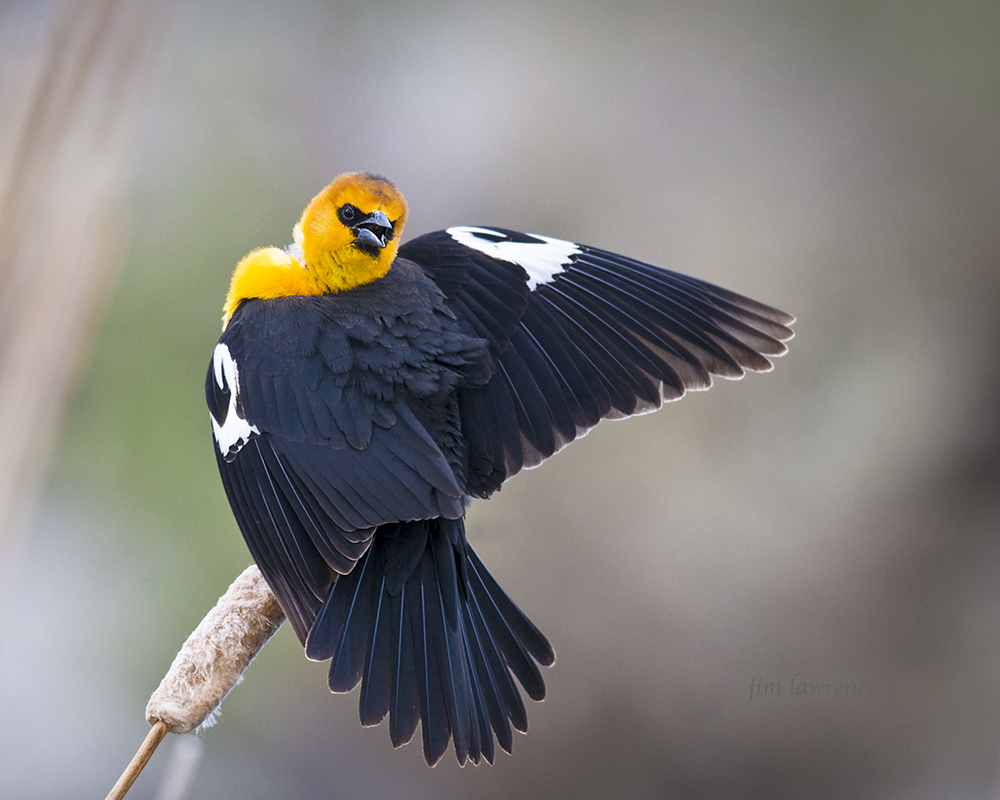
Yellow-headed blackbirds are relatively large blackbirds with large, yellow heads. They measure 8.3–10.2 in (21–26 cm) in length, with a wingspan of 16.5–17.3 in (42–44 cm) and a weight of 1.6–3.5 oz (44–100 g). Adults have a pointed bill. The adult male is mainly black with a yellow head and breast; they have a white wing patch sometimes only visible in flight. The adult female is mainly brown with a dull yellow throat and breast. Immature members of both sexes are brown with duller yellow plumage compared to adult males. Immature males also have some white patches on the wing. Both sexes resemble the respective sexes of the smaller yellow-hooded blackbird of South America.
Range & habitat
These birds migrate in the winter to the southwestern United States and Mexico. They often migrate in huge flocks with other species of birds. The only regions of the United States where these blackbirds are permanent residents are the San Joaquin Valley and the Lower Colorado River Valley of Arizona and California. It is an extremely rare vagrant to western Europe, with some records suspected to refer to escapes from captivity. When migrating, males and females travel separately. Males typically arrive at the breeding marshes 2–3 weeks before females during spring migration. Research suggests that females choose breeding sites based on the reproductive success (number of young per breeding female) of the site in previous years. The breeding habitat of the yellow-headed blackbird are marshes in North America (mainly west of the Great Lakes), particularly in plants such as cattails (genus Typha), bulrush (genus Scirpus), and common reeds (genus Phragmites). The nest is built with and attached to marsh vegetation and is constructed over open water. They nest in colonies, often sharing their habitat closely with the red-winged blackbird (Agelaius phoeniceus). During the breeding and nesting season the males are very territorial and spend much of their time perched on reed stalks and displaying or chasing off intruders.
Wikipedia: “Migration, habitat, and breeding”
At the table
These birds eat seeds for the majority of the year and insects throughout the summer months. They forage in marshes, fields, or on the ground, sometimes catching insects in flight. Sunflowers are fairly popular amongst yellow-headed blackbirds in the Northern Great Plains, with a study indicating that males eat more sunflower than grains and females more grains than sunflower. Some methods of gathering food involve flipping over stones, catching insects from the top of water, and foraging. Foraging methods take place in uplands, with the flock taking a "rolling" formation in which birds fly from the back to the front of the flock to feed. Female yellow-headed blackbirds primarily feed their newly-hatched young insects from the order Odonata, which includes dragonflies and damselflies. Outside the nesting period, they often feed in flocks, often with related species.
Wikipedia: “Food”
Listen
Looking for field recordings…
Where it lives
Recorded sightings
—
geo-referenced records in GBIF, from museums, herbaria and field observers.
Drag the globe to turn it. Dots are where records exist, not a range map; darker means more records.
In the stacks
This page is assembled live from iNaturalist, GBIF, Wikipedia, the Source Library and the Internet Archive. It is not yet part of the hand-edited codex. iNaturalist taxon 10470.