- Plants
- ›Vascular Plants
- ›flowering plants
- ›Dicots
- ›Mints, Plantains, Olives, and Allies
- ›Acanthus Family
- ›Thunbergioideae
- ›Thunbergieae
- ›Thunbergia
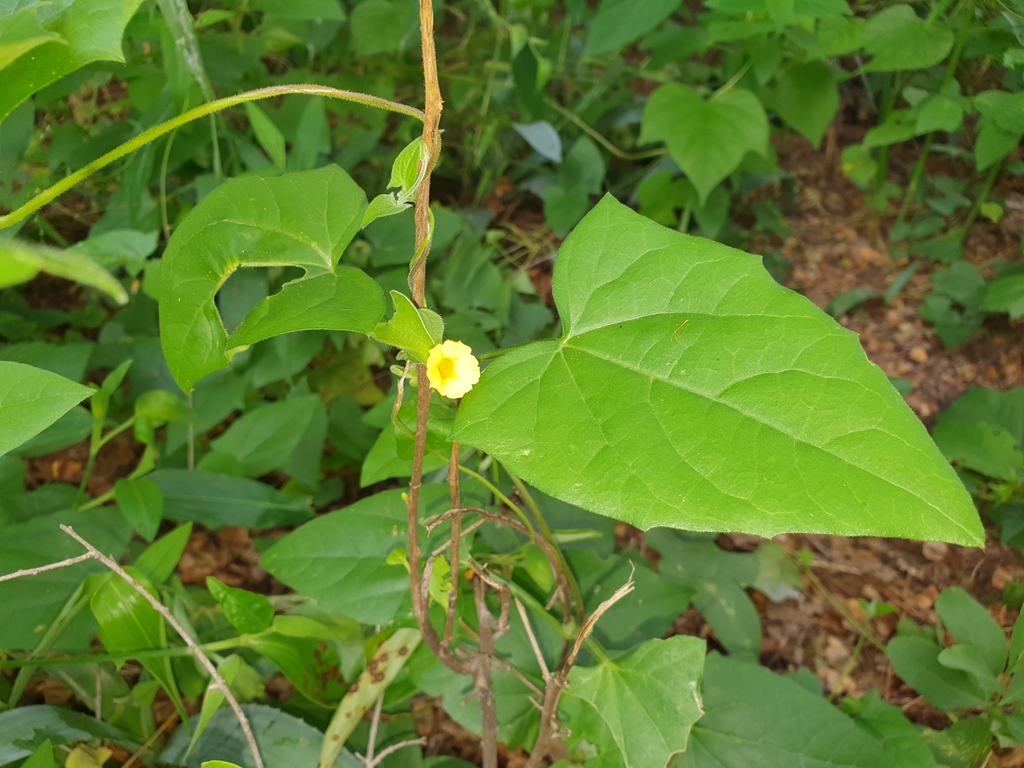
Thunbergia reticulata
Thunbergia alata, commonly called black-eyed Susan vine, is a herbaceous perennial climbing plant species in the family Acanthaceae. It is native to Eastern Africa, and has been naturalized in other parts of the world.
From the article Thunbergia reticulata on Wikipedia (CC BY-SA), quoted section by section
Description
Thunbergia reticulata is an annual plant. Its stems can grow up to 40 cm in length in erect plants, or up to 1.5 meters long in creeping or twining forms. The leaves are opposite, triangular-ovate to cordate in shape, and often exhibit hastate lobes at the base. They are typically sparsely hairy, particularly on the veins beneath, with margins that are either entire or coarsely toothed. The petiole ranges from 1 to 5.5 cm in length and is narrowly to broadly winged. The flowers are axillary and typically solitary, though sometimes paired. The bracteoles are green with prominent brownish to purple veins, ovate in shape, and measure 1.7–2.5 cm in length, with a cordate base and distinct 4-angled corners. The corolla of the flower is white, cream, or orange and lacks a purple throat. The fruit is a depressed, beaked, globose capsule ranging from 10–15 mm long and is densely covered in fine velvety hairs.
Range & habitat
Thunbergia reticulata is distributed across several countries in Africa, including: Botswana, Eritrea, Ethiopia, Kenya, Namibia, Sudan, Zambia, and Zimbabwe. The species has also been introduced into Malaysia.
Wikipedia: “Distribution”
Where it lives
Recorded sightings
—
geo-referenced records in GBIF, from museums, herbaria and field observers.
Drag the globe to turn it. Dots are where records exist, not a range map; darker means more records.
In the stacks
Searching the stacks…
Every page naming Thunbergia reticulata in the Biodiversity Heritage Library →
This page is assembled live from iNaturalist, GBIF, Wikipedia, the Source Library and the Internet Archive. It is not yet part of the hand-edited codex. iNaturalist taxon 1044669.