On eBird ↗
Hispaniolan Crossbill
Live sightings near you, the range map, bar charts of when it is seen, and Macaulay Library photos and recordings.
Hispaniolan Crossbill
Loxia megaplaga
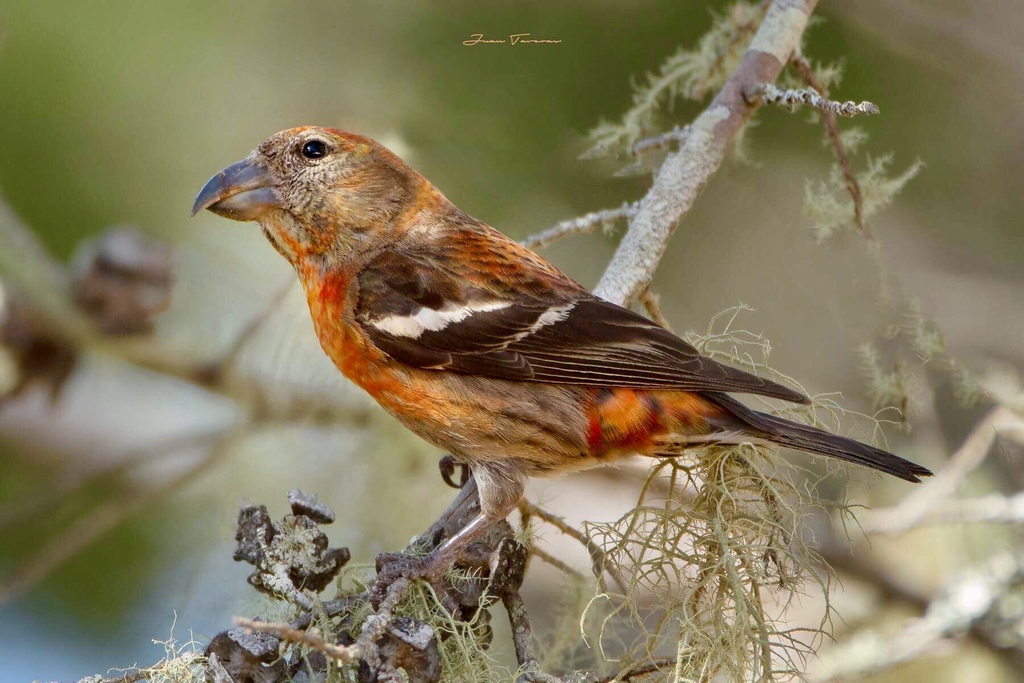
The Hispaniolan crossbill (Loxia megaplaga) is an Endangered species of passerine bird in the family Fringillidae, the finches and euphonias. It is endemic to the island of Hispaniola that is shared by Haiti and the Dominican Republic).
From the article Hispaniolan crossbill on Wikipedia (CC BY-SA), quoted section by section
Description
The Hispaniolan crossbill is about 15 to 16 cm (5.9 to 6.3 in) long and weighs about 28 g (0.99 oz). The species is sexually dimorphic. Both sexes have the characteristic crossed bill from which the genus' English name derives. In this species the direction of the crossing is variable. Adult males are mostly dull brown with a reddish to reddish orange wash that is heaviest on the nape, upper back, and upper chest. Their wings are blackish with two white wing bars. Adult females are also mostly dull brown. They have a yellow rump, a yellow wash on the upper breast, and thin brown streaks on the whole breast. Both sexes have a dark brown to black iris, a gray to black bill, and pink legs and feet. Juveniles are similar to adult females but are browner overall and have heavier streaks on the breast.
Range & habitat
The Hispaniolan crossbill has a highly disjunct distribution on the island of Hispaniola. It is found in Haiti in the Massif de la Selle and Massif de la Hotte. In the Dominican Republic it is found in the Sierra de Bahoruco and Cordillera Central. A few individuals in Jamaica's Blue Mountains in the 1970s are believed to have been vagrants. The species inhabits forests of Hispaniolan pine (Pinus occidentalis). This tree is found from about 540 m (1,800 ft) above sea level up to about 2,600 m (8,500 ft).
Wikipedia: “Distribution and habitat”
What it does
The Hispaniolan crossbill feeds primarily on the seeds of the Hispaniolan pine. It pries cone scales apart with its crossed bill and extracts the seeds with its tongue. In addition to pine seeds, there are also a very few isolated observations of single birds feeding on palm fruit and mistletoe fruit. The species forages in the upper branches of tall pines and typically on the outer part of branches where foliage is of medium density. Typically the chosen trees are about 85 to 105 years old; trees of this age are believed to produce more cones than younger ones.
Wikipedia: “Feeding”
Listen
Looking for field recordings…
Where it lives
Recorded sightings
—
geo-referenced records in GBIF, from museums, herbaria and field observers.
Drag the globe to turn it. Dots are where records exist, not a range map; darker means more records.
In the stacks
Searching the stacks…
Every page naming Loxia megaplaga in the Biodiversity Heritage Library →
This page is assembled live from iNaturalist, GBIF, Wikipedia, the Source Library and the Internet Archive. It is not yet part of the hand-edited codex. iNaturalist taxon 10422.