On eBird ↗
Ecuadorian Cacique
Live sightings near you, the range map, bar charts of when it is seen, and Macaulay Library photos and recordings.
Ecuadorian Cacique
Cacicus sclateri
The Ecuadorian cacique (Cacicus sclateri) is a species of bird in the family Icteridae. It is found in Colombia, Ecuador, and Peru, where its natural habitat is subtropical or tropical moist lowland forest. A fairly common bird with a wide range, the IUCN has rated it a "species of least concern".
From the article Ecuadorian cacique on Wikipedia (CC BY-SA), quoted section by section
Description
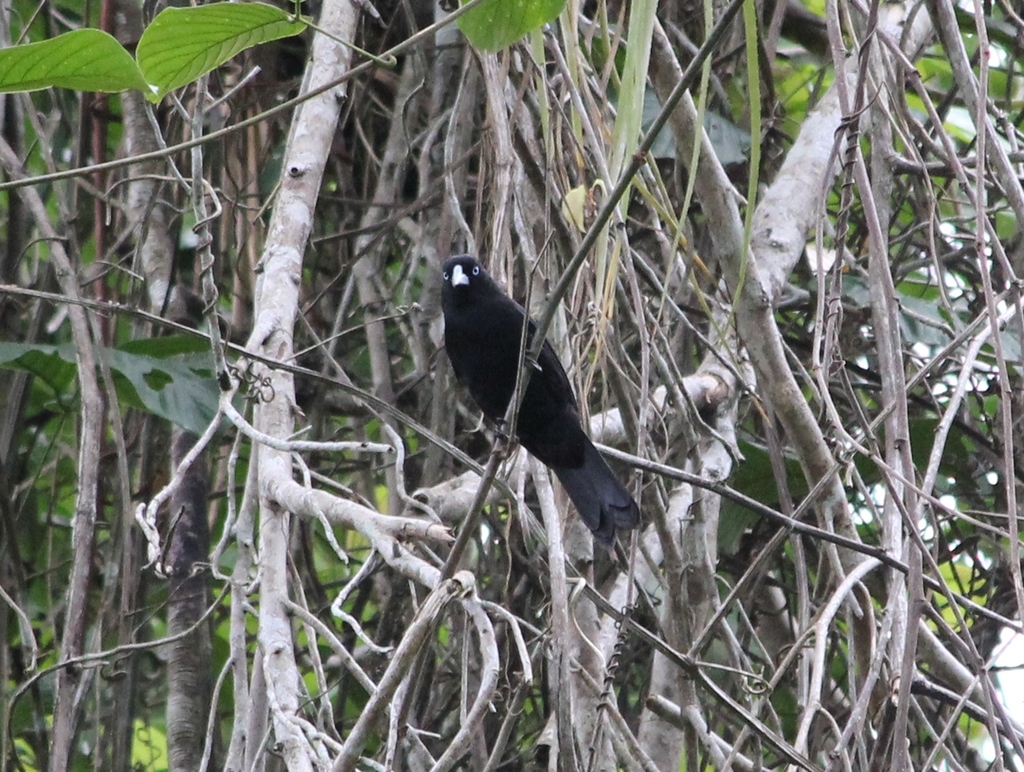
The male Ecuadorian cacique grows to a length of about 23 cm (9 in), with the female being a little smaller. The plumage of both sexes is entirely black, the beak is whitish, long and pointed, and the iris is blue in adults and brown in juveniles. This bird can be distinguished from the otherwise similar solitary cacique (Cacicus solitarius) because that species is larger, has a darker-coloured iris and spends more time in undergrowth and near the ground and less time in trees. Also similar is the red-rumped cacique (C. haemorrhous), but it reveals its bright red rump patch when in flight. This bird has a number of noisy calls, including a repeated "péach-yo" and "péach-yo-yo", uttered while perched with raised tail, a "k-cheeyow?", and a "kweeyh-kweeyh-kweeyh-kweeyh-wonhh?" among others.
Range & habitat
The species is native to southern Colombia, eastern Ecuador and northeastern Peru. It typically lives in moist woodland and the edges of riverside and Várzea forests, at altitudes of up to 400 m (1,300 ft).
Wikipedia: “Distribution and habitat”
What it does
An arboreal bird, the Ecuadorian cacique usually feeds alone but sometimes pairs of birds or small family groups move together through the tree canopy. It often visits flowering and fruiting trees and can sometimes be seen probing the petioles of Cecropia trees. Its diet is mainly insects such as ants, beetles and caterpillars, as well as fruit and possibly nectar.
Wikipedia: “Ecology”
Listen
Looking for field recordings…
Where it lives
Recorded sightings
—
geo-referenced records in GBIF, from museums, herbaria and field observers.
Drag the globe to turn it. Dots are where records exist, not a range map; darker means more records.
In the stacks
Searching the stacks…
Every page naming Cacicus sclateri in the Biodiversity Heritage Library →
This page is assembled live from iNaturalist, GBIF, Wikipedia, the Source Library and the Internet Archive. It is not yet part of the hand-edited codex. iNaturalist taxon 10362.