On eBird ↗
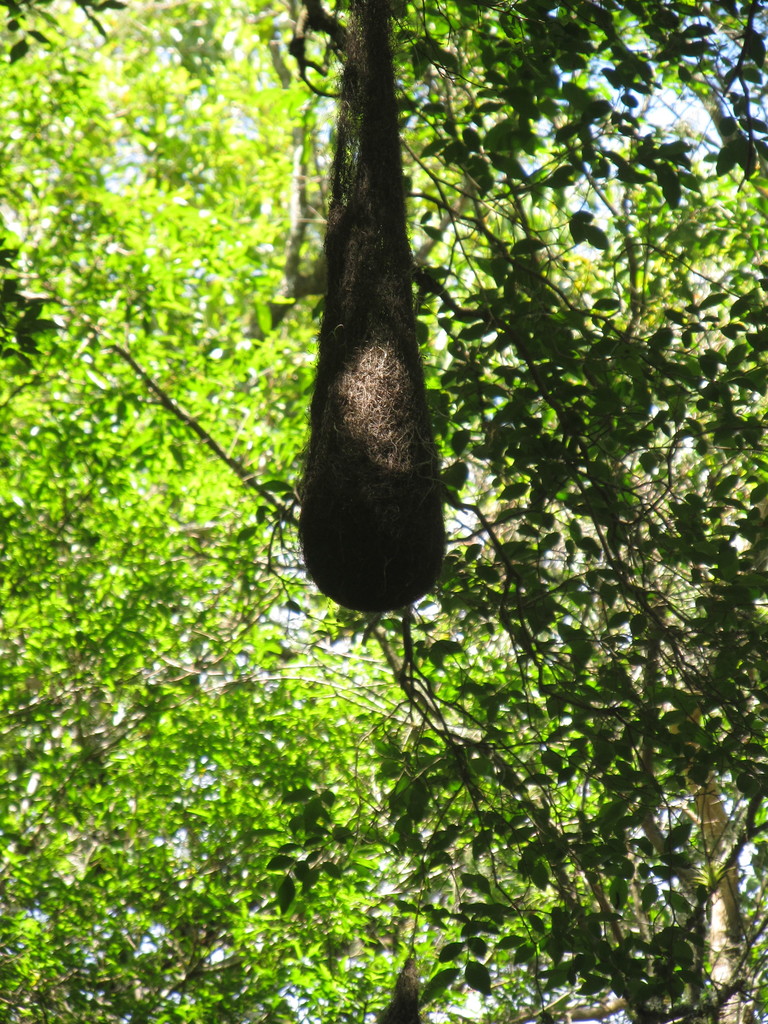
Golden-winged Cacique
Live sightings near you, the range map, bar charts of when it is seen, and Macaulay Library photos and recordings.
Golden-winged Cacique
Cacicus chrysopterus
The golden-winged cacique (Cacicus chrysopterus) is a species of bird in the family Icteridae, the oropendolas, New World orioles, and New World blackbirds. It is found in Argentina, Bolivia, Brazil, Paraguay, and Uruguay.
From the article Golden-winged cacique on Wikipedia (CC BY-SA), quoted section by section
Description
Male golden-winged caciques are about 21 cm (8.3 in) long and females about 19 cm (7.5 in). Males weigh about 35 to 47 g (1.2 to 1.7 oz) and females about 30 to 34 g (1.1 to 1.2 oz). The sexes have the same plumage. Adults are almost entirely black. Their lower rump and their median and inner greater wing coverts are bright yellow. They have a pearly white to yellow iris, a pale bluish gray bill, and black legs and feet. Juveniles are duller overall than adults and have dark eyes.
Range & habitat
Sources differ on the range of the golden-winged cacique. Some state that it has a disjunct distribution with ranges of significantly different sizes. The smaller range extends in a narrow band from central Bolivia south to Tucuman Province in northwestern Argentina. The larger includes the eastern two-thirds of Paraguay, much of northeastern Argentina, the northern half of Uruguay, and Brazil south of a line that roughly follows from western Mato Grosso do Sul to northern Paraná to western Rio de Janeiro state. Other sources assign it a continuous range that connects the areas that the others keep separate. In its far western range the golden-winged cacique inhabits the Yungas forest along the eastern slope of the Andes. In its large range it inhabits humid to mesic Chaco woodlands and gallery forest, Atlantic forest, and the transitional forests between the Chaco and the Atlantic. In elevation it reaches 2,800 m (9,200 ft) in the west and 2,000 m (6,600 ft) in Brazil.
Wikipedia: “Distribution and habitat”
What it does
The golden-winged cacique feeds on insects, other invertebrates, small vertebrates, nectar, and wild and cultivated fruits. It typically finds prey by probing bark, insect galls, and epiphytes, sometimes spreading its beak ("gaping") to expose it. It feeds mostly in trees and sometimes hangs upside down when feeding. It usually forages in pairs or family groups but has been seen in flocks of up to 30 individuals in the non-breeding season. It often joins mixed-species feeding flocks that include other icterids.
Wikipedia: “Feeding”
Listen
Looking for field recordings…
Where it lives
Recorded sightings
—
geo-referenced records in GBIF, from museums, herbaria and field observers.
Drag the globe to turn it. Dots are where records exist, not a range map; darker means more records.
In the stacks
Searching the stacks…
Every page naming Cacicus chrysopterus in the Biodiversity Heritage Library →
This page is assembled live from iNaturalist, GBIF, Wikipedia, the Source Library and the Internet Archive. It is not yet part of the hand-edited codex. iNaturalist taxon 10361.