On eBird ↗
Northern Slaty Brushfinch
Live sightings near you, the range map, bar charts of when it is seen, and Macaulay Library photos and recordings.
Northern Slaty Brushfinch
Atlapetes schistaceus
The slaty brush finch (Atlapetes schistaceus) is a species of bird in the Emberizidae family. It is found in humid Andean forests from western Venezuela, through Colombia, to Ecuador, with a disjunct population in central Peru. The latter is sometimes considered a separate species, the Taczanowski's brush finch (A. taczanowskii). Furthermore, the Cuzco brush finch from south-eastern Peru is sometimes considered a subspecies of the slaty brush finch.
From the article Slaty brushfinch on Wikipedia (CC BY-SA), quoted section by section
Description
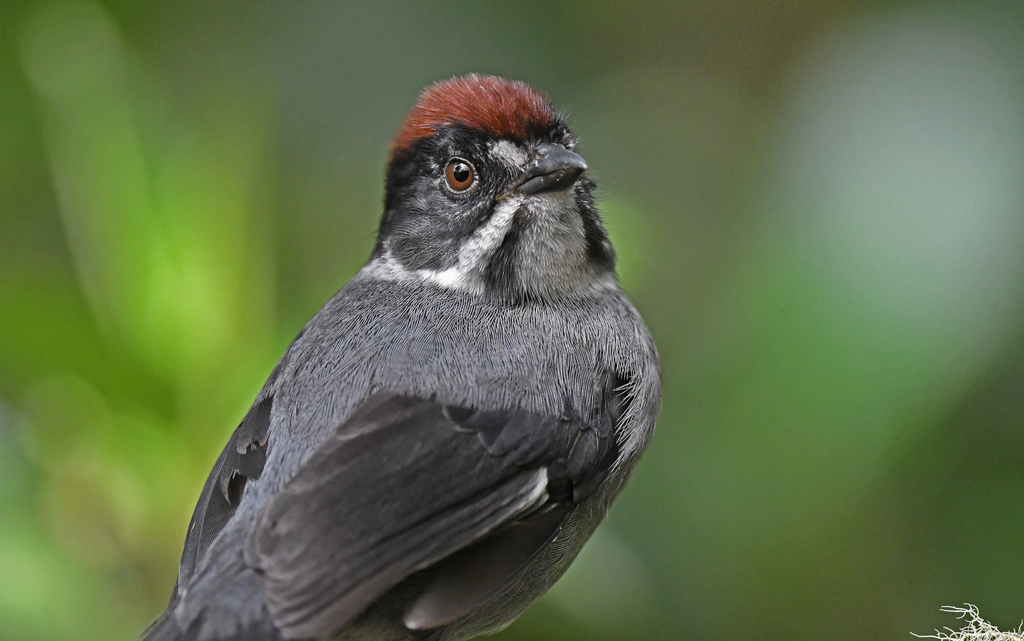
The slaty brushfinch is 17 to 18 cm (6.7 to 7.1 in) long and weighs about 23 to 44 g (0.81 to 1.6 oz). The sexes have the same plumage. Adults of the nominate subspecies A. s. schistaceus have a rusty crown and nape and a mostly black face. They have a whitish spot on the lores and a long white "moustache" with a thin black stripe below it. Their upperparts are dark gray and their tail blackish. Their wings are mostly blackish with white bases on the primaries and white marginal coverts. The last shows as a white spot on the folded wing. Their throat is whitish with dark speckles, their breast, flanks, and undertail coverts medium gray, and the center of their belly whitish. Juveniles have some black streaks in the crown and blackish streaks on the breast and flanks. Subspecies A. s. castaneifrons has a paler crown than the nominate with nearly blackish upperparts and no white on the primaries. A. s. fumidus has paler upperparts and darker underparts than castaneifrons. A. s. tamae also is like castaneifrons with darker underparts. All subspecies have a dark reddish brown iris, a blackish bill, and brown-gray legs and feet.
Range & habitat
The slaty brushfinch has a disjunct distribution. The subspecies are found thus:
A. s. fumidus: the Serranía del Perijá that straddles the Colombia-Venezuela border A. s. castaneifrons: Venezuelan Andes from northern Táchira north to far southern Lara state A. s. tamae: from southern Táchira in western Venezuela into adjoining Norte de Santander Department in eastern Colombia A. s. schistaceus: Colombia's Western and Central Andes and south on the eastern Andean slope to northern Azuay Province in central Ecuador The slaty brushfinch inhabits the shrubby edges and undergrowth of a variety of humid to wet forest types. These include elfin forest, cloudforest, and montane secondary forest. In Venezuela it also occurs above tree line in patches of trees. In elevation it ranges between 2,000 and 3,800 m (6,600 and 12,500 ft) in Venezuela, between 2,000 and 3,600 m (6,600 and 11,800 ft) in Colombia, and mostly between 2,500 and 3,400 m (8,200 and 11,200 ft) in Ecuador.
Wikipedia: “Distribution and habitat”
What it does
The slaty brushfinch feeds on a wide variety of insects, other small invertebrates, and fruits. It forages singly or in pairs and regularly joins mixed-species feeding flocks. It mostly forages in the forest undergrowth up to about 5 m (15 ft) above the ground, in contrast to many other brushfinches which forage mainly near the ground. However, it does forage as high as the canopy. It generally takes its food by gleaning.
Wikipedia: “Feeding”
Listen
Looking for field recordings…
Where it lives
Recorded sightings
—
geo-referenced records in GBIF, from museums, herbaria and field observers.
Drag the globe to turn it. Dots are where records exist, not a range map; darker means more records.
In the stacks
Searching the stacks…
Every page naming Atlapetes schistaceus in the Biodiversity Heritage Library →
This page is assembled live from iNaturalist, GBIF, Wikipedia, the Source Library and the Internet Archive. It is not yet part of the hand-edited codex. iNaturalist taxon 10333.