On eBird ↗
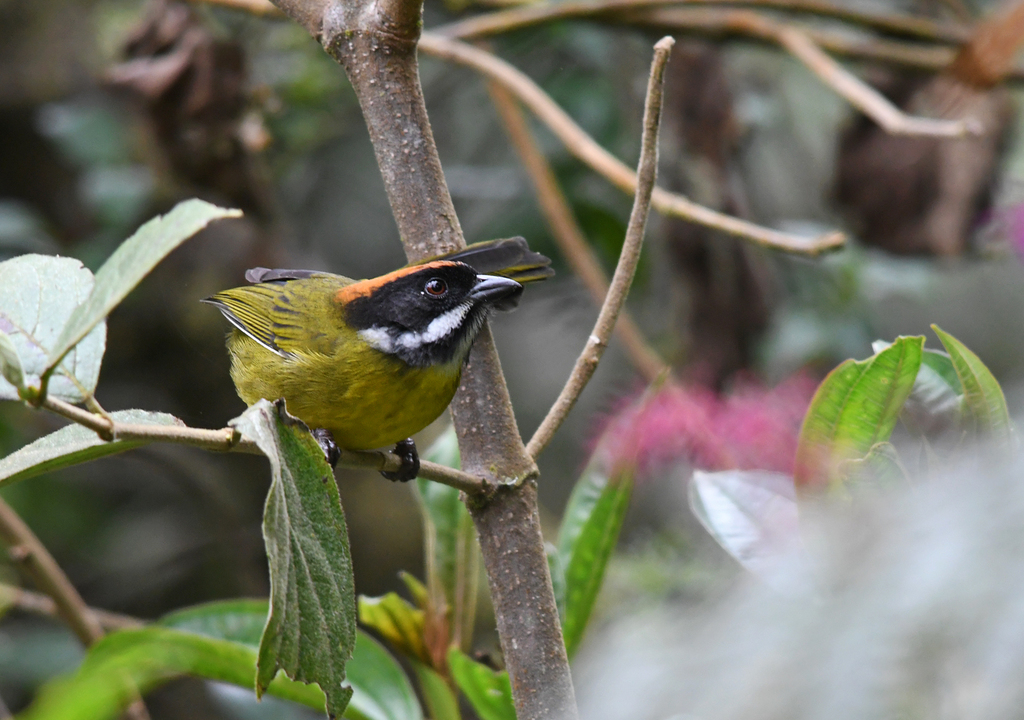
Moustached Brushfinch
Live sightings near you, the range map, bar charts of when it is seen, and Macaulay Library photos and recordings.
Moustached Brushfinch
Atlapetes albofrenatus
The moustached brushfinch (Atlapetes albofrenatus) is a species of bird in the family Passerellidae.
It is found in northern Colombia, where its natural habitats are subtropical or tropical moist montane forest and heavily degraded former forest.
From the article Moustached brushfinch on Wikipedia (CC BY-SA), quoted section by section
Description
Like most Atlapetes species, the moustached brushfinch is a large-headed, long-tailed New World sparrow. Adult. Adults are between 17.5 and 18cm in length, and weigh approximately 30g. Their upper parts are mostly olive green, with the primaries and tail being black tinged with olive. The breast, belly and vent are deep yellow, while the flanks are yellow with a greenish wash. The species has a striking head pattern, with a bright chestnut-rufous cap and nape, black forehead, and an all black mask extending from the lores to the nape. The throat and malar stripes are white, separated by black submalars. In some poses the white malar stripe can be seen to extend almost to the nape. The bill is black, the irises are red or reddish brown, and the tarsi and toes are brownish grey or pinkish grey. Juvenile. Brownish olive above, dusky olive yellowish below with faint streaking. The moustachial area is dull yellow with a weakly formed malar stripe. The mask and sides of the head are duller blackish or dusky, and the crown is olive to brownish olive (not chestnut). Similar species. The plumage of the merida brushfinch of Venezuela is distinguished from that of the moustached brushfinch by its yellow throat, a lighter crown described as cinnamon-rufous, a broader white malar stripe with a narrow black submalar, and a much narrower area of black on the forehead.
Range & habitat
The moustached brushfinch is endemic to Colombia's Eastern Andes. Its range extends from just south of Bogotá to Santander. It appears to be localized in several disjunct areas rather than being widely distributed within the overall range. It is a species of the upper tropical and subtropical zones, and thus typically occurs between 1400 and 2500m in altitude, although it has been seen as low as 1000m. The species is resident (i.e. non-migratory). The species inhabits the borders, undergrowth and midstory of thick subtropical cloud, elfin, and oak-dominated forests, as well as tangles of dry, thorny, scrubby brush. It is tolerant of disturbed habitat, and can be found in dense foliage on the borders of regenerating secondary forest.
Wikipedia: “Distribution and habitat”
What it does
Behaviour. Moustached brushfinches normally move around quickly inside dense tangles of brush, with occasional visits to more exposed positions. They have been observed foraging, mainly close to the ground (<10m), as single birds, in pairs, and in what appear to be small family groups. Diet. Insects, seeds and fruit. Breeding. The breeding behaviour of the species has not been studied. The only relevant observation that has been recorded is that of an immature bird seen near Soatá in January, suggesting that breeding takes place in the December/January period.
Wikipedia: “Behaviour and ecology”
Listen
Looking for field recordings…
Where it lives
Recorded sightings
—
geo-referenced records in GBIF, from museums, herbaria and field observers.
Drag the globe to turn it. Dots are where records exist, not a range map; darker means more records.
In the stacks
Searching the stacks…
Every page naming Atlapetes albofrenatus in the Biodiversity Heritage Library →
This page is assembled live from iNaturalist, GBIF, Wikipedia, the Source Library and the Internet Archive. It is not yet part of the hand-edited codex. iNaturalist taxon 10329.