On eBird ↗
Shining Honeycreeper
Live sightings near you, the range map, bar charts of when it is seen, and Macaulay Library photos and recordings.
Shining Honeycreeper
Cyanerpes lucidus
The shining honeycreeper (Cyanerpes lucidus) is a small bird in the tanager family. It is found in the tropical New World in Central America from southern Mexico to Panama and northwest Colombia. It is sometimes considered to be conspecific with the purple honeycreeper (C. caeruleus), but the two species breed sympatrically in eastern Panama and northwest Colombia.
From the article Shining honeycreeper on Wikipedia (CC BY-SA), quoted section by section
Description
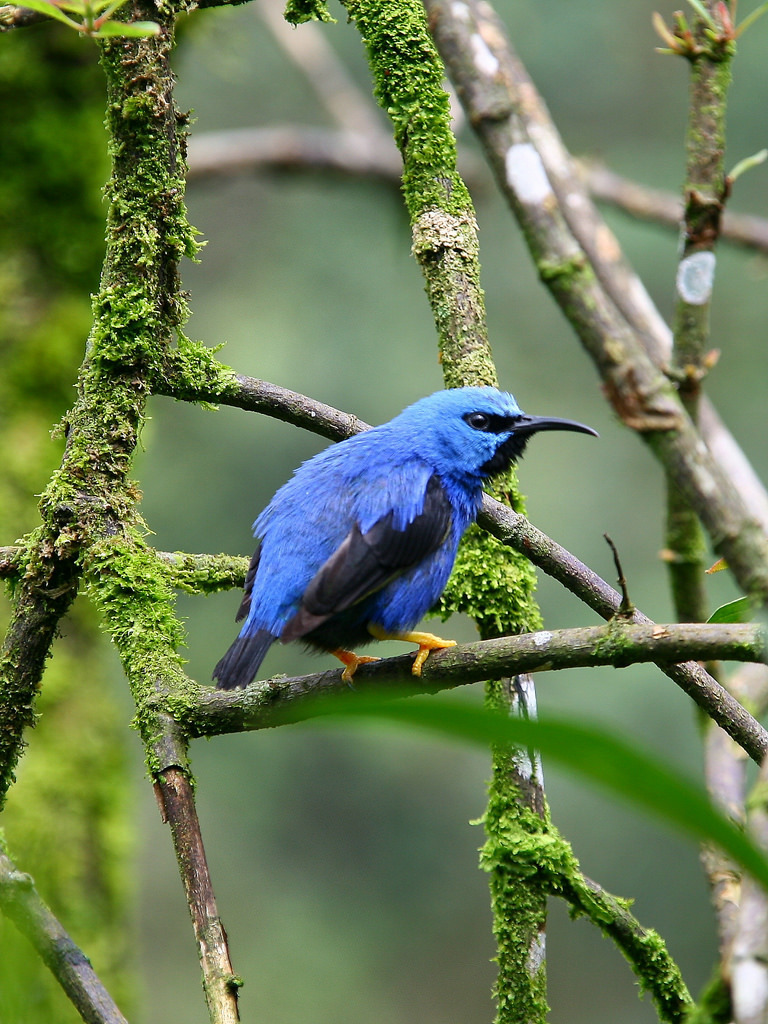
The shining honeycreeper is 10 to 11 cm (3.9 to 4.3 in) long and weighs an average of about 11 g (0.39 oz). It has a slender, decurved, longish bill and a short tail. The species is sexually dimorphic. Adult males of the nominate subspecies are mostly ultramarine blue. They have a lighter, more azure head with a small black mask from the lores to just past the eye, a black throat and upper breast, and black wings and tail. Adult females have a mostly grass-green head with a grayish blue or greenish crown and nape with some thin white stripes on the forecrown, brownish dusky lores, and a blue malar stripe. Their upperparts, wings, and tail are dull grass green. Their chin and throat are buff. Their breast, sides, flanks, belly, and undertail coverts are grayish green with blue streaks on the breast. Their underwing coverts are dull yellow. Subspecies C. l. isthmicus is smaller than the nominate and has a thinner and shorter bill. The male's overall blue is darker than the nominate's with a significantly lighter blue head. Females have duller green upperparts and a less bluish crown and nape than the nominate. Both sexes of both subspecies have a dark brown iris and a black bill. Males' legs and feet are bright yellow and females' yellowish green or light green with a thin yellow line down the back of the leg.
Range & habitat
The shining honeycreeper has a disjunct distribution that is not shown on the map. The nominate subspecies is the more northerly of the two and has a somewhat larger range. It is found from eastern Chiapas in southern Mexico south on the Caribbean slope through Belize, Guatemala, and Honduras into northern Nicaragua. It occurs very spottily rather than continuously in Belize, Guatemala, and Honduras. Subspecies C. l. isthmicus is found on the Caribbean slope from far southern Nicaragua through Costa Rica and western Panama and from there across all of Panama into extreme northwestern Colombia's Chocó Department. It separately occurs on the Pacific slope from central Puntarenas and western San José provinces in Costa Rica into western Panama. The species inhabits the interior and edges of evergreen forest and secondary forest in the lowlands of the tropical and lower subtropical zones. Overall it ranges in elevation from sea level to 1,500 m (4,900 ft) but reaches only 1,200 m (3,900 ft) in Costa Rica and 100 m (300 ft) in Colombia.
Wikipedia: “Distribution and habitat”
What it does
The shining honeycreeper feeds on fruit, insects, and nectar. It forages mostly in the forest canopy, usually in pairs and often as part of a mixed-species feeding flock. It takes most insect prey by gleaning from foliage and twigs but also takes it in mid-air with a sally from a perch.
Wikipedia: “Feeding”
Listen
Looking for field recordings…
Where it lives
Recorded sightings
—
geo-referenced records in GBIF, from museums, herbaria and field observers.
Drag the globe to turn it. Dots are where records exist, not a range map; darker means more records.
In the stacks
Searching the stacks…
Every page naming Cyanerpes lucidus in the Biodiversity Heritage Library →
This page is assembled live from iNaturalist, GBIF, Wikipedia, the Source Library and the Internet Archive. It is not yet part of the hand-edited codex. iNaturalist taxon 10264.