On eBird ↗
Lazuli Bunting
Live sightings near you, the range map, bar charts of when it is seen, and Macaulay Library photos and recordings.
Lazuli Bunting
Passerina amoena
The lazuli bunting (Passerina amoena) is a North American songbird named for the gemstone lapis lazuli.
From the article Lazuli bunting on Wikipedia (CC BY-SA), quoted section by section
Description
Measurements:
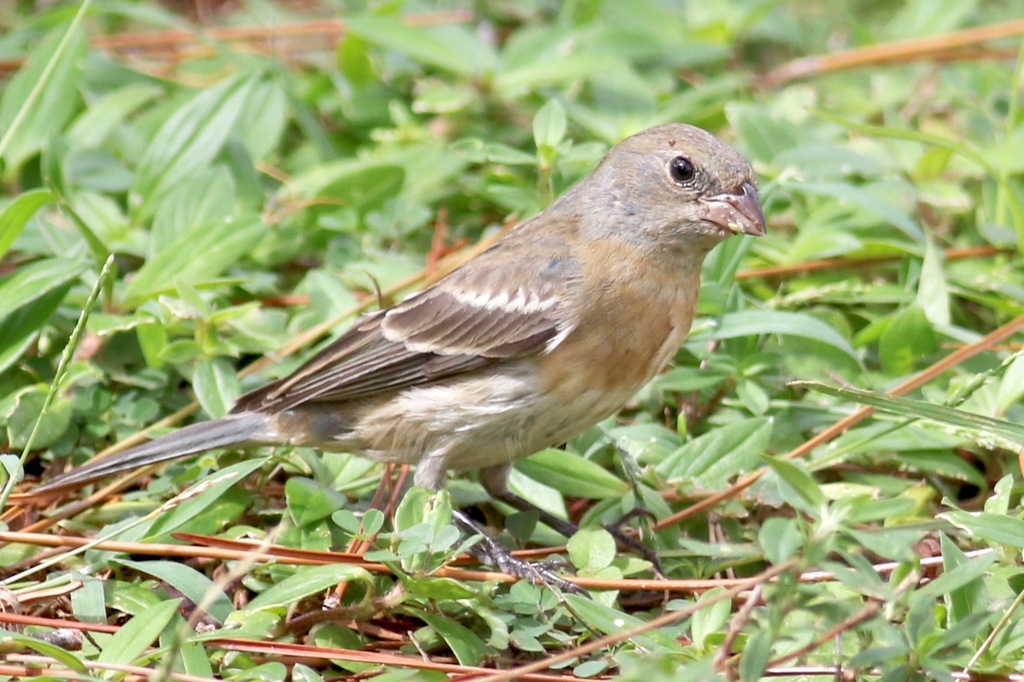
Length: 5.1–5.9 in (13–15 cm) Weight: 0.5–0.6 oz (13–18 g) Wingspan: 8.7 in (22 cm) The male is easily recognized by its bright blue head and back (lighter than the closely related indigo bunting), its conspicuous white wingbars, and its light rusty breast and white belly. The color pattern may suggest the eastern and western bluebirds, but the smaller size (13–15 cm or 5–5.9 inches long), wingbars, and short and conical bunting bill quickly distinguish it. The female is brown, grayer above and warmer underneath, told from the female indigo bunting by two thin and pale wingbars and other plumage details.
Range & habitat
Lazuli buntings breed mostly west of the 100th meridian from southern Canada to northern Texas, central New Mexico and Arizona, and southern California. On the Pacific coast their breeding range extends south to extreme northwestern Baja California. They migrate to southeastern Arizona and Mexico. Their habitat is brushy areas and sometimes weedy pastures, generally well-watered, and sometimes in towns.
Wikipedia: “Distribution and habitat”
What it does
They eat mostly seeds and insects. They may feed conspicuously on the ground or in bushes, but singing males are often very elusive in treetops.
Wikipedia: “Diet”
Listen
Looking for field recordings…
Where it lives
Recorded sightings
—
geo-referenced records in GBIF, from museums, herbaria and field observers.
Drag the globe to turn it. Dots are where records exist, not a range map; darker means more records.
In the stacks
Searching the stacks…
Every page naming Passerina amoena in the Biodiversity Heritage Library →
This page is assembled live from iNaturalist, GBIF, Wikipedia, the Source Library and the Internet Archive. It is not yet part of the hand-edited codex. iNaturalist taxon 10234.