On eBird ↗
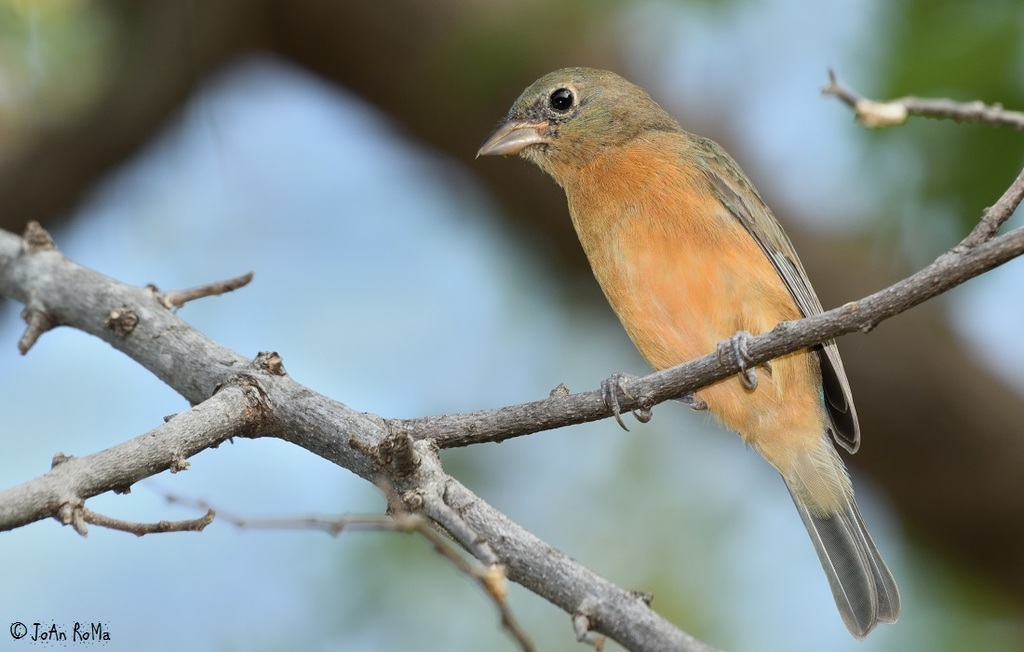
Rose-bellied Bunting
Live sightings near you, the range map, bar charts of when it is seen, and Macaulay Library photos and recordings.
Rose-bellied Bunting
Passerina rositae
The rose-bellied bunting or Rosita's bunting (Passerina rositae) is a species of bird in the family Cardinalidae, the cardinals or cardinal grosbeaks. It is endemic to a very small area of southern Mexico.
From the article Rose-bellied bunting on Wikipedia (CC BY-SA), quoted section by section
Description
The rose-bellied bunting is 13.5 to 14.5 cm (5.3 to 5.7 in) long and weighs 19.5 to 20.5 g (0.69 to 0.72 oz). The adult male's crown is purplish-blue, and it is electric blue on the rest of its upperparts that fades from darker to lighter towards the tail. Its chin is grayish, the throat and chest blue, and the belly and vent area salmon pink. The adult female's head and upperparts are gray-brown with a bluish tinge at the rump. Its undersides are pinkish buff, warmer on the throat becoming paler towards the lower belly.
Range & habitat
The rose-bellied bunting's core range is a narrow strip along the Pacific slope of the Isthmus of Tehuantepec in eastern Oaxaca and western Chiapas. There is one additional record further east in Chiapas, in El Triunfo Biosphere Reserve. It inhabits arid to semiarid thorn forest, moister gallery forest, and swamp forest. In elevation it ranges from 180 to 800 m (590 to 2,620 ft).
Wikipedia: “Distribution and habitat”
What it does
The rose-bellied bunting forages alone or in pairs in the lower to mid-level of its habitat. Its diet consists of seeding grasses and fruit from trees and bushes.
Wikipedia: “Feeding”
Listen
Looking for field recordings…
Where it lives
Recorded sightings
—
geo-referenced records in GBIF, from museums, herbaria and field observers.
Drag the globe to turn it. Dots are where records exist, not a range map; darker means more records.
In the stacks
Searching the stacks…
Every page naming Passerina rositae in the Biodiversity Heritage Library →
This page is assembled live from iNaturalist, GBIF, Wikipedia, the Source Library and the Internet Archive. It is not yet part of the hand-edited codex. iNaturalist taxon 10233.