On eBird ↗
Indigo Bunting
Live sightings near you, the range map, bar charts of when it is seen, and Macaulay Library photos and recordings.
Indigo Bunting
Passerina cyanea
The indigo bunting (Passerina cyanea) is a small seed-eating bird in the cardinal family, Cardinalidae. It is migratory, ranging from southern Canada to northern Florida during the breeding season, and from southern Florida to northern South America during the winter. It often migrates by night, using the stars to navigate. Its habitat is farmland, brush areas, and open woodland. The indigo bunting is closely related to the lazuli bunting and interbreeds with the species where their ranges overlap.
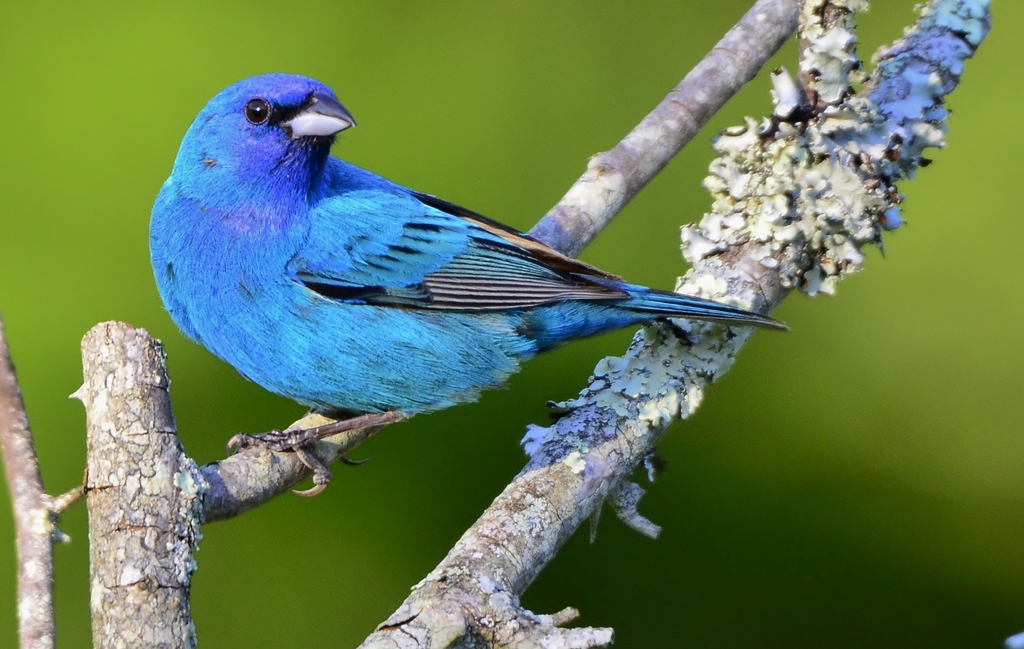
The indigo bunting is a small bird, measuring 11.5–13 cm (4.5–5.1 in) in length. It displays sexual dimorphism in its coloration; the male is vibrant blue in the summer, with brightly colored plumage during the breeding season to attract a mate. It is brown during the winter months, while the female is brown year-round. Nest-building and incubation are done solely by the female. The diet of the indigo bunting consists primarily of insects during the summer months and seeds during the winter months.
From the article Indigo bunting on Wikipedia (CC BY-SA), quoted section by section
Description
The indigo bunting is a smallish songbird, around the size of a small sparrow. It measures 11.5–15 cm (4.5–5.9 in) long, with a wingspan of 18–23 cm (7.1–9.1 in). Body mass averages 14.5 g (0.51 oz), with a reported range of 11.2–21.4 g (0.40–0.75 oz). During the breeding season, the adult male appears mostly a vibrant cerulean blue. Only the head is indigo. The wings and tail are black with cerulean blue edges. In fall and winter plumage, the male has brown edges to the blue body and head feathers, which overlap to make the bird appear mostly brown. The adult female is brown on the upperparts and lighter brown on the underparts. It has indistinct wing bars and is faintly streaked with darker markings underneath. The immature bird resembles the female in coloring, although a male may have hints of blue on the tail and shoulders and have darker streaks on the underside. The beak is short and conical. In the adult female, the beak is light brown tinged with blue, and in the adult male the upper half is brownish-black while the lower is light blue. The feet and legs are black or gray. First years and adult males are distinguishable through close observations of the skull and its degree of ossification. Juvenile skulls have a slightly pinkish color that gives under pressure due to its singular layer. …
Range & habitat
The habitat of the indigo bunting is brushy forest edges, open deciduous woods, second growth woodland, and farmland. Increases in population size have been seen in the event of forest clearings and development of land into farms. The breeding range stretches from southern Canada to Maine, south to northern Florida and eastern Texas, and westward to southern Nevada. The winter range begins in southern Florida and central Mexico and stretches south through the West Indies and Central America to northern South America. It has occurred as a vagrant in Antigua and Barbuda, Barbados, Denmark, Ecuador, Germany, Iceland, Ireland, Netherlands, the Netherlands Antilles, Saint Pierre and Miquelon, Serbia and the United Kingdom.
Wikipedia: “Distribution and habitat”
What it does
The indigo bunting forages for food on the ground or in trees or shrubs. In winter, it often feeds in flocks with other indigo buntings, but is a solitary feeder during the breeding season. During the breeding season, the species eats seeds of grasses and herbs, berries, spiders and insects, including caterpillars, grasshoppers, true bugs, and beetles. The seeds of grasses are the mainstay of its diet during the winter, although buds and insects are eaten when available. The young are fed mainly insects at first, to provide them with protein. The indigo bunting does not drink frequently, generally obtaining sufficient water from its diet.
Wikipedia: “Diet”
Listen
Looking for field recordings…
Where it lives
Recorded sightings
—
geo-referenced records in GBIF, from museums, herbaria and field observers.
Drag the globe to turn it. Dots are where records exist, not a range map; darker means more records.
In the stacks
Searching the stacks…
Every page naming Passerina cyanea in the Biodiversity Heritage Library →
This page is assembled live from iNaturalist, GBIF, Wikipedia, the Source Library and the Internet Archive. It is not yet part of the hand-edited codex. iNaturalist taxon 10227.