On eBird ↗
Yellow-throated Chlorospingus
Live sightings near you, the range map, bar charts of when it is seen, and Macaulay Library photos and recordings.
Yellow-throated Chlorospingus
Chlorospingus flavigularis
The yellow-throated bush tanager (Chlorospingus flavigularis) is a species of bird traditionally placed in the family Thraupidae, but now closer to Arremonops in the Emberizidae. It is found in Bolivia, Colombia, Ecuador, Panama, and Peru.
From the article Yellow-throated chlorospingus on Wikipedia (CC BY-SA), quoted section by section
Description
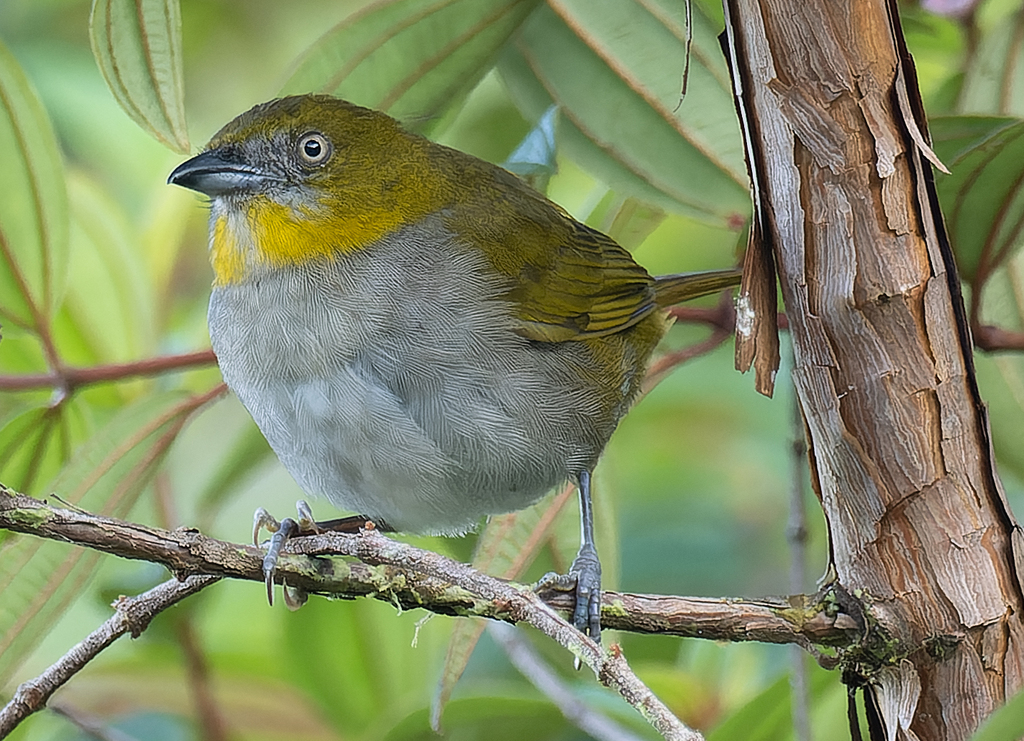
The two subspecies of the "yellow-throated" group of the yellow-throated chlorospingus are about 15 cm (5.9 in) long and weigh 21.5 to 31 g (0.76 to 1.1 oz). The sexes have the same plumage. Adults of the nominate subspecies C. f. flavigularis have gray lores. Their rest of their face and their crown, nape, upperparts, and tail are yellowish olive. Their flight feathers are dusky with dull yellow edges. Their throat is yellow, with the color extending sideways onto the neck. The rest of their underparts are pale gray that is lightest on the belly center and has an olive tinge on the flanks and undertail coverts. They have a hazel iris, a dusky maxilla, a grayish mandible with a dusky tip, and dark gray legs and feet. Subspecies C. f. marginatus has a brownish gray center of the throat with yellow edges; its underparts are also brownish gray. Its iris is gray. Subspecies C. f. hypophaeus is smaller and lighter than the nominate and marginatus. It is about 12 to 13 cm (4.7 to 5.1 in) long and weighs 15 to 20 g (0.53 to 0.71 oz). Adults have gray lores. Their rest of their face and their crown, nape, upperparts, and tail are brownish olive to yellowish green. Their flight feathers are dusky with dull yellow edges. Their throat is orange-yellow, their breast brownish to pinkish buff, their sides and flanks grayish olive, and the rest of their underparts whitish. …
Range & habitat
The yellow-throated chlorospingus has a disjunct distribution. Each subspecies is separate from the others and some have gaps within their overall range. Subspecies C. f. hypophaeus is the northernmost of the three. It is found in Panama from Bocas del Toro Province to Coclé Province and separately in western Guna Yala (formerly called San Blas Province). It also apparently is found on Cerro Tacarcuna in extreme northwestern Colombia on the Panama border. Subspecies C. f. marginatus is found intermittently on the western slope of Colombia's Western Andes from Valle del Cauca Department south and continuing essentially continuously along the western slope in Ecuador to El Oro Province. The nominate subspecies is found in the far northern end of Colombia's Western Andes, on both slopes of the Central Andes in Antioquia Department, and on the eastern slope of the Eastern Andes from Boyacá Department south. Its range continues south on the eastern Andean slope through Ecuador and intermittently in Peru to Puno Department. It is also found on the isolated Serranía de San Lucas in northern Colombia. The yellow-throated chlorospingus inhabits montane and lowland evergreen forest and secondary forest in the tropical and lower subtropical zones. In most areas it tends to favor the forest understory and its edges. …
Wikipedia: “Distribution and habitat”
What it does
The two South American subspecies of the yellow-throated chlorospingus feed on berries, fruit, and insects. They forage in pairs or groups of up to about 12 and often join mixed-species feeding flocks. They forages mostly in the forest's lower to middle levels but do ascend higher at times. It takes most food by gleaning from leaves, branches, moss, and vines while perched. The diet of C. f. hypophaeus has not been studied but is assumed to be similar to that of the other subspecies. It tends to forage higher than the others but otherwise in the same manner.
Wikipedia: “Feeding”
Listen
Looking for field recordings…
Where it lives
Recorded sightings
—
geo-referenced records in GBIF, from museums, herbaria and field observers.
Drag the globe to turn it. Dots are where records exist, not a range map; darker means more records.
In the stacks
Searching the stacks…
Every page naming Chlorospingus flavigularis in the Biodiversity Heritage Library →
This page is assembled live from iNaturalist, GBIF, Wikipedia, the Source Library and the Internet Archive. It is not yet part of the hand-edited codex. iNaturalist taxon 10213.