On eBird ↗
Sooty-capped Chlorospingus
Live sightings near you, the range map, bar charts of when it is seen, and Macaulay Library photos and recordings.
Sooty-capped Chlorospingus
Chlorospingus pileatus
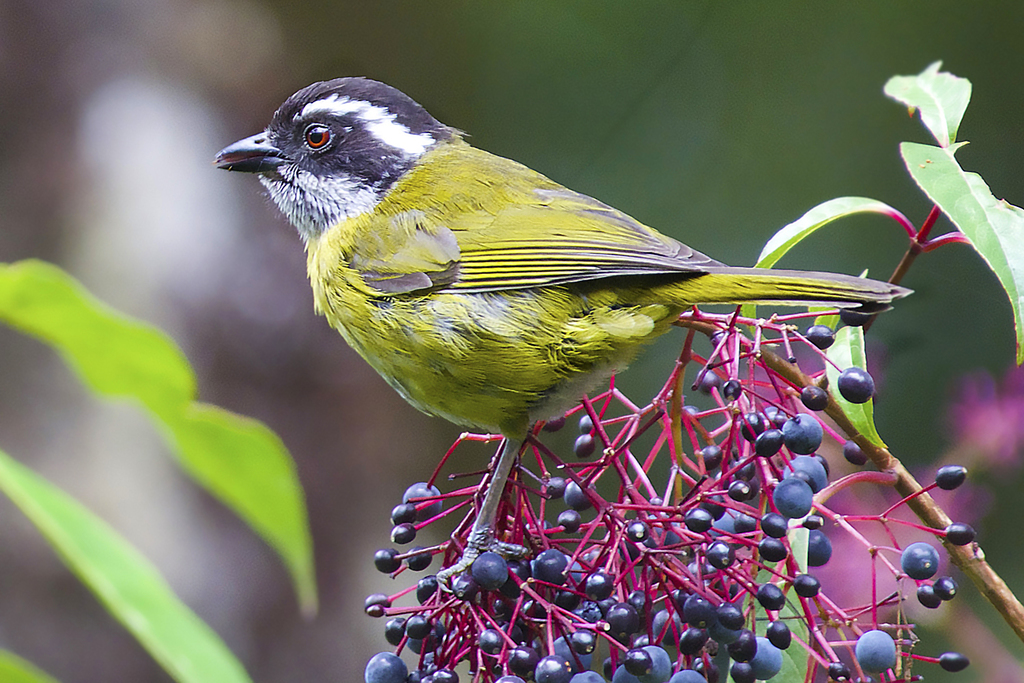
The sooty-capped bush tanager (Chlorospingus pileatus) is a small passerine bird traditionally placed in the family Thraupidae, but now viewed closer to Arremonops in the Emberizidae. This bird is an endemic resident breeder in the highlands of Costa Rica and western Panama.
From the article Sooty-capped chlorospingus on Wikipedia (CC BY-SA), quoted section by section
Description
The sooty-capped chlorospingus is 13 to 14 cm (5.1 to 5.5 in) long and weighs about 16 to 24 g (0.56 to 0.85 oz). The sexes have the same plumage. Adults have a mostly sooty black head with a bold jagged white stripe from above the eye back and down the neck; its shape has been likened to a lightning bolt. Their upperparts and tail are olive. Their flight feathers are dusky with olive-yellow edges. Their throat is whitish with many, though inconspicuous, black specks. The most common color morph has a wide band of olive-yellow across the breast that extends along the sides, flanks, and undertail coverts. The center of its lower breast and its belly are yellowish white. A less common morph, found only on two volcanoes in Costa Rica, is duller and grayer overall than the common morph and has grayish olive underparts. Both morphs have a reddish brown iris, a blackish bill, and dull brownish to fuscous black legs and feet.
Range & habitat
The sooty-capped chlorospingus is found on several isolated volcanoes in north-central Costa Rica's Cordillera de Tilarán, in the Cordillera de Talamanca from south-central Costa Rica into northern Panama's Chiriquí Province, and on isolated volcanoes further south in Chiriquí. Its range is within that of the very widespread common chlorospingus (C. opthamalicus) but they are separable by their head patterns and mostly different elevational habitats. The sooty-capped chlorospingus inhabits montane evergreen forest, elfin forest, and mature secondary forest in the subtropical and lower temperate zones. In elevation it ranges overall between 1,500 and 3,000 m (4,900 and 9,800 ft). In Costa Rica it is found mostly above 2,000 m (6,600 ft).
Wikipedia: “Distribution and habitat”
What it does
The sooty-capped chlorospingus feeds on small arthropods and fruits. In the breeding season it forages in pairs or groups of up to about six individuals; outside that season it sometimes associates in groups of up to about 40 individuals. In both seasons it regularly joins mixed-species feeding flocks. It flicks its wings and tail while foraging. It feeds mostly from the forest's understory to its mid-level, seeking food in dense shrubs, on moss branches, in bromeliads, and in clusters of dead leaves.
Wikipedia: “Feeding”
Listen
Looking for field recordings…
Where it lives
Recorded sightings
—
geo-referenced records in GBIF, from museums, herbaria and field observers.
Drag the globe to turn it. Dots are where records exist, not a range map; darker means more records.
In the stacks
Searching the stacks…
Every page naming Chlorospingus pileatus in the Biodiversity Heritage Library →
This page is assembled live from iNaturalist, GBIF, Wikipedia, the Source Library and the Internet Archive. It is not yet part of the hand-edited codex. iNaturalist taxon 10212.