On eBird ↗
Lanai Hookbill
Live sightings near you, the range map, bar charts of when it is seen, and Macaulay Library photos and recordings.
Lanai Hookbill
Dysmorodrepanis munroi
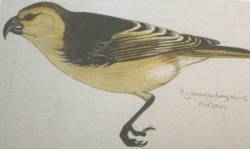
The Lānaʻi hookbill (Dysmorodrepanis munroi) is an extinct species of Hawaiian honeycreeper. It was endemic to the island of Lānaʻi in Hawaiʻi, and was last seen in the southwestern part of the island. George C. Munro collected the only known specimen of this species in 1913, which is housed in the Bernice P. Bishop Museum in Honolulu, and saw the species only twice more, once in 1916 and for a final time in 1918. No other sightings have been reported. They inhabited montane dry forests dominated by ʻakoko (Euphorbia species) and ōpuhe (Touchardia sandwicensis). The Lānaʻi hookbill was monotypic within the genus Dysmorodrepanis and had no known subspecies. Its closest relative is believed to be the ʻōʻū, and some early authors suggested that the Lānaʻi hookbill was merely a deformed ʻōʻū. The Lānaʻi hookbill was a plump, medium-sized bird with greenish olive upperparts and pale whitish yellow underparts. It also had a yellow or white superciliary line and a white chin and throat. The wings also had a distinctive and conspicuous white wing patch. The hookbill's distinguishing characteristic was its heavy, parrotlike bill, which had the mandibles hooking sharply towards each other, leaving a gap between them when the beak was closed.
As the bird became extinct before significant field observations could be made, not much is known about its behavior. The Lānaʻi hookbill is only known to have eaten the fruit of the ōpuhe; however, it is unlikely that its unique bill would have developed to eat fruit, and it may have been a snail specialist.
From the article Lānaʻi hookbill on Wikipedia (CC BY-SA), quoted section by section
Description
The Lānaʻi hookbill was a plump, medium-sized bird. It was about 6 inches (15 cm) in length, and the weight is unknown. It had greenish olive upperparts and pale whitish yellow underparts, as well as a yellow or white superciliary line. The chin and throat were white. The wings' secondaries had a distinctive and conspicuous white wing patch. Due to the subdued colors of the sole specimen, it is believed that it was a female, suggesting that the male would have had a brighter plumage, especially in the superciliary line. The eyes, which were large for a bird of the hookbill's size, were dark brown and the muscular legs were gray with yellow toepads. The hookbill's distinguishing characteristic was a heavy, parrotlike bill. The upper mandible hooked sharply downwards, while the heavy lower mandible hooked sharply upwards towards the middle of the upper mandible. This structure left a gap between the two mandibles when the bird held its beak closed. It is believed that the bill was pale pink in coloration. The jaw muscles were particularly well developed around the bill. The hookbill's tongue was primitive and nontubular. Like other Hawaiian honeycreepers, the hookbill possessed a distinctive musty odor. …
Range & habitat
The Lānaʻi hookbill was endemic to the island of Lānaʻi in Hawaii. All recorded sightings of the species were made from the southwestern end of Lānaʻi's forests, which included the Kaiholena Valley and Waiakeakua. These sightings were between 2,000 and 2,600 feet (610 and 790 m) in elevation. However, the species' habitat once covered thousands of acres on Lānaʻi, and it is possible that the species once had a broader range on the island. The species was non-migratory. It is believed that the Lānaʻi hookbill inhabited montane dry forests on Lānaʻi dominated by ʻakoko (Euphorbia species) and ōpuhe (Touchardia sandwicensis). The unique shape of the hookbill's bill, particularly when compared with the ʻōʻū's bill, and its apparent rarity suggested that the species was an extreme specialist and was therefore restricted to this habitat.
Wikipedia: “Distribution and habitat”
What it does
The Lānaʻi hookbill is only known to have eaten the fruit of the ōpuhe. The type specimen was caught while feeding on the plant, and its berries were subsequently discovered in its stomach. It is considered likely that the hookbill additionally ate ʻakoko fruits due to their similarity in size and shape to those of the ōpuhe. However, the hookbill's unique bill is considered unlikely to have evolved if the species was purely frugivorous, and it has been suggested that the hookbill specialized in eating snails. The species was very active while searching for food, constantly flying from tree to tree. While perched it shifted restlessly. Based upon the structure of the bill, it has been suggested that this unique bill was used as a pincer, with the tips of both mandibles touching. The hookbill could have used this movement to pluck fruits or flowers for consumption, or it may have been used to extract snails from their shells. It is also possible that the bird could have crushed a snail shell between its mandibles and then used its tongue to ingest the meat and expel the shell out of the open sides of the beak. There is no recorded information on the Lānaʻi hookbill's breeding behavior. …
Wikipedia: “Ecology and behavior”
Listen
Looking for field recordings…
Where it lives
Recorded sightings
—
geo-referenced records in GBIF, from museums, herbaria and field observers.
Drag the globe to turn it. Dots are where records exist, not a range map; darker means more records.
In the stacks
Searching the stacks…
Every page naming Dysmorodrepanis munroi in the Biodiversity Heritage Library →
This page is assembled live from iNaturalist, GBIF, Wikipedia, the Source Library and the Internet Archive. It is not yet part of the hand-edited codex. iNaturalist taxon 10203.