On eBird ↗
Grassland Sparrow
Live sightings near you, the range map, bar charts of when it is seen, and Macaulay Library photos and recordings.
Grassland Sparrow
Ammodramus humeralis
The grassland sparrow (Ammodramus humeralis) is a species of bird in the family Passerellidae. It is found in Argentina, Bolivia, Brazil, Colombia, French Guiana, Guyana, Paraguay, Peru, Suriname, Uruguay, and Venezuela. Its natural habitats are dry savannah, subtropical or tropical seasonally wet or flooded lowland grassland, and pastureland.
From the article Grassland sparrow on Wikipedia (CC BY-SA), quoted section by section
Description
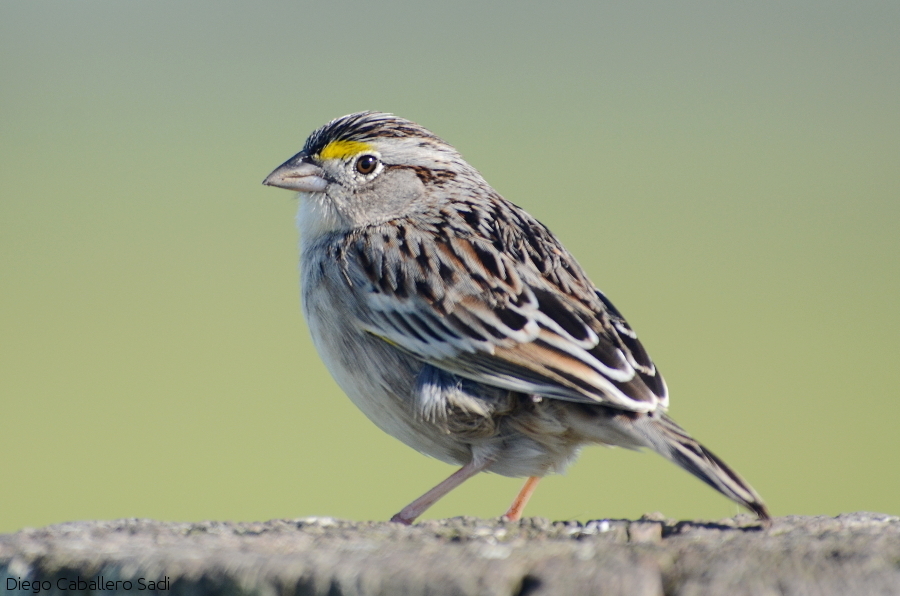
The grassland sparrow is a robust species with a large head and a short tail, with a total length of about 13 cm (5 in). The wings are short and the legs fairly long. The upper parts are brownish-grey streaked with black. The breast and flanks are greyish-buff or pinkish-buff and the underparts are dull white. There is a narrow white eye-ring, and a spot of yellow on the lores and another on the bend of the wing. The song is a high-pitched but thin series of plaintive phrases, "eee, telee, teeeee". This bird is similar in appearance to the yellow-browed sparrow, but that has more yellow on the face and the voice is quite distinct.
Range & habitat
This sparrow is native to the western half of South America. Its range includes Argentina, Bolivia, Brazil, Colombia, French Guiana, Guyana, Paraguay, Peru, Suriname, Uruguay and Venezuela. Its typical habitat is tall savannah grassland, but it also inhabits pastureland and cerrado. It is present in lowland areas and at altitudes of up to 1,100 m (3,600 ft), possibly higher in southern Venezuela.
Wikipedia: “Distribution and habitat”
What it does
A "secretive" bird, this species feeds on the ground and flits away into the vegetation if disturbed. It can be observed when singing from an elevated perch, and feeds out in the open in the early morning and late evening. The diet consists of grass and other seeds, and small insects are also eaten, particularly during the breeding season. The nest is cup-shaped and built on the ground, with a runway through the foliage leading to it.
Wikipedia: “Behavior”
Listen
Looking for field recordings…
Where it lives
Recorded sightings
—
geo-referenced records in GBIF, from museums, herbaria and field observers.
Drag the globe to turn it. Dots are where records exist, not a range map; darker means more records.
In the stacks
Searching the stacks…
Every page naming Ammodramus humeralis in the Biodiversity Heritage Library →
This page is assembled live from iNaturalist, GBIF, Wikipedia, the Source Library and the Internet Archive. It is not yet part of the hand-edited codex. iNaturalist taxon 10134.