On eBird ↗
Chestnut-headed Oropendola
Live sightings near you, the range map, bar charts of when it is seen, and Macaulay Library photos and recordings.
Chestnut-headed Oropendola
Psarocolius wagleri
The chestnut-headed oropendola (Psarocolius wagleri) is a species of bird in the family Icteridae, the oropendolas, New World orioles, and New World blackbirds. It is found in Mexico, in every Central American country except El Salvador, and in Colombia and Ecuador.
From the article Chestnut-headed oropendola on Wikipedia (CC BY-SA), quoted section by section
Description
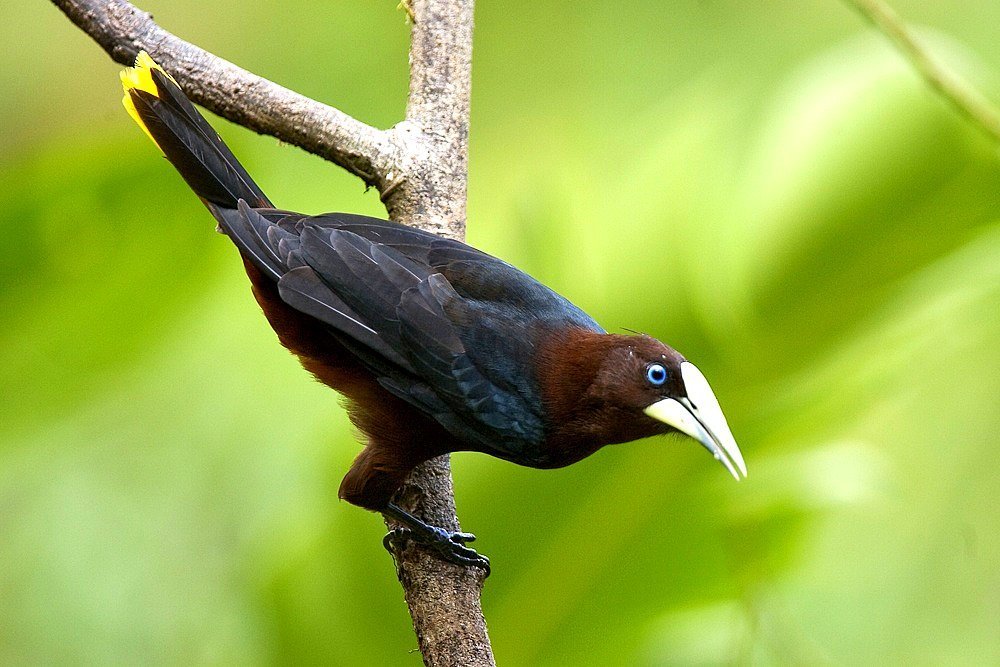
Chestnut-headed oropendola males average 35 cm (14 in) long and females 28 cm (11 in). Males weigh an average of 214 g (7.5 oz) and females 113 g (4.0 oz). The species looks very long-winged in flight. Males have a slight crest. Adult males of the nominate subspecies have a dark purplish chestnut head, throat, and upper breast. Their body and wings are mostly black with a bluish gloss. Their rump and uppertail coverts are dark chestnut and their rear flanks and undertail coverts a medium chestnut. Their central pair of tail feathers are black and the rest yellow with black edges on the outermost pair. Females are much like males but have duller colors. Subspecies P. w. ridgwayi is much like the nominate but has paler chestnut parts. Both sexes of both subspecies have very large bill with a swollen casque; it is ivory-colored with a pale bluish to gray tip and tomium and sometimes an overall pale greenish tinge. They have a pale blue iris and black legs and feet. Juveniles are duller than adults and have brownish eyes, a brownish bill, and some yellow feathers on the forehead.
Range & habitat
The nominate subspecies of the chestnut-headed oropendola is the more northerly of the two. It is found on the Gulf/Caribbean slope from Veracruz and northern Oaxaca in southeastern Mexico south through Belize, eastern Guatemala, and eastern Honduras into northeastern Nicaragua. However, it is not on the Yucatán Peninsula. Subspecies P. w. ridgwayi is found throughout southern Nicaragua, along the Caribbean and lower Pacific slopes of Costa Rica, throughout Panama, and into northern Colombia. There its range extends east to the Serranía de las Quinchas and Serranía de San Lucas and south along the Pacific slope into northwestern Ecuador to northern Manabí Province. There are also scattered records in Ecuador south to El Oro Province. The chestnut-headed oropendola inhabits evergreen forest and secondary forest in the tropical and lower subtropical zones. It also occurs in plantations and suburban areas and in northern Central America sometimes at the edges of pine-oak forest. In Mexico and Central America it ranges in elevation from sea level to about 1,700 m (5,600 ft). In Colombia it reaches 1,300 m (4,300 ft) and in Ecuador 700 m (2,300 ft).
Wikipedia: “Distribution and habitat”
What it does
The chestnut-headed oropendola feeds primarily on small vertebrates such as frogs and lizards. Insects, other arthropods, fruit, and nectar are also significant components of its diet. It usually forages from the forest's mid-story to its canopy, and typically in flocks of up to 15 individuals.
Wikipedia: “Feeding”
Listen
Looking for field recordings…
Where it lives
Recorded sightings
—
geo-referenced records in GBIF, from museums, herbaria and field observers.
Drag the globe to turn it. Dots are where records exist, not a range map; darker means more records.
In the stacks
Searching the stacks…
Every page naming Psarocolius wagleri in the Biodiversity Heritage Library →
This page is assembled live from iNaturalist, GBIF, Wikipedia, the Source Library and the Internet Archive. It is not yet part of the hand-edited codex. iNaturalist taxon 10125.