- Plants
- ›Vascular Plants
- ›flowering plants
- ›Dicots
- ›Legumes, Milkworts, and Allies
- ›Legumes
- ›Faboideae
- ›milkvetches, locoweeds, and allies
- ›Astragalus
- ›Platonychium
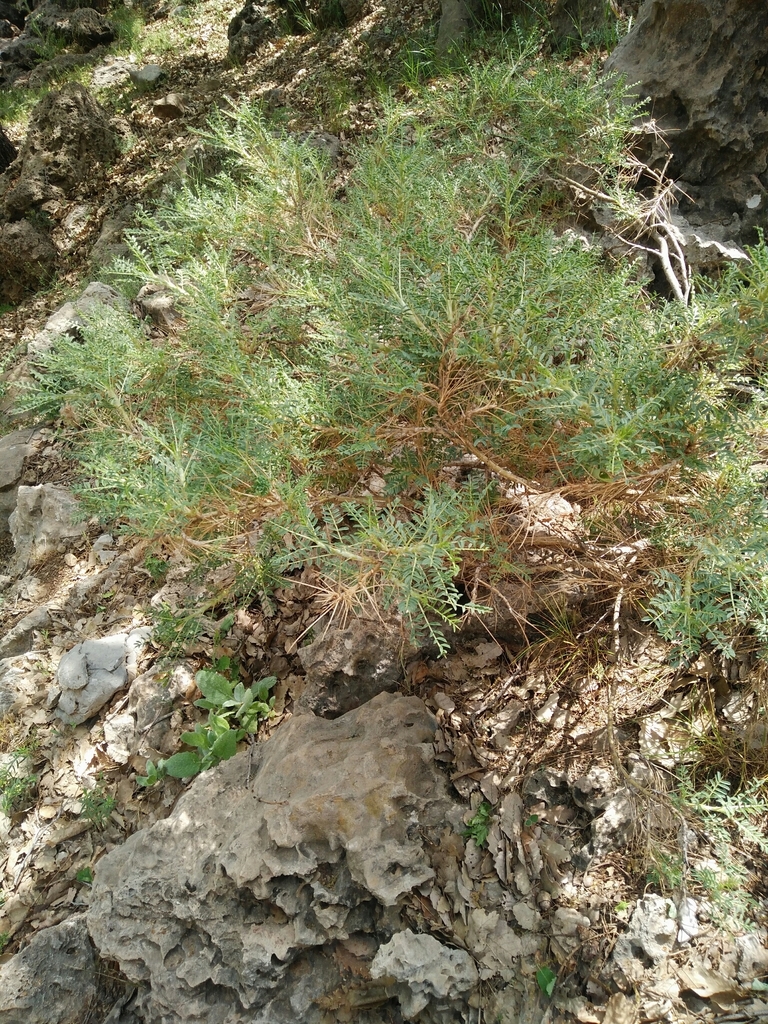
Gum Tragacanth Milkvetch
Astragalus gummifer
Astragalus gummifer (tragacanth, gum tragacanth milkvetch), is a small woody evergreen shrub, with a typical height and spread of 30 cm at maturity, indigenous to western Asia, specifically Iran, Iraq and Turkey. This nitrogen fixing plant bears hermaphroditic flowers, which are bee-pollinated. It has many medical, culinary, and material uses.
From the article Astragalus gummifer on Wikipedia (CC BY-SA), quoted section by section
Description
This species is shrubby, with small branches and short woody gray stem surrounded by thorns. The compound leaves are stipulate with elliptical leaflets (pinnae) borne in opposite pairs. The rachis of the leaf is extended into a sharp thorn.
Range & habitat
Astragalus gummifer is native to temperate regions of Western Asia centralized in Iran, Iraq, Lebanon, Syria, and Turkey but also found in Tajikastan, Afghanistan, Pakistan, and Russia.
Wikipedia: “Distribution”
What it does
Astragalus gummifer finds dry sub-alpine slopes and valleys habitable typically 1200–2600 metres below the tree line in Iraq. The shrub grows in highlands and deserts. The shrub tolerates a pH range between 3.2 and 7.8 and temperatures as low as -5 to -10 Celsius. Standard environment consists of low water supply, full sun, no shade, and well-drained sandy/loamy soil. The plant adheres to a perennial life cycle (living for more than two years) and is an evergreen retaining its leaves throughout all seasons. Plant also known to have symbiotic relationship with soil bacteria, which fix nitrogen used by the plant.
Wikipedia: “Habitat and Ecology”
At the table
Dried sap containing gum can be extracted from the plants root and stem, and used as a food additive (E413) mainly a thickener for salad dressings and sauces. The gum is also an excellent emulsifier and can be used in ice cream to provide its texture.
Wikipedia: “Food”
In medicine
The gum obtained from the roots and stem of the plant also bears many medicinal properties and is often referred to as tragacanth gum. The gum acts as a demulcent, which soothes irritated tissues making it helpful in treating burns. The gum acts as an antitumor as well stimulating the immune system in order to treat cancer. The plant also serves as an adaptogen fighting against chronic degenerative diseases by helping the body get to normal stress levels.
Wikipedia: “Medicinal”
Where it lives
Recorded sightings
—
geo-referenced records in GBIF, from museums, herbaria and field observers.
Drag the globe to turn it. Dots are where records exist, not a range map; darker means more records.
In the stacks
Searching the stacks…
Every page naming Astragalus gummifer in the Biodiversity Heritage Library →
This page is assembled live from iNaturalist, GBIF, Wikipedia, the Source Library and the Internet Archive. It is not yet part of the hand-edited codex. iNaturalist taxon 1006935.