On eBird ↗
Black-capped Sparrow
Live sightings near you, the range map, bar charts of when it is seen, and Macaulay Library photos and recordings.
Black-capped Sparrow
Arremon abeillei
The black-capped sparrow (Arremon abeillei) is a species of bird in the family Passerellidae, the New World sparrows. It is found in Ecuador and Peru.
From the article Black-capped sparrow on Wikipedia (CC BY-SA), quoted section by section
Description
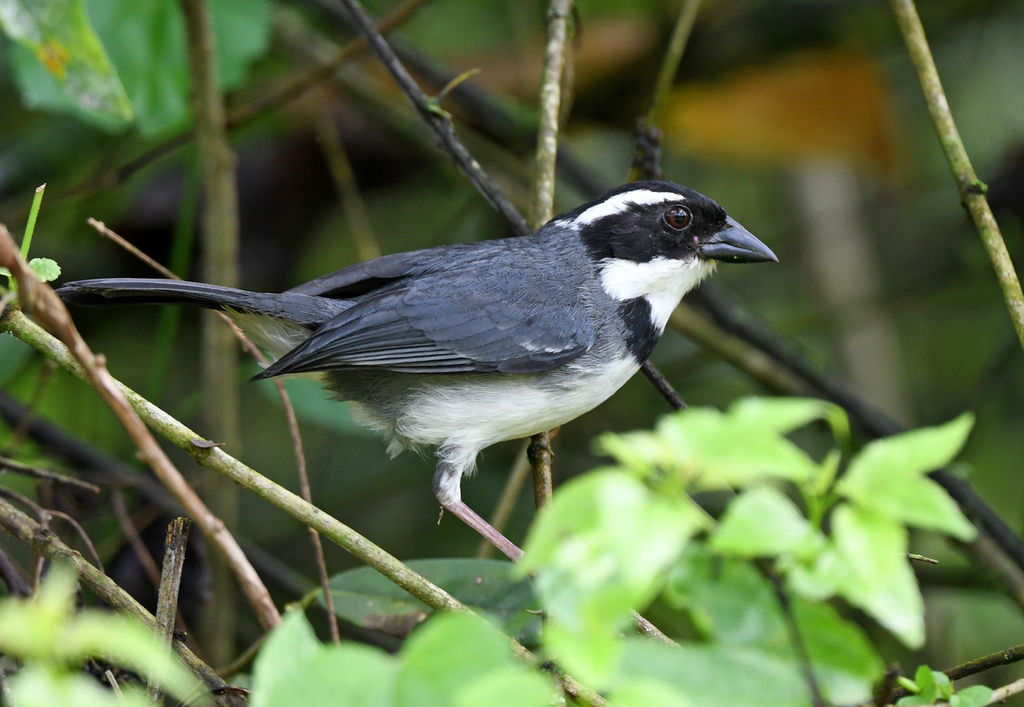
The black-capped sparrow is about 15 cm (5.9 in) long and weighs about 26 g (0.92 oz). The sexes have the same plumage. Adults have a mostly black head with a white throat and a wide white stripe from above the eye down the side of the nape. They often raise their crown feathers in a shaggy crest. Their upperparts and tail are blue-gray. Their wing coverts are blue-gray; some individuals have small pale tips on them that form two wing bars. Their flight feathers are dusky with blue-gray edges. Their throat is white with a black band below it across the upper breast. Their flanks are gray and the rest of their underparts white. They have a brown iris, a black bill, and black legs and feet.
Range & habitat
The black-capped sparrow is found along the Pacific coast from central Manabí Province in Ecuador south into Peru as far as northern Cajamarca Department. However, there is a gap in Ecuador's southern Guayas Province. It primarily inhabits somewhat dry tropical deciduous forest, gallery forest, and scrublands; locally it occurs in more humid evergreen forest especially in Ecuador. In Ecuador it ranges in elevation mostly from sea level to 800 m (2,600 ft) but locally reaches 1,600 m (5,200 ft). In Peru it reaches 1,800 m (5,900 ft).
Wikipedia: “Distribution and habitat”
What it does
The black-capped sparrow's diet has not been studied; it is assumed to include insects, seeds, and fruits. It usually is seen singly or in pairs. It forages on the ground or near it in low vegetation.
Wikipedia: “Feeding”
Listen
Looking for field recordings…
Where it lives
Recorded sightings
—
geo-referenced records in GBIF, from museums, herbaria and field observers.
Drag the globe to turn it. Dots are where records exist, not a range map; darker means more records.
In the stacks
Searching the stacks…
Every page naming Arremon abeillei in the Biodiversity Heritage Library →
This page is assembled live from iNaturalist, GBIF, Wikipedia, the Source Library and the Internet Archive. It is not yet part of the hand-edited codex. iNaturalist taxon 10067.