On eBird ↗
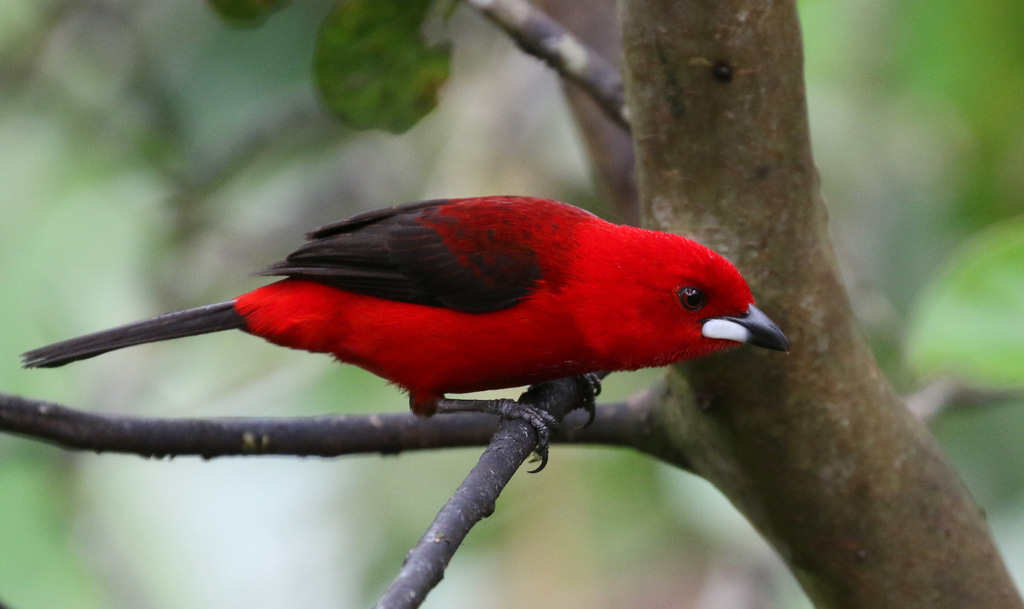
Brazilian Tanager
Live sightings near you, the range map, bar charts of when it is seen, and Macaulay Library photos and recordings.
Brazilian Tanager
Ramphocelus bresilius
The Brazilian tanager (Ramphocelus bresilius) is a species of bird in the family Thraupidae. It is endemic to eastern Brazil and far northeastern Argentina, occurring in the coastal region from Paraíba and southwards to Santa Catarina and Misiones.
From the article Brazilian tanager on Wikipedia (CC BY-SA), quoted section by section
Description
The Brazilian tanager is about 18 cm (7 in) long and weighs 27.9 to 35.5 g (0.98 to 1.3 oz). It has a heavy bill with a wide base to the mandible. The species is sexually dimorphic. Adult males of the nominate subspecies are mostly rich shiny red that is slightly darker on the back; the feathers of the central back have black bases that sometimes show. Their head, neck, and throat have a plush appearance. Their wings and tail are black, sometimes with inconspicuous red tips on the median upperwing coverts. Adult females have a grayish brown head, neck, throat, upperparts, wings, and tail, though sometimes the forecrown and rump have a reddish tinge. Their breast, belly, and undertail coverts are brownish red. Males of subspecies R. b. dorsalis have a darker red back than the nominate; females are like the nominate. Both sexes of both subspecies have a reddish brown iris and dull brown to slate-gray legs. Males have a blackish bill with a white basal half on the mandible. Females have a dusky brown bill.
Range & habitat
The nominate subspecies of the Brazilian tanager is the more northerly of the two. It is found from Paraiba in Brazil's far east south to Bahia. Subspecies R. b. dorsalis is found from Bahia, eastern Minas Gerais, and Espírito Santo south to northeastern Santa Catarina state. There are also scattered records from interior Brazil. Though some sources also include northwestern Argentina's Misiones Province in the species' range, the South American Classification Committee has only unconfirmed records there. The Brazilian tanager inhabits the edges and clearings of forest and more open non-forested landscapes such as parks, gardens, towns, and the edges of marshes. It often is found near water including the ocean. In elevation it ranges from sea level to 1,000 m (3,300 ft).
Wikipedia: “Distribution and habitat”
What it does
The Brazilian tanager feeds on arthropods and fruits. Pulpy fruits and those of figs (Ficus) have been noted, and in one study almost a third of its insect prey was beetles (Coleoptera). It typically forages in pairs and only seldom in larger groups, unlike several other Ramphocelus species.
Wikipedia: “Feeding”
Listen
Looking for field recordings…
Where it lives
Recorded sightings
—
geo-referenced records in GBIF, from museums, herbaria and field observers.
Drag the globe to turn it. Dots are where records exist, not a range map; darker means more records.
In the stacks
Searching the stacks…
Every page naming Ramphocelus bresilius in the Biodiversity Heritage Library →
This page is assembled live from iNaturalist, GBIF, Wikipedia, the Source Library and the Internet Archive. It is not yet part of the hand-edited codex. iNaturalist taxon 10055.