On eBird ↗
Plushcap
Live sightings near you, the range map, bar charts of when it is seen, and Macaulay Library photos and recordings.
Plushcap
Catamblyrhynchus diadema
The plushcap (Catamblyrhynchus diadema) is a species of bird in the tanager family Thraupidae and it is the only member of the genus Catamblyrhynchus.
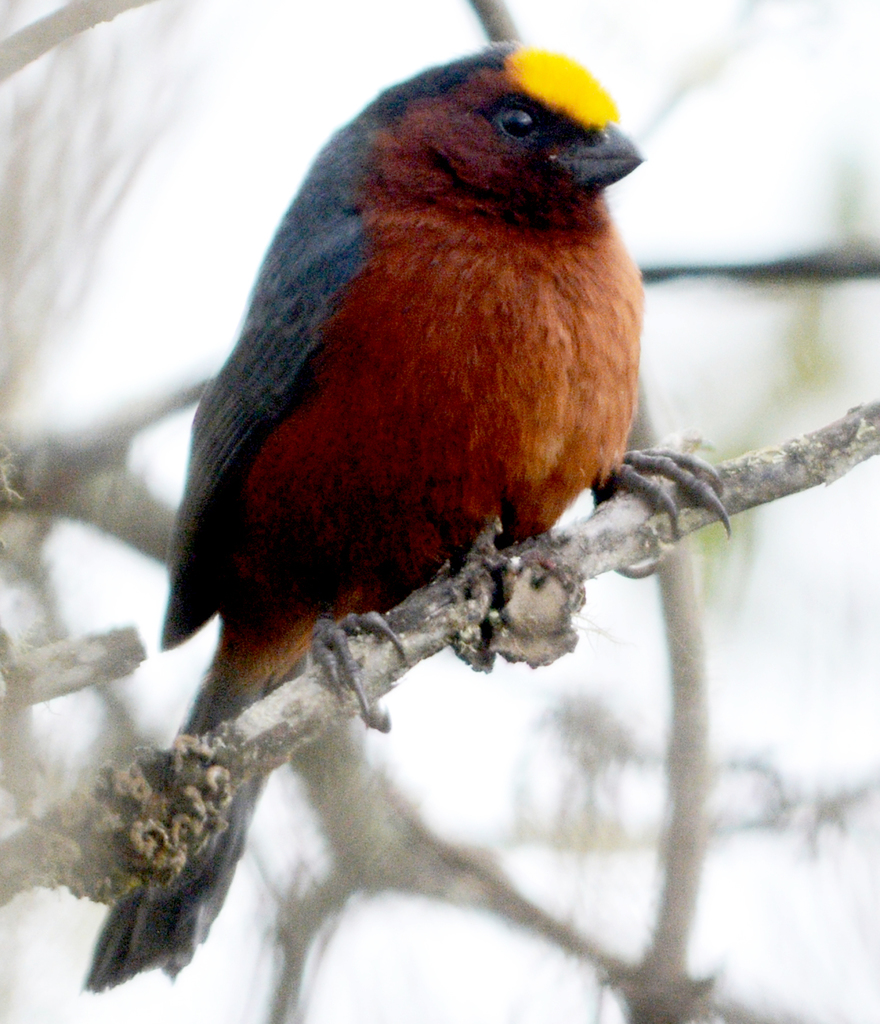
The plushcap is one of the most distinctive of all Neotropical passerines in both its appearance and behavior. The plushcap was in its own family until recently when it was grouped with the tanagers. The bill is broad and black. The body is a chestnut color with a bright golden-yellow forecrown. The forecrown is made up of stiff feathers. It has been speculated that these short, dense feathers are less susceptible to feather wear and more resistant to moisture than typical feathers. This may be an adaptation for its specialized feeding mode, in which it probes into dense whorls of bamboo for its prey items. They are found at high elevations from northern Venezuela south to Argentina, including the coastal mountains of Venezuela and the Andes of Colombia, Ecuador, Peru, Bolivia, and extreme northwestern Argentina. They live in montane forests and secondary forests near bamboo. They forage for insects inside the bamboo. They will eat small insects, berries, and small plant matter.
From the article Plushcap on Wikipedia (CC BY-SA), quoted section by section
Description
The plushcap is about 14 cm (5.5 in) long and males weigh on average 14.9 g (0.53 oz) and females 13.4 g (0.47 oz). It has a chestnut body and a golden-yellow forecrown (the plush part of the name). From its nape to its wings, it is black. The males and females look similar but the males are slightly larger than the females. Juveniles are just duller versions of their parents. The subspecies C. d. citrinifrons is found in Peru and has a paler cap while C. d. federalis is found in coastal Venezuela and is brighter than C. d. diadema.
Vocalizations. While the plushcap is usually quiet, when it does vocalize it has a long series of chirps and twitters.
Range & habitat
Plushcaps prefer to live in montane forest or secondary woodland by Chusquea bamboo which they use to find food. They stay at high elevation, between 2,300–3,500 m (7,500–11,500 ft).
Wikipedia: “Distribution and habitat”
What it does
The diet consists of small insects, berries, and plant material, and they typically forage in small groups within mixed species flocks of wide diversity. The plushcap looks for insects by probing and pushing its bill into the stems and leaf nodes of the bamboo and prying them open. They also forage by running their bill along the stems of bamboo with a series of tiny biting motions. Plushcaps will often hang upside down while searching for the insects.
Wikipedia: “Diet”
Listen
Looking for field recordings…
Where it lives
Recorded sightings
—
geo-referenced records in GBIF, from museums, herbaria and field observers.
Drag the globe to turn it. Dots are where records exist, not a range map; darker means more records.
In the stacks
Searching the stacks…
Every page naming Catamblyrhynchus diadema in the Biodiversity Heritage Library →
This page is assembled live from iNaturalist, GBIF, Wikipedia, the Source Library and the Internet Archive. It is not yet part of the hand-edited codex. iNaturalist taxon 10015.